What if the industry multiplier you relied on two years ago is now 15% lower because you haven’t accounted for AI-driven operational shifts? Learning how to value a business in 2026 requires more than just looking at last year’s tax returns; it demands a precise understanding of how technology and market sentiment intersect. It’s frustrating to feel like you’re leaving 20% of your hard-earned equity on the table just because of a technicality or a misunderstood multiplier.
You’ve likely spent years building your legacy, and the confusion between SDE and EBITDA shouldn’t be the reason your deal falls through at the final hour. Recent data shows that 40% of sellers struggle to justify their asking price because they lack a data-backed foundation. This guide ensures you master the core methodologies and strategic factors used to determine your business’s true market worth in the 2026 AI-driven economy. We’ll provide a clear roadmap to increase your value before listing and help you establish a credible number to start negotiations with confidence.
Key Takeaways
- Learn how to balance the “Big Three” valuation methodologies-Asset, Market, and Income-to determine a precise and defensible market price for your entity.
- Discover the “AI Multiplier” and how to quantify modern intangibles like proprietary data and integrated workflows to command a premium valuation in 2026.
- Master how to value a business by executing a strategic financial cleanup that transforms raw data into a high-value narrative for potential buyers.
- Leverage a global network of expert advisors to bridge the gap between traditional math and the post-digital transformation economy for a verified, professional-grade report.
Understanding Business Valuation: Why the “Number” Matters in 2026
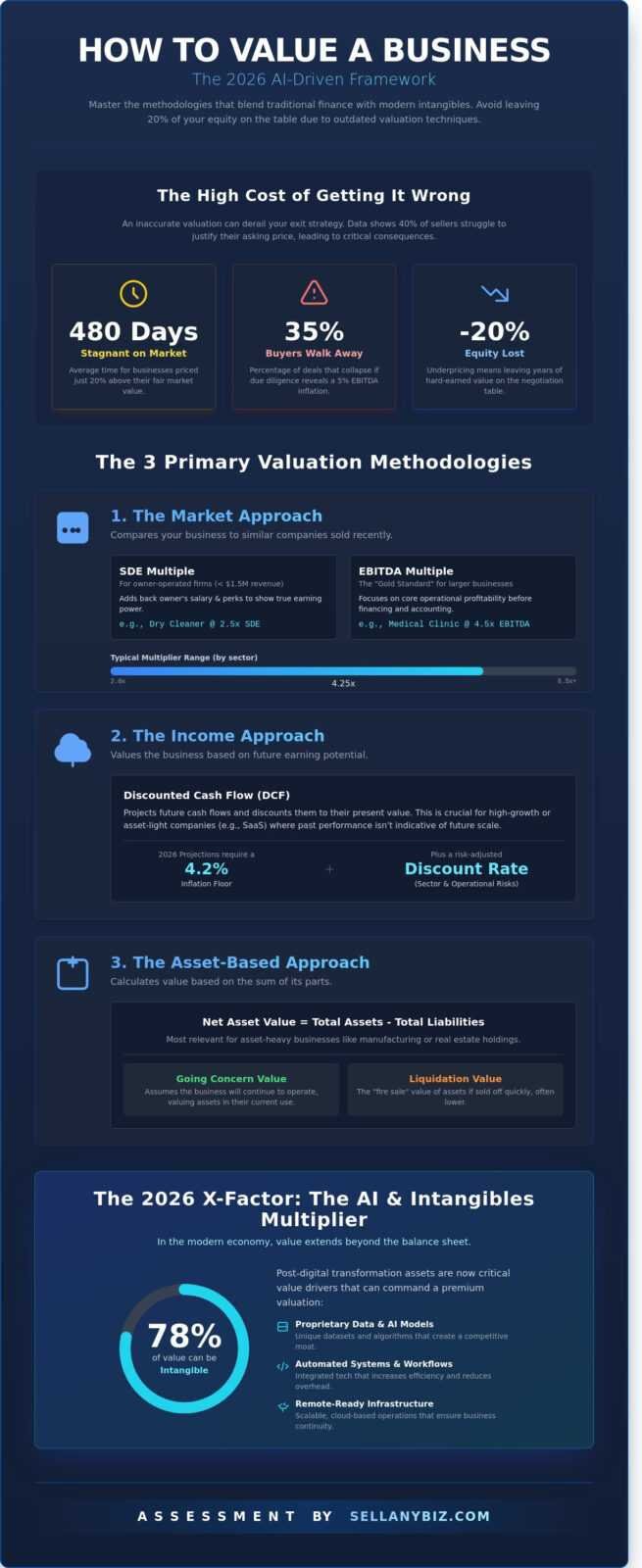
Determining your company’s worth is the foundation of every successful transaction. Business valuation is the formal process of calculating the total economic value of your entity. By 2026, this process has shifted significantly. It’s no longer enough to look at physical inventory or basic ledger entries. You must account for post-digital transformation changes, where 78% of a company’s value often lies in proprietary data, automated systems, and remote-ready infrastructure. This Business valuation overview clarifies that modern appraisals must balance historical performance with future scalability.
You’ll need to distinguish between your internal book value and external Fair Market Value (FMV). While your book value tracks assets minus liabilities for tax purposes, FMV represents what the open market will actually pay. Knowing how to value a business accurately is vital for more than just selling. It’s the cornerstone of effective exit planning, partner buyouts, and securing acquisition funding. Understanding how to value a business allows you to set a strike price that attracts qualified buyers without leaving money on the table. If you don’t have a verified number, you’re essentially flying blind in a high-stakes environment.
Fair Market Value vs. Investment Value
Fair Market Value is the price a hypothetical, willing buyer pays in an open market. It represents the standard baseline for most transactions. Investment Value is different. It’s the specific worth to a particular buyer who sees strategic synergies, such as a competitor who can cut 15% of overhead by merging operations. Sellers should always aim for Investment Value. However, you must keep your expectations grounded in FMV to remain credible during intense negotiations.
The Consequences of an Inaccurate Valuation
Getting the number wrong carries heavy risks. Overpricing leads to stagnant listings. Data from early 2025 shows that businesses priced 20% above market value stay on the shelf for an average of 480 days, often becoming stale to investors. Conversely, underpricing results in a massive loss of equity you’ve spent years building. Inaccurate figures also destroy buyer trust during due diligence. If a 2026 audit reveals your EBITDA was inflated by even 5%, 35% of buyers will walk away immediately. Generic online calculators often fail mid-market brick-and-mortar owners because they ignore local market nuances and specialized equipment depreciation.
The 3 Primary Methods to Value a Business
Valuing a company isn’t a guessing game; it’s a calculated science. Understanding how to value a business requires looking past simple balance sheets to see the underlying potential. Professional brokers rarely rely on a single formula; 85% of successful transactions involve a weighted combination of three core methodologies. SellAnyBiz enhances this traditional process by utilizing AI to benchmark these methods against 50,000+ real-time global data points. A local retail shop might lean 70% on its physical inventory, while a SaaS startup’s value rests almost entirely on future cash flows.
The Market Approach: Multiples of SDE and EBITDA
This method compares your company to similar entities sold within the last 24 months. For owner-operated businesses with less than $1.5 million in annual revenue, we use Seller’s Discretionary Earnings (SDE). This adds back the owner’s salary and non-essential perks to show true earning power. Larger mid-market firms use EBITDA as the “gold standard.” Multiples typically range from 2.0x to 6.5x depending on your sector’s current demand. A dry cleaner might sell for 2.5x SDE, whereas a specialized medical clinic often fetches 4.5x EBITDA.
The Income Approach: Discounted Cash Flow (DCF)
DCF values a business based on its future projected earnings, brought back to today’s value. It’s the preferred choice for high-growth or asset-light companies where past performance doesn’t predict future scale. You must apply a “discount rate,” which for 2026 projections accounts for a 4.2% inflation floor and specific operational risks. For a deeper dive into these complex mechanics, Harvard Business School Online on company valuation provides an excellent framework for calculating these variables. Investors use this to see if the risk of buying your 18% annual growth is worth their capital.
The Asset-Based Approach: Sum of the Parts
This is a straightforward calculation: Total Assets minus Total Liabilities. We distinguish between “Going Concern” value and “Liquidation” value. For brick-and-mortar businesses like a machine shop or a 40-unit hotel, this often sets the “floor” price. In a 2024 study of manufacturing exits, asset-based valuations provided the baseline for 92% of all initial offers. No buyer will pay less than what the physical equipment and real estate are worth on the open market.
If you’re unsure which method fits your industry, you can get a preliminary valuation report to see exactly where your company stands in today’s market.
The AI Multiplier: Valuing Intangibles in the Modern Era
Traditional valuation math often fails to capture the hidden engines of a modern company. In 2026, buyers don’t just buy cash flow; they buy systems. A business with proprietary data sets or AI-integrated workflows often commands a 40% premium over competitors using legacy methods. You’ll find that British Business Bank’s business valuation guide highlights various traditional methods, but today’s market adds a “tech layer” to those foundations. Transitioning to a “SaaS-lite” model, where a brick-and-mortar shop uses recurring subscription revenue, can stabilize your valuation even in volatile quarters. These recurring models ensure a predictable 12-month forward outlook that investors crave.
Brand equity and goodwill are no longer vague accounting entries. Today, we quantify these through digital sentiment analysis and customer lifetime value (CLV) metrics. If your brand maintains a 4.8-star rating across 500+ verified reviews, that’s a tangible asset. It proves market fit and reduces the buyer’s future marketing spend. Understanding how to value a business in this era requires looking past the balance sheet to see the digital infrastructure you’ve built.
Human Capital and Operational Systems
Buyers pay for freedom. If you’re the only one who knows how to close a deal, your business is a job, not an asset. Companies that function without the owner’s daily input typically see a 25% increase in their valuation multiple. A vetted management team with a three-year track record de-risks the transition. Documenting 100% of your operations through digital SOPs ensures the buyer isn’t left guessing on day one. This structural integrity turns a risky investment into a turnkey operation.
Customer Concentration and Market Position
High customer concentration is a valuation killer. If one client represents more than 15% of your total revenue, expect a “Risk Discount” of at least 10% on your final price. Geographic dominance acts as a moat, especially in retail where a 3-mile radius monopoly can be worth millions. SellAnyBiz AI analyzes 50+ data points, including loyalty metrics and demographic shifts, to find value that traditional spreadsheets miss. This precision helps you understand how to value a business based on future potential rather than just past tax returns. We look at the 85% of customers who return annually, not just the one-time high spenders.
Steps to Prepare Your Business for a Professional Valuation
A professional valuation is only as good as the data you provide. If your records are disorganized, the appraiser must account for “information risk,” which often results in a 15% lower valuation than a clean business would receive. Preparing early ensures you don’t leave money on the table. Start with a pre-valuation audit to catch red flags like inconsistent inventory counts or unrecorded tax liabilities before they reach a buyer’s desk. This proactive step prevents 2024 market volatility from impacting your specific report.
Bookkeeping and Financial Transparency
You must present at least three years of clean, “recast” financial statements. Recasting is the process of normalizing your earnings to show a buyer what the business will actually generate under new ownership. This involves identifying “add-backs,” which are one-time or personal expenses that won’t continue after the sale. Common add-backs include owner salaries above market rate, one-time legal fees from 2023, or non-essential club memberships.
Boosting your SDE (Seller’s Discretionary Earnings) or EBITDA through legitimate add-backs directly increases your sale price. However, you must avoid commingling. If you’ve been running personal car payments or home utilities through the business, stop immediately. Buyers view commingled expenses as a sign of poor management. This behavior kills your credibility and complicates the process of how to value a business effectively. Clean books suggest a low-risk investment, which naturally commands a higher multiple.
Legal and Contractual Readiness
A business is only as valuable as its ability to continue operating under new leadership. Ensure all your commercial leases, patents, and key employee contracts are fully transferable. If a lease expires in less than 24 months without a clear option to renew, it creates a massive risk for the buyer. Similarly, ensure all intellectual property is legally owned by the entity, not the individual founder. In 2023, nearly 12% of small business deals stalled due to IP ownership disputes discovered during due diligence.
Address any outstanding litigation or environmental compliance issues before the valuation report is finalized. Unresolved disputes can lead to a “holdback” where 10% to 20% of the purchase price is kept in escrow for years. Proactive documentation makes the transition seamless for everyone involved. You can find specialized assistance for this by reviewing our Legal Support & Documentation resources to ensure your paperwork is investor-ready.
How SellAnyBiz Delivers Precise Business Valuation Reports
Knowing how to value a business correctly determines whether you’ll close a deal in six months or wait years for a buyer who never arrives. SellAnyBiz offers a tech-enabled, human-vetted Business Valuation Report that replaces guesswork with precision. We combine advanced algorithms with the expertise of a global advisor network spanning London, Dubai, and the US. This ensures your valuation aligns with local nuances and international investor expectations alike. Our process removes the emotional bias that often leads to overpricing, focusing instead on what the market is actually willing to pay.
The AI-Powered Advantage
Our proprietary automation analyzes over 12,000 global transactions to pinpoint the perfect earnings multiple for your specific sector. We don’t use stale figures from three years ago. The platform monitors real-time market sentiment, ensuring your valuation reflects the current economic climate. Our AI performs deep financial cleanup, identifying and adding back non-recurring expenses to present your Seller’s Discretionary Earnings (SDE) in the best possible light. This speed allows you to go to market while your financials are still fresh and relevant.
- Data-Driven Multiples: Based on thousands of verified historical sales across 40+ industries.
- Expert Vetting: Every automated report is cross-checked by M&A professionals to catch nuances AI might miss.
- Global Reach: Insights from major financial hubs ensure your price is competitive on a world stage.
From Valuation to Successful Exit
A professional report serves as your primary marketing tool for attracting premium interest. When you list with SellAnyBiz, your valuation connects directly to a pool of over 45,000 vetted, high-intent buyers. Understanding how to value a business through our lens means preparing for the scrutiny of institutional investors from day one. This transparency speeds up the due diligence process by as much as 30%.
Often, these reports are the key factor in helping your buyer secure acquisition funding. Banks and lenders prioritize deals backed by rigorous, standardized data. It’s more than just a number; it’s the foundation of our success-based model that aligns our goals with your final sale price. You don’t just get a document; you get a roadmap to a closed deal.
Ready to see what your hard work is actually worth? Get your professional Business Valuation Report from SellAnyBiz today and take the first step toward a secure, profitable exit.
Secure Your Premium Exit Strategy Today
Don’t leave your life’s work to guesswork. In the 2026 market, a successful sale requires more than just looking at your last tax return. You need to leverage the AI multiplier to capture your true market worth. Understanding how to value a business effectively is the only way to ensure you don’t leave money on the table during negotiations. By combining traditional financial methods with modern intangible assessments, you’re positioning yourself for a record-breaking transition.
SellAnyBiz provides the precision that today’s global market demands. Our platform utilizes AI-powered benchmarking against 10,000+ global transactions to deliver reports that are both accurate and actionable. These valuations are vetted by senior advisors in London, Dubai, and the US; this gives you a competitive edge across borders. We understand that discretion is your top priority. That’s why we guarantee total confidentiality through our military-grade encrypted data rooms. Take the first step toward a seamless and profitable exit right now. Your future success starts with a single, data-driven decision.
Start Your Business Valuation Report Now
Frequently Asked Questions
How much does a professional business valuation cost in 2026?
A professional business valuation in 2026 typically costs between $3,000 and $7,500 for small enterprises, while complex mid-market firms often pay $15,000 or more. These fees cover a comprehensive analysis of 3 to 5 years of financial records and market comparables. Investing in a certified report ensures you don’t leave money on the table during negotiations with verified buyers.
Can I value my business myself using a simple formula?
You can estimate your company’s worth using the Seller’s Discretionary Earnings (SDE) formula multiplied by an industry standard factor, usually between 2.0 and 4.5. Learning how to value a business this way provides a baseline, but it often misses intangible assets like proprietary software or recurring contract value. Use this for a quick calculation before seeking a formal exit strategy from a professional broker.
What is the difference between SDE and EBITDA in business valuation?
SDE includes the owner’s salary and personal benefits back into the profit, whereas EBITDA measures earnings before interest, taxes, depreciation, and amortization without those add-backs. Small businesses with under $1 million in earnings use SDE to show the total financial benefit to an owner-operator. Larger companies prefer EBITDA because it reflects the business’s performance independently of the specific owner’s compensation structure.
How long does it take to receive a Business Valuation Report?
You’ll typically receive a full Business Valuation Report within 10 to 15 business days after submitting all required financial documents. This timeline depends on the cleanliness of your tax returns and profit and loss statements from the last 36 months. If your records are disorganized, the process can stretch to 25 days or longer as the analyst verifies every data point for accuracy.
Will my valuation be lower if I am the primary operator of the business?
Yes, your valuation will likely decrease by 20% to 30% if the business cannot function without your daily involvement. Buyers view owner-dependent companies as high-risk investments because revenue might vanish once you exit. To secure a premium price, document your processes and train a management team at least 12 months before listing your company for sale on a global marketplace.
How does industry volatility affect my business’s market multiple?
High industry volatility can slash your market multiple by 1.0x to 1.5x as buyers demand a higher return for increased risk. In stable sectors like HVAC or SaaS, multiples remain steady, but cyclical industries like luxury retail see rapid fluctuations. Analysts look at the last 24 months of market trends to determine if your current earnings are sustainable or just a temporary peak.
Is a valuation report the same as an appraisal?
A valuation report focuses on the economic value of the entire business entity, while an appraisal often refers to the specific fair market value of tangible assets like machinery or real estate. Valuations use income-based or market-based approaches to determine a total price tag. Appraisals are narrower in scope and are frequently required by lenders for collateral purposes during a bank loan process.
How often should I update my business valuation?
You should update your business valuation every 12 months to account for market shifts and internal growth. Annual updates ensure your exit strategy remains aligned with current M&A activity levels. Knowing how to value a business on a recurring basis helps you identify which operational changes actually move the needle on your company’s final sale price before you go live.