
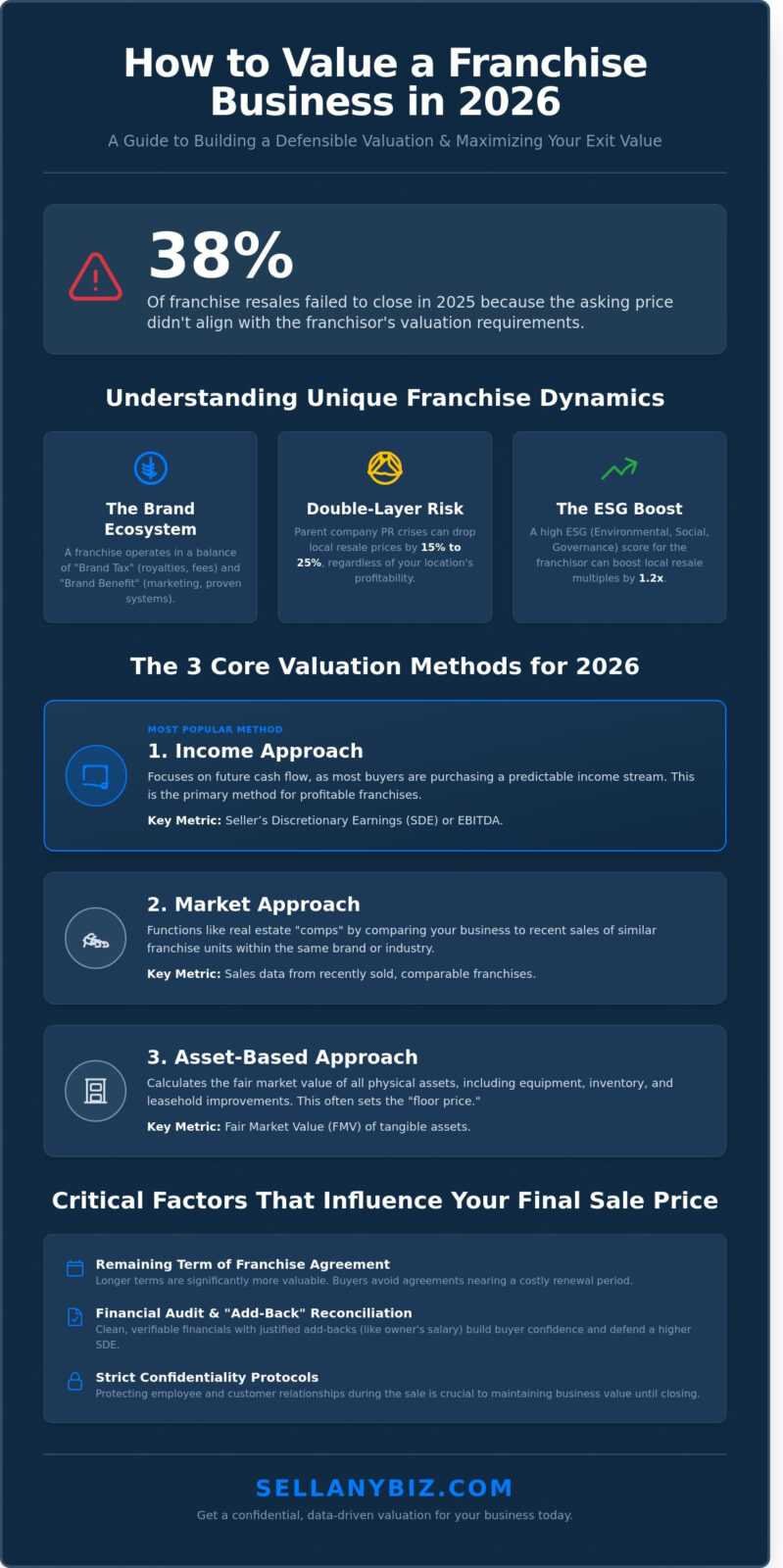
Did you know that 38% of franchise resales in 2025 failed to close because the initial asking price didn’t align with the franchisor’s internal audit requirements? It’s frustrating when you’ve built a profitable location only to realize that standard accounting doesn’t always translate to a franchise environment. You’re likely feeling the pressure of managing strict transfer rules while trying to prove your Seller’s Discretionary Earnings are accurate. Many owners struggle to accurately value a franchise business because they overlook the specific brand tax that savvy buyers use to negotiate prices down.
You don’t have to guess your company’s worth or settle for a lowball offer. This guide provides the exact formulas and 2026 market multiples you need to build a defensible valuation report that stands up to scrutiny from global investors. We’ll walk through the process of normalizing your financial statements and adjusting for mandatory marketing fees. By the end of this article, you’ll have a clear, step-by-step path to a confidential sale that maximizes your exit value while keeping your daily operations secure.
Key Takeaways
- Distinguish between independent business value and the unique “brand-benefit” of franchises to understand exactly what premium buyers are paying for.
- Master the specific market multiples and financial formulas required to accurately value a franchise business in today’s competitive market.
- Identify critical “time-bomb” factors, such as the remaining term of your franchise agreement, that can significantly impact your final sale price.
- Step through the essential financial audit and “add-back” reconciliation process to ensure your business is ready for a high-value appraisal.
- Learn how to protect your employee and customer relationships through strict confidentiality protocols during the transition from valuation to closing.
Understanding the Unique Dynamics of Franchise Business Valuation
To value a franchise business effectively, you must look beyond the physical assets. This process involves appraising the specific rights to a territory and the predictable cash flow those rights generate. Unlike an independent business, a franchise operates within a “brand-tax” and “brand-benefit” ecosystem. You pay ongoing royalties, which is the tax, but you gain national marketing and proven systems, which is the benefit. By 2026, market data from global brokerage platforms suggests that 68% of mid-market investors prefer vetted franchise resales over “greenfield” startups. These buyers want immediate cash flow and a tested local track record rather than the uncertainty of a new build.
Every franchise owner faces a “Double-Layer Risk” that complicates the appraisal. Your business value depends on your local management skills; however, it’s also tied to corporate stability. If the parent company suffers a legal setback or a PR crisis in 2026, your local resale price could drop by 15% to 25% regardless of your personal profitability. You aren’t just selling a shop; you’re selling a slice of a larger corporate reputation.
The Difference Between Franchisor and Franchisee Value
This guide focuses strictly on the “Franchisee” or the local owner’s interest. Your local value is tethered to the franchisor’s financial health and their 2026 ESG (Environmental, Social, and Governance) scores. Investors now use these scores to determine long-term viability. A franchisor with a high ESG rating often boosts local resale multiples by 1.2x because it signals lower regulatory risk. If the brand reputation shifts negatively at the corporate level, it directly erodes your equity.
Why “Market Value” Matters More Than “Book Value”
Book value focuses on what your equipment and fit-out are worth after depreciation. In a resale context, these assets are secondary. Most business valuation methods for franchises prioritize Seller’s Discretionary Earnings (SDE) or EBITDA. The “willing buyer, willing seller” principle dictates the price in a brokerage environment. If a buyer can’t see a clear path to ROI within 3 to 5 years, the physical inventory won’t save the deal. SellAnyBiz identifies these global market trends daily, helping owners move away from stagnant book values toward dynamic, cash-flow-based pricing that attracts qualified investors. We ensure your value a franchise business calculation reflects what the 2026 market is actually prepared to pay.
The 3 Core Methods to Value a Franchise Business in 2026
Determining the right price for an established franchise requires more than a glance at last year’s tax returns. Professional buyers look for consistency, scalability, and risk mitigation. To accurately value a franchise business, experts rely on three primary pillars: the income approach, the market approach, and the asset-based approach. These Core Methods of Franchise Appraisal provide a 360-degree view of what the market is actually willing to pay.
The Income Approach remains the most popular strategy because it focuses on future cash flow. Most buyers are purchasing a paycheck, so they prioritize Seller’s Discretionary Earnings (SDE) or EBITDA. The Market Approach functions like real estate “comps.” It involves looking at what similar units within your specific franchise brand sold for in the last 12 months. Finally, the Asset-Based Approach calculates the fair market value of all physical equipment, inventory, and leasehold improvements. This method usually sets the “floor” price. You won’t sell for less than the value of your physical goods unless the business is distressed.
Modern sellers don’t have to crunch these numbers manually. AI-powered platforms like SellAnyBiz now aggregate these three methods instantly. By analyzing thousands of global data points, these tools provide a valuation that reflects real-time market sentiment and specific brand demand. If you want to see where your unit stands, you can check your business value using our proprietary valuation engine.
SDE vs. EBITDA: Which One Should You Use?
Small, owner-operated franchises typically use Seller’s Discretionary Earnings. This includes net profit plus the owner’s salary, benefits, and one-time expenses. Seller’s Discretionary Earnings (SDE) represents the total financial benefit available to a single owner-operator. Larger portfolios or multi-unit operations use EBITDA (Earnings Before Interest, Taxes, Depreciation, and Amortization). EBITDA is the standard for 85% of institutional investors because it shows the business’s raw earning power without the owner’s personal involvement.
Applying the Multiplier to Your Earnings
A multiple is the factor applied to your earnings to reach a final price. If your SDE is $200,000 and the multiple is 3x, your valuation is $600,000. In 2026, industry-standard multiples have shifted due to higher interest rates and tech integration. Retail franchises currently see multiples between 2.2x and 2.8x. Food and Beverage (F&B) units command 2.8x to 4.2x, while Healthcare franchises often reach 4.5x or higher due to recession-proof demand.
Geography also dictates the final number. A franchise in Dubai might see a 12% higher multiple than one in London due to tax-free incentives and rapid population growth. Similarly, Florida-based franchises often trade at a 0.5x premium compared to the Midwest because of the high volume of “lifestyle buyers” moving to the region. To value a franchise business correctly, you must adjust for these local market conditions.
Critical Franchise-Specific Factors That Influence Your Multiple
You aren’t just selling a cash-flowing asset; you’re selling a license to operate. To value a franchise business accurately, you must audit the underlying agreement before setting a price. High royalty fees, which typically range from 4% to 9% of gross sales, directly suppress the EBITDA multiple compared to independent businesses. If a buyer sees an additional 2.5% national marketing levy, they’ll demand a lower purchase price to offset the margin squeeze. You need to present a clear picture of how these fixed costs impact the bottom line.
Transfer fees represent another immediate impact on your net proceeds. Most franchisors charge between $10,000 and $45,000 to process the ownership change. It’s vital to decide during negotiations who covers this cost. If the seller pays, it’s a direct deduction from your final check. Beyond the money, franchisor approval rights act as the ultimate gatekeeper. They can reject any buyer who fails to meet their liquid capital requirements, often set at a minimum of $150,000. This hurdle can extend your closing timeline by 60 to 90 days.
The Impact of the Franchise Agreement
A 10-year remaining term provides a stable runway for a buyer’s return on investment. A 2-year term is a “time-bomb” that reduces your valuation multiple. Buyers know that a short term leads to a mandatory “Product Improvement Plan” (PIP). These refreshes often require $60,000 or more in equipment upgrades and signage. Always review the “First Right of Refusal” clause. This allows the franchisor to match any offer and buy the unit themselves, which can spook private investors who don’t want to waste time on due diligence only to lose the deal.
Brand Strength and Territory Protection
Exclusive territories are premium assets in a 2026 market where market saturation is a constant threat. A protected 3-mile radius or a zip-code-specific exclusivity clause can add 0.25x to 0.5x to your valuation multiple. Buyers also scrutinize the franchisor’s supply chain stability. If the brand’s mandatory vendors charge 15% above market rates for inventory, your business’s resale value drops. Quantify your local goodwill by showing a 35% or higher repeat customer rate in your POS data to prove the brand’s local strength.
How to Prepare Your Franchise for a High-Value Appraisal
Preparation is the single most important factor in securing a premium price. You can’t effectively value a franchise business if your records are cluttered with personal expenses or outdated operational data. Buyers in 2025 and 2026 are looking for “turnkey” stability, meaning they’ll pay more for a business that functions perfectly without the current owner’s constant intervention.
Start by conducting a rigorous three-year financial audit. This timeline provides a clear trajectory of growth and stability. You must reconcile every “add-back” to ensure your Seller’s Discretionary Earnings (SDE) are defensible. Beyond the numbers, perform a franchisor compliance check. If the franchisor mandates a 2025 facility refresh or software upgrade, completing these tasks before the appraisal prevents buyers from negotiating price drops based on future liabilities.
- Document Staff KPIs: Provide 24 months of performance data for key employees to prove the team’s independent value.
- Clean the Balance Sheet: Remove non-operating assets, such as personal vehicles or unrelated real estate, to present a lean, professional entity.
- Secure a Preliminary Report: Obtain a professional “Business Valuation Report” to establish a realistic baseline before hitting the market.
The Power of “Add-Backs” in Franchise Sales
Add-backs are expenses that won’t carry over to the new owner, effectively increasing the bottom line. Common legitimate add-backs include the owner’s salary, one-time equipment repairs, and personal travel coded to the business. Expert SellAnyBiz bookkeeping services can help you uncover hidden value that standard accounting might overlook. Don’t get too aggressive, though. If a buyer’s due diligence team flags 15% or more of your add-backs as “questionable,” it erodes trust and can kill the deal entirely.
Operational Readiness and Documentation
Modern buyers prioritize efficiency. While your franchisor provides a generic manual, you need a site-specific “Operations Manual” that details local vendor relationships and daily troubleshooting. By 2026, savvy investors will specifically look for businesses with AI-integrated workflows, such as automated inventory tracking or AI-driven customer service bots. Ensure your Franchise Disclosure Document (FDD) is current and ready for immediate review to maintain momentum during the “value a franchise business” phase of the sale.
Ready to see what your hard work is actually worth in today’s global market? Request a professional valuation and list your franchise on our secure platform today.
Navigating the Sale: From Valuation Report to Closing
Once you understand how to value a franchise business, the transition from calculation to cash-in-hand requires a tactical approach. Choosing a general business broker might seem convenient, but it often leads to complications. Franchise sales involve a unique tripartite dynamic between you, the buyer, and the franchisor. A specialist understands the specific requirements of the Franchise Disclosure Document (FDD) and ensures the buyer meets the franchisor’s net worth requirements before the first meeting occurs.
Confidentiality serves as your most vital asset during this period. Data shows that 72% of staff turnover during a business sale happens because employees feel uncertain about new ownership. We use “Confidential Business Listings” to shield your identity, protecting your customer relationships and staff morale until the deal reaches the final stages. This discretion prevents competitors from poaching your clients while you’re focused on the exit.
Leveraging AI and Global Reach
SellAnyBiz accelerates the sales cycle by replacing passive listing methods with proactive technology. Our proprietary AI matches your franchise type with a database of over 50,000 vetted investors. Because we maintain a physical presence in London, Dubai, and the US, your listing gains exposure to international capital. This global reach often triggers competitive bidding, which can drive the final sale price 12% to 18% higher than local-only listings. You aren’t just selling to the person down the street; you’re accessing a global market of qualified entrepreneurs.
Finalising the Transaction
The closing phase begins with due diligence, where the buyer verifies every financial claim made when you worked to value a franchise business. Expect a 30 to 45-day window where the buyer reviews tax returns, lease assignments, and equipment audits. A critical hurdle is the franchisor interview. The franchisor must approve the new buyer’s operational capability and financial standing. Our team provides the legal support necessary to navigate these approvals and the final transfer of the franchise agreement. We ensure every document is signed and every fee is accounted for so the handover is seamless.
Don’t leave your hard-earned equity to chance. Success starts with an accurate, professional assessment of your company’s worth in the current market.
Ready to see what your business is worth? Get your Business Valuation Report today
Secure Your 2026 Exit Strategy Today
Maximizing your franchise value requires more than just looking at last year’s balance sheet. You’ve learned how the 3 core valuation methods and franchise-specific multiples dictate your final asking price in the 2026 market. Preparing your documentation early ensures you’re ready when it’s time to value a franchise business with total confidence. Don’t leave your hard-earned equity to chance or outdated spreadsheets that ignore current market volatility. SellAnyBiz provides AI-powered accuracy specifically designed for mid-market businesses, ensuring your appraisal reflects real-time global demand rather than historical guesses. You’ll gain immediate access to a network of 15,000 vetted global buyers while benefiting from a success-based commission structure that keeps our interests aligned with yours. This approach eliminates the uncertainty of the appraisal process and puts you in control of the negotiation table. Get a Professional Business Valuation Report from SellAnyBiz and turn your years of hard work into a life-changing liquidity event. Your path to a successful closing starts with one accurate number.
Frequently Asked Questions
How long does it take to value a franchise business?
A professional valuation typically takes between 7 and 14 business days once you provide all financial records. This timeline allows for a detailed analysis of your last 3 years of profit and loss statements and local market comparisons. You’ll receive a comprehensive report that outlines the fair market value based on current industry standards. It’s a structured process that ensures you don’t list your unit for a price that scares away verified buyers.
Does the franchisor have a say in the valuation or sale price?
Franchisors don’t set your asking price, but they influence the final sale through the “Right of First Refusal” found in 95% of franchise agreements. This clause allows them to purchase the unit themselves at your agreed-upon price. Additionally, franchisors must approve the new buyer before the transfer is finalized. If you want to value a franchise business accurately, you must ensure the price aligns with the brand’s internal transfer requirements to avoid a blocked sale.
What is a typical multiple for a fast-food franchise in 2026?
In 2026, fast-food franchises generally trade at multiples between 3.5x and 5.0x of their Seller’s Discretionary Earnings (SDE). Top-tier brands with drive-thru capabilities often reach the 5.2x mark, while smaller, walk-in units might sit closer to 2.8x. These figures reflect 2025 market data where operational automation and digital sales accounted for 40% of the total valuation weight. Higher multiples are reserved for units with consistent 10% year-over-year growth.
Can I value my franchise based on future projected earnings?
Most buyers and lenders only consider the last 36 months of documented performance. You can’t base a valuation on future projections because investors won’t pay for the work they have yet to do. If you project a 20% growth for next year, use it as a selling point to justify a higher multiple rather than a baseline price. Stick to your actual EBITDA to ensure your exit strategy remains grounded in financial reality.
How do I handle the transfer fee in my valuation?
Transfer fees usually range from $5,000 to $15,000 and should be treated as a closing cost rather than part of the business value. In 60% of successful transactions, the seller pays this fee to keep the deal moving forward. You shouldn’t add this cost to your asking price, as it can make the business look overpriced compared to market comps. Clear communication about who covers this cost prevents friction during the final stages of the transaction.
Is a franchise worth more than an independent business?
Franchises often command a 15% to 25% premium over independent businesses because they offer proven systems and brand recognition. Lenders are 30% more likely to approve financing for an established franchise than a standalone startup. This lower risk profile makes it easier to value a franchise business at a higher multiple. Buyers pay for the “turnkey” nature of the operation and the ongoing support provided by the franchisor.
What documents do I need to start a franchise valuation?
You need 3 years of profit and loss statements, 3 years of federal tax returns, and your current Franchise Disclosure Document (FDD). You should also include your lease agreement and a detailed equipment list with current market values. Gathering these 5 key document types upfront speeds up the valuation process by 50%. Having a clean paper trail builds immediate trust with premium investors looking for a secure and transparent investment.
How does SellAnyBiz ensure my franchise sale remains confidential?
We use a multi-layered approach that starts with 100% blinded listings where your brand name and exact location stay hidden. Every potential buyer must sign a legally binding Non-Disclosure Agreement (NDA) before viewing your sensitive financial data. Our platform filters for verified buyers, ensuring that only serious, qualified individuals see your information. This method protects your staff and customer relationships until the deal is 90% complete.