Axial vs Boutique Business Brokers: Which Route Fits Your 2026 Exit?
Also available in:Italiano

Wider buyer reach will not close a transaction if no one manages the execution. When weighing axial vs boutique business brokers for a 2026 exit, founders often treat deal networks and traditional intermediaries as interchangeable tools. They aren't. One aggregates institutional buyer interest; the other coordinates your transaction from valuation to closing.
You want maximum valuation and genuine competitive tension. At the same time, you cannot afford confidentiality leaks, nor do you want to pay heavy upfront advisory retainers to an intermediary with limited regional reach. It's a demanding trade-off between broad market discovery and hands-on deal management.
This guide compares both models across deal discovery, fee mechanics, and execution depth so you can determine which structure fits your EBITDA, transaction complexity, and personal time commitment. We'll examine how buyer vetting operates in practice, where the transaction workload truly falls, and how to protect your enterprise value through final closing.
Key Takeaways
- Evaluating axial vs boutique business brokers reveals a fundamental distinction: online deal networks expand market reach, while boutique intermediaries deliver hands-on execution and advisory support.
- Learn how buyer-paid platform success fees contrast with traditional broker retainers and sell-side commission structures.
- Assess your EBITDA, transaction complexity, and executive bandwidth to select an exit path that protects confidentiality while sustaining deal momentum.
- Discover how unified transaction platforms bridge the gap by combining institutional deal discovery with structured document preparation and secure data rooms.
Table of Contents
Understanding the Core Differences Between Axial and Boutique Business Brokers
Choosing between an online deal network and an advisory firm changes how your exit unfolds. When comparing axial vs boutique business brokers, the distinction rests on infrastructure versus execution. One provides programmatic reach across institutional investors. The other provides dedicated human management to shepherd a deal across the finish line.
How Axial Operates as a Digital Deal Sourcing Network
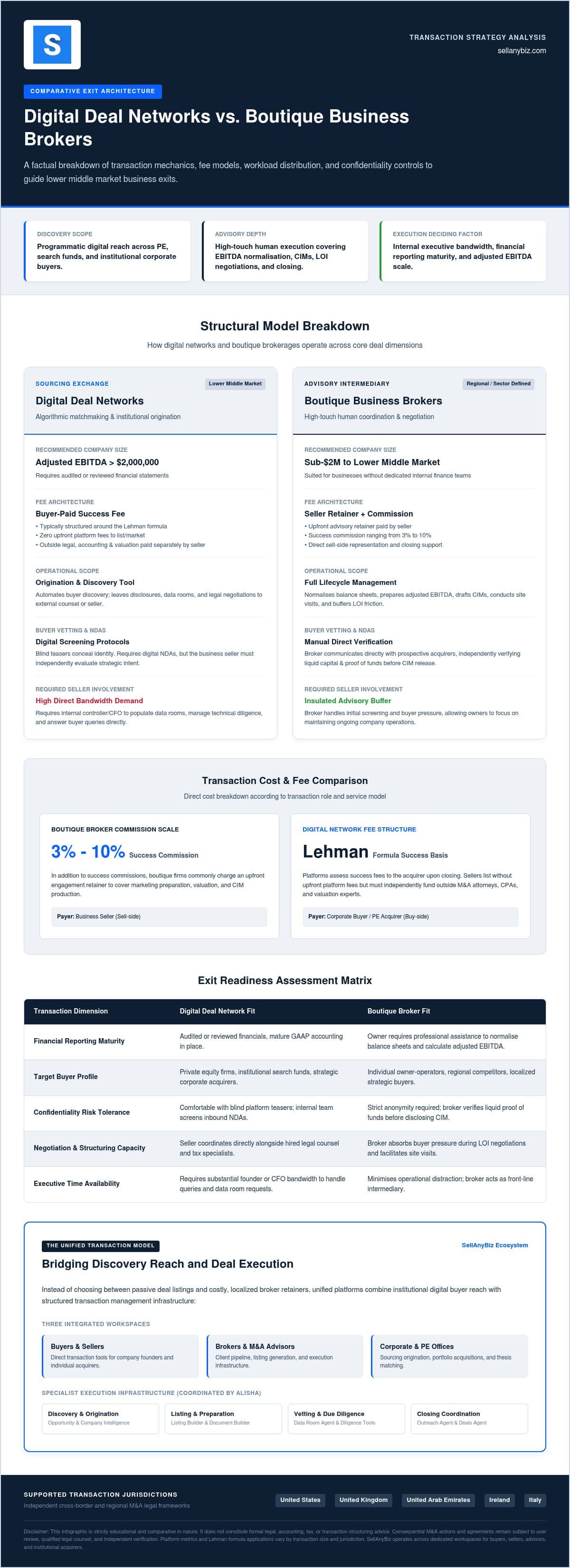
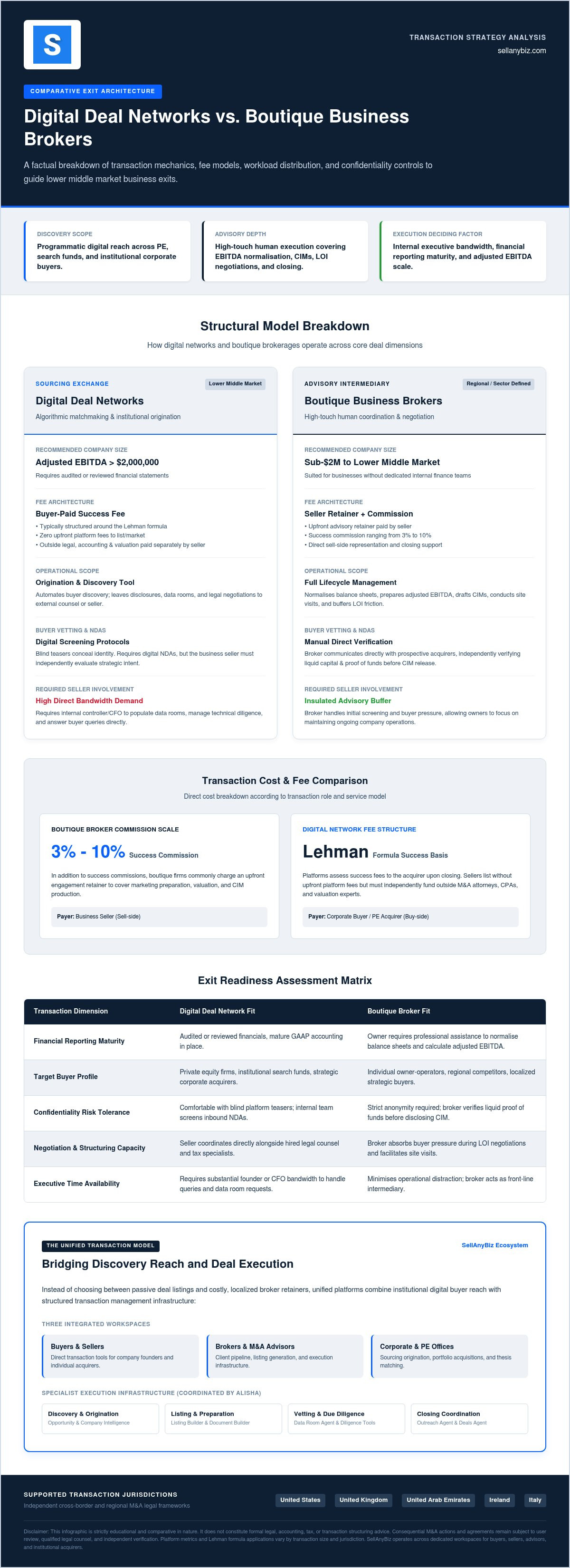
Axial operates as a deal sourcing exchange for the North American lower middle market, connecting sell-side advisors and business owners directly to corporate acquirers, search funds, and private equity firms. The platform automates visibility through buyer matching criteria. However, Axial remains an origination tool rather than an advisory practice. Sellers on the network must coordinate their own legal disclosures, data rooms, and purchase agreement negotiations unless an external intermediary represents them.
The Tactical Role of Boutique Business Brokers
Business brokers operating as boutique intermediaries deliver high-touch representation across defined geographical or sector boundaries. Instead of relying on passive software alerts, a boutique broker manages your entire transaction lifecycle:
- Normalising historical balance sheets and calculating adjusted EBITDA
- Drafting confidential information memorandums (CIMs) and non-disclosure agreements
- Vetting acquirer liquid capital before granting financial access
- Absorbing buyer pressure during letters of intent (LOI) negotiations
Where deal platforms offer scale, boutique brokerages offer insulation. In the debate between axial vs boutique business brokers, founders must balance digital breadth against the practical necessity of deal structuring, site visit coordination, and hands-on closing support.
Evaluating Deal Reach, Cost Models, and Transaction Involvement
Deciding between axial vs boutique business brokers requires looking closely at who pays, who does the work, and how information leaks are prevented. The impact of digitalisation on M&A has expanded cross-border deal discovery, but capital reach doesn't eliminate transaction overhead.
Fee Structures: Software Subscriptions Versus Success Commissions
On Axial, business owners and sell-side advisors market opportunities without upfront platform fees. Instead, the platform assesses a closing success fee on the buyer, typically structured around the Lehman formula. However, self-directed sellers absorb outside advisory expenses. You must hire transaction counsel, accounting support, and valuation specialists separately. Conversely, boutique brokers charge the seller directly, often pairing an upfront retainer with a success commission ranging from 3% to 10% depending on transaction size.
Confidentiality Controls and Buyer Screening Standards
Both models protect sensitive operational data through distinct processes:
- Deal networks: Blind teasers conceal company identities, requiring signed digital NDAs before releasing financial memorandums. Even so, the seller must screen each applicant's strategic intent.
- Boutique intermediaries: A dedicated broker speaks directly with prospective acquirers, verifying proof of funds and operational fit before distributing the CIM.
When weighing axial vs boutique business brokers, seller bandwidth is the decisive factor. Handling hundreds of platform queries pulls leadership away from core operations. Business owners balancing digital reach against transaction control can evaluate current market parameters by reviewing verified confidential business listings to benchmark active deal structures.
How to Choose the Right Route for Your Company Size and Goals
Enterprise value, accounting maturity, and internal bandwidth determine your transaction path. Selecting between axial vs boutique business brokers requires a candid audit of your company's operational independence and target buyer profile.
When an Online Deal Network Delivers the Best Outcome
Institutional deal networks perform best when your business meets strict financial and operational benchmarks:
- Adjusted EBITDA consistently exceeds $2 million with audited or reviewed statements.
- An internal controller or CFO can manage data room population and technical financial diligence.
- The primary exit thesis targets institutional private equity, family offices, or funded searchers.
If your operations function smoothly without daily founder involvement, deal networks provide scalable access to professional capital partners. For firm leaders preparing their operations and leadership teams ahead of a transaction, discover Significant Business Results for specialized exit strategy consulting and executive coaching tailored to architecture, engineering, and construction businesses.
When a Dedicated Boutique Brokerage Is Essential
A specialized boutique intermediary becomes critical under specific operational conditions:
- Significant founder dependency requiring complex transition agreements or structured earnouts.
- Unadjusted books that require rigorous financial recasting and owner add-back defense.
- Owner fatigue, where absorbing dozens of unvetted buyer meetings risks operational decline.
- Transactions below $2 million EBITDA that primarily attract individual owner-operators.
- Highly regulated sectors, such as medical and clinical practices, where industry-focused intermediaries like Healthcare Biz Brokers, Inc. provide specialized business valuation and targeted acquirer screening.
Boutique firms absorb deal friction, manage site visits, and negotiate deal terms while you maintain revenue momentum.
Your choice in the debate between axial vs boutique business brokers depends on whether you need a digital distribution channel or an active transaction manager. To gauge current buyer requirements and evaluate transaction structures across multiple sectors, browse active market listings to benchmark your business profile.
The Connected Alternative: Combining Digital Buyer Reach with Deal Execution
The standard debate between axial vs boutique business brokers frames exits as a rigid choice between unassisted software networks and traditional intermediaries. Modern platforms remove this division by pairing institutional discovery with structured deal infrastructure.
Streamlining Deal Management with Integrated Transaction Workspaces
Fragmented communication stalls transactions. Unified digital environments eliminate friction by organizing diligence workflows into dedicated modules:
- Role-based workspaces where sellers, vetted advisors, and institutional buyers collaborate directly
- Document builders that produce standardized NDAs, teasers, and financial summaries with human review
- Secure data rooms with permission controls and buyer activity tracking
Instead of managing scattered email threads, leadership teams track diligence requests through centralized pipelines. Reviewing active SellAnyBiz listings shows how modern platforms maintain confidentiality while exposing opportunities to qualified acquirers.
Balancing Automated Discovery with Professional Advisory Support
Software reach works best alongside experienced advisory judgment. Technology-enabled platforms allow boutique brokers to syndicate mandates across international markets while keeping tight control over local negotiations. Sellers gain access to partner-supported business brokers, formal business valuation reports, and transaction documentation on demand.
This connected architecture resolves the core tension in axial vs boutique business brokers. Founders no longer have to compromise between broad institutional reach and rigorous transaction management.
Structuring Your 2026 Exit for Maximum Value
Resolving the choice between axial vs boutique business brokers comes down to execution capacity. If your company boasts clean, audited financials and dedicated internal leadership to run diligence, an institutional deal network widens your buyer pool. If your business requires hands-on financial recasting, confidential buyer vetting, and negotiation insulation, a boutique broker remains an indispensable partner.
You don't have to navigate these trade-offs in isolation. SellAnyBiz bridges the gap with an AI-powered transaction ecosystem supporting buyers, sellers, and advisors. Through integrated deal workspaces featuring secure data rooms, verified networks, and structured document tools, you maintain complete oversight without sacrificing transaction velocity. Take the next step to benchmark your position and check your sale readiness before entering the market. With the right infrastructure in place, you can protect confidentiality, run a competitive process, and exit on your own terms.
Frequently Asked Questions
What is the primary difference between Axial and a boutique business broker?
Axial functions as a digital deal network connecting lower-middle-market companies and sell-side representatives with institutional capital. In contrast, a boutique business broker delivers high-touch advisory services, actively managing business valuation, buyer screening, and transaction negotiations. Evaluating axial vs boutique business brokers highlights a core distinction between programmatic software discovery and dedicated, human-led deal execution.
Can a business owner use Axial without hiring an M&A adviser or business broker?
Yes, business owners can market opportunities directly on Axial without hiring an intermediary. However, pursuing an unassisted exit means you must prepare confidential teasers, vet inbound inquiries, populate data rooms, and coordinate legal closing documents yourself. Without dedicated transaction guidance, managing these administrative workflows often pulls executive bandwidth away from running the day-to-day business.
How do the costs of using a digital deal network compare to business broker commissions?
Axial charges its success fee to the buyer upon closing, calculated using the standard Lehman formula, while qualified sellers market opportunities without platform fees. Conversely, boutique business brokers charge the seller directly, pairing an upfront retainer with a success fee between 3% and 10%. Even on fee-free networks, unassisted sellers must fund third-party legal, accounting, and tax advisors.
How is confidentiality preserved when listing a business on an online deal platform?
Digital platforms protect sensitive operations through gated blind teasers that conceal company identities, precise locations, and proprietary metrics. Prospective acquirers cannot view identifying details without submitting their credentials and executing an approved non-disclosure agreement. Sellers maintain complete control over which buyers receive clearance, ensuring competitors and employees don't discover the pending exit prematurely.
Which businesses are better suited for boutique business brokers than digital networks?
Companies generating under $2 million EBITDA or businesses with heavy founder dependency achieve better outcomes with boutique intermediaries. In the comparison of axial vs boutique business brokers, regional service firms and local brick-and-mortar companies benefit from hands-on financial recasting, personal site visits, and direct buyer vetting. Boutique brokers absorb this operational friction, protecting owners who lack internal corporate development teams.
Disclaimer
Disclaimer: SellAnyBiz provides general business marketplace, brokerage and transaction-support information. Services may be subject to regional legal and regulatory requirements. Please review our Disclaimer & Compliance Notice for full details.