Business Sale Legal Abu Dhabi: A 2026 Guide to Regulatory Compliance
Also available in:Italiano

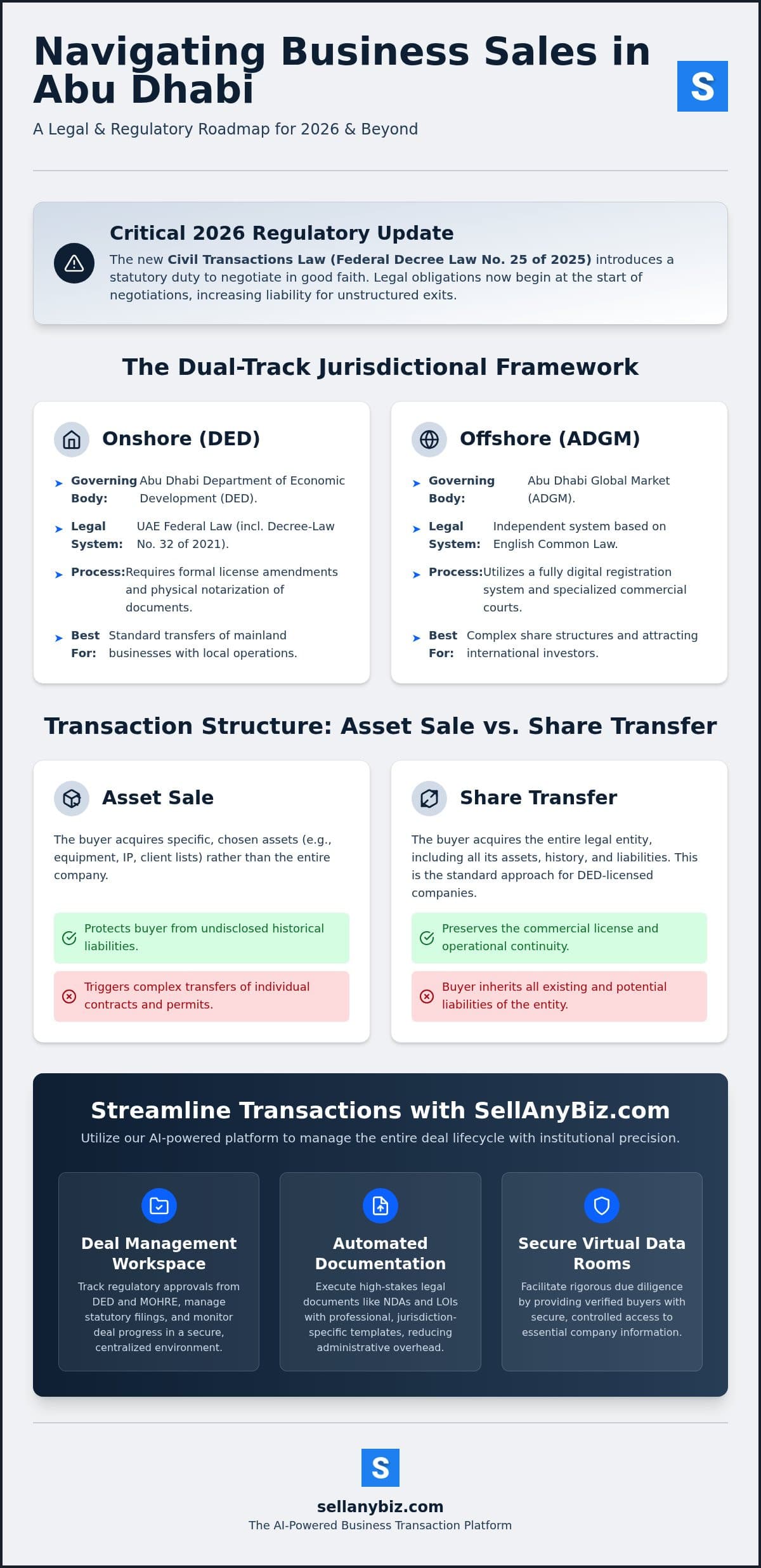
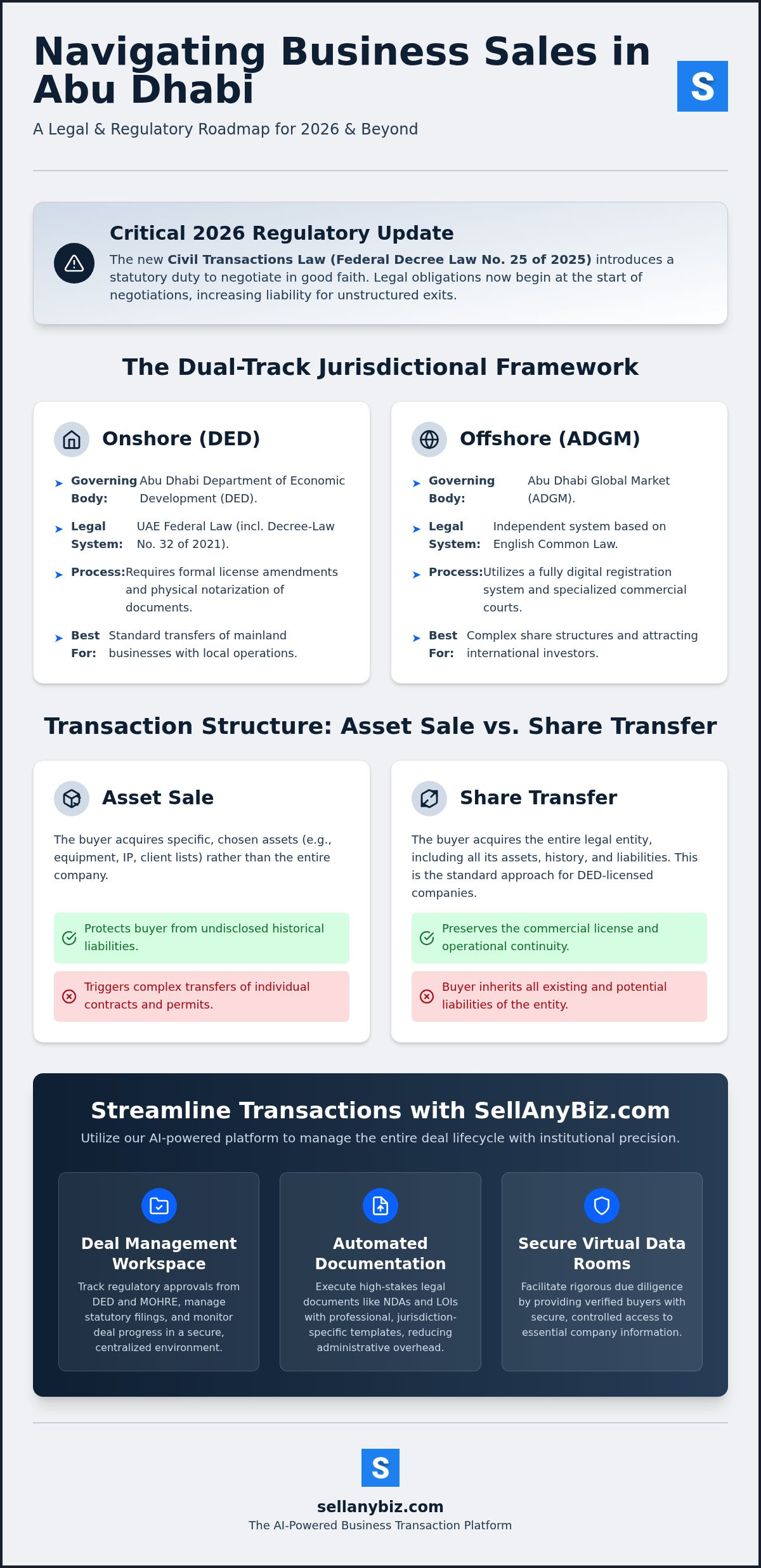
In 2026, an unstructured exit in the UAE capital is no longer just a missed opportunity. It's a significant regulatory liability. The new Civil Transactions Law, Federal Decree Law No. 25 of 2025, mandates that legal obligations now begin the moment you enter negotiations. For any owner, managing a business sale legal Abu Dhabi process requires navigating a dual-track system. You must reconcile the specific mandates of the Department of Economic Development (DED) with the sophisticated framework of the Abu Dhabi Global Market (ADGM).
You understand that the stakes are high. The complexity of Federal Decree-Law No. 32 of 2021, combined with new merger notification thresholds starting July 30, 2026, can make a standard share transfer feel volatile. This guide provides an institutional roadmap to bridge the gap between initial intent and final completion. By utilizing the SellAnyBiz.com Deal Management framework, sellers can track regulatory approvals with precision. We'll detail the differences between asset and share sales, the mechanics of staff visa transitions, and the preparation required for rigorous due diligence. You'll gain the clarity needed to move forward with absolute confidence.
Key Takeaways
- Distinguish between Onshore (DED) and Offshore (ADGM) jurisdictions to define your regulatory roadmap.
- Compare asset sales and share transfers to effectively manage future liabilities and entity continuity.
- Navigate the business sale legal Abu Dhabi landscape by securing approvals from the DED and MOHRE under 2026 mandates.
- Execute professional due diligence using secure virtual data rooms to verify your right to sell.
- Use SellAnyBiz.com Deal Management tools to automate high-stakes documentation like NDAs and LOIs.
Table of Contents
Understanding the Legal Framework for Business Sales in Abu Dhabi
Abu Dhabi’s regulatory environment is defined by its bifurcated legal structure. Sellers must first identify if their entity is Onshore or Offshore. This distinction dictates every subsequent step of the business sale legal Abu Dhabi process. Onshore companies fall under the jurisdiction of the Abu Dhabi Department of Economic Development (DED). These entities are governed primarily by UAE Federal Decree-Law No. 32 of 2021. Additionally, the new Civil Transactions Law, Federal Decree Law No. 25 of 2025, came into force on June 1, 2026. It introduces a statutory duty to negotiate in good faith and disclose material information. Conversely, the Abu Dhabi Global Market (ADGM) operates as an offshore financial center. It utilizes an independent judicial system based on English Common Law.
Onshore vs. ADGM: Choosing Your Legal Route
The procedural path varies significantly between these two jurisdictions. Onshore transactions require formal license amendments through the DED. They also necessitate the notarization of transfer documents at the Abu Dhabi Judicial Department. This often involves physical presence or a verified Power of Attorney. In contrast, ADGM entities use a digital registration system. Their specialized commercial courts provide a familiar framework for international investors. While ADGM offers greater flexibility for complex share structures, the administrative costs are often higher. The Abu Dhabi Investment Office (ADIO) provides resources to help investors navigate these jurisdictional benefits. Choosing the wrong route during the initial LOI stage can lead to months of administrative delays.
Foreign Ownership Regulations in 2026
As of 2026, the landscape for foreign ownership has reached a mature phase. The 100% ownership rules now cover the vast majority of commercial and industrial activities. This shift has largely removed the requirement for a UAE National partner for mainland businesses. However, specific strategic sectors still require a National Service Agent (NSA). This role is purely administrative. It doesn't grant equity; but it must be clearly addressed in the Share Purchase Agreement (SPA).
The current ownership structure directly impacts the complexity of the deal. For 100% foreign-owned entities, the transfer is direct and streamlined. For businesses maintaining an NSA, the legal documentation must define the termination or transition of that service agreement. Sellers should use the SellAnyBiz.com Broker and M&A Advisor Workspace to manage these specific regulatory stages. This ensures all jurisdictional approvals and statutory filings are tracked in a secure environment. The 2026 amendments to the UAE Companies Law also introduce a formal redomiciliation framework. This allows companies to transfer their legal seat between mainland and free zones while preserving corporate continuity. This adds a layer of flexibility for buyers looking to restructure post-acquisition.
Asset Sale vs. Share Transfer: Legal Structures in Abu Dhabi
Choosing between an asset sale and a share transfer is the most consequential decision in a business sale legal Abu Dhabi transaction. In a share transfer, the buyer acquires the entire legal entity. This includes its history, assets, and all existing liabilities. For DED-licensed companies, this is the standard approach. It preserves the commercial license and avoids the bureaucratic burden of re-applying for operational permits. Asset sales differ. They involve the cherry-picking of specific business components like equipment, intellectual property, or client lists. While this protects the buyer from undisclosed liabilities, it triggers a complex web of individual contract transfers.
The Share Purchase Agreement (SPA) in the UAE
The SPA is the definitive document governing the transfer. Under Abu Dhabi jurisdiction, it must include specific clauses regarding the settlement of existing debts and the transition of the manager on the license. Local SPAs often require notarization to be recognized by the DED. Understanding the UAE commercial environment and trade regulations is essential when drafting warranties and indemnities. These clauses must align with the new Civil Transactions Law of 2026, which mandates good faith during negotiations. Sellers typically use the official 'Sale and Purchase of Shares' form at the DED to finalize the legal record. To see how these structures appear in the current market, you can browse verified business listings in Abu Dhabi.
Legal Risks of Asset Sales in Abu Dhabi
Asset sales present significant operational hurdles for those navigating business sale legal Abu Dhabi requirements. The primary challenge lies in workforce management. Since the legal entity doesn't change hands, the buyer cannot simply take over employee visas. Instead, the seller must cancel existing labor contracts and the buyer must issue new ones through the Ministry of Human Resources and Emiratisation (MOHRE). This process is time-consuming and risks staff turnover.
Real estate adds another layer of friction. Most commercial leases in Abu Dhabi malls or office towers require explicit landlord consent for a transfer. Novation is the legal process by which a new party replaces an existing one in a commercial lease, effectively terminating the old contract and creating a new agreement under the same terms. Without this, the buyer may find themselves with a business but no legal right to occupy the premises.
Key Regulatory Bodies and Compliance Standards
Execution of a business sale legal Abu Dhabi transaction requires precise coordination with several federal and local authorities. The Abu Dhabi Department of Economic Development (DED) acts as the primary gatekeeper for mainland licenses. It manages all amendments to the Memorandum of Association (MOA) and verifies the commercial capacity of the buyer. For entities operating within the free zone, Abu Dhabi Global Market's legal framework provides the statutory basis for offshore compliance. Beyond the license itself, the Ministry of Human Resources and Emiratisation (MOHRE) and the Federal Tax Authority (FTA) impose strict obligations that can derail a deal if ignored.
MOHRE and Labor Law Compliance
Workforce continuity is often the most sensitive part of a deal. Sellers are legally obligated to settle all outstanding employee entitlements before a transfer is finalized. This includes the End-of-Service Gratuity (ESG). In most Abu Dhabi transactions, the buyer assumes these liabilities in exchange for a purchase price adjustment. As of 2026, Emiratization targets have expanded. Companies with 20 to 49 employees in 14 specific sectors must now employ at least two UAE nationals. Failure to meet these quotas results in significant fines that a buyer's due diligence will certainly surface. Work permits must be formally canceled and reissued, or transferred if the legal entity remains intact.
VAT and Financial Legalities
Tax compliance isn't automatic during a sale. Article 7 of the UAE VAT Law outlines the 'Transfer of a Going Concern' (TOGC). Under this provision, the sale of a business isn't considered a supply for VAT purposes, provided the buyer continues the same activity. Both parties must notify the FTA within 20 business days of the transaction completion. If the seller fails to de-register or notify the authority, they may remain liable for tax on future turnovers. Economic Substance Regulations (ESR) also require a final notification to the Ministry of Finance. Sellers should use SellAnyBiz.com Workspaces to collaborate with tax advisors. This ensures all filings are documented and stored within the platform’s secure environment.
Regulatory oversight has intensified with the July 30, 2026, merger control framework. If the combined annual sales of the parties in the UAE exceed AED 300,000,000, a formal merger notification is mandatory. This requirement applies even if the business is being sold to a local competitor. SellAnyBiz.com Deal Management stages allow users to track these specific approval milestones. This prevents the common pitfall of assuming a deal is closed before the authorities have issued their final clearance.
Essential Documentation and the Legal Due Diligence Process
Legal due diligence is the mechanism that converts interest into a closed transaction. For a buyer, this process verifies that the seller possesses the absolute 'right to sell' and quantifies all underlying liabilities. In the current business sale legal Abu Dhabi environment, transparency is no longer optional. Preparation of a Virtual Data Room (VDR) has become the industry standard for 2026. This digital environment allows for the secure exchange of sensitive corporate records while maintaining a detailed audit trail of access. Sellers who fail to organize their regulatory and financial disclosures early often face deal fatigue or aggressive price renegotiations during the final stages of the acquisition.
SellAnyBiz.com provides integrated secure data rooms specifically designed for UAE transactions. These workspaces allow sellers to categorize documents by jurisdiction, ensuring that mainland DED requirements and ADGM filings are segregated for clarity. This structured approach builds immediate credibility with sophisticated buyers, such as private equity firms and family offices, who prioritize operational compliance over high-level projections.
The 2026 Abu Dhabi Legal Checklist
A successful exit requires a comprehensive document repository. Buyers will scrutinize the historical continuity of the legal entity. You must ensure the following records are verified and up to date:
- Valid Commercial License: Must reflect current activities and verified Chamber of Commerce membership.
- Notarized Memorandum of Association (MOA): Includes all subsequent amendments and side agreements.
- Regulatory Clearances: Proof of compliance with Economic Substance Regulations (ESR) and Mandatory GHG Reporting where applicable.
- Financial Audit Reports: At least three years of audited statements to support the valuation.
The Tawtheeq system is the mandatory digital registration for all tenancy contracts in Abu Dhabi, serving as the official proof of legal premises for commercial licensing and utility clearances. Without a valid Tawtheeq, the DED will not approve the transfer of a mainland license. Sellers should also provide utility clearance certificates from ADDC to ensure no trailing debts affect the new owner.
Executing the Non-Disclosure Agreement (NDA)
Information security begins before the data room is opened. Generic NDAs often fail in Abu Dhabi courts because they lack specific local jurisdiction clauses. When drafting these documents, you must specify whether disputes will be settled in the ADGM Courts or the Abu Dhabi Civil Courts. This choice dictates the language of proceedings and the legal principles applied to any breach of confidentiality.
The SellAnyBiz.com AI Builder allows users to generate localized NDAs that account for these jurisdictional nuances. By using digital NDAs within the platform, sellers can track exactly when a document was signed and by whom. This creates a secure foundation for the entire business sale legal Abu Dhabi journey. To begin preparing your entity for a structured exit, you can explore verified buyer mandates and listings to understand current market expectations.
Streamlining Abu Dhabi Business Transactions with SellAnyBiz.com
Modernizing the business sale legal Abu Dhabi process requires more than just legal counsel. It demands a structured digital infrastructure. SellAnyBiz.com serves as this foundational layer. It provides a connected workspace where every participant, from the seller to the corporate acquisition team, can interact with precision. The platform manages the entire deal lifecycle within a single secure environment. This eliminates the risks associated with fragmented communication and unsecured document sharing. It is an AI-powered transaction platform designed to replace the friction of traditional deal-making with a methodical, professional flow.
AI-Assisted Document Preparation
Speed is a critical factor in maintaining deal momentum. The SellAnyBiz.com AI Builder reduces the time spent on initial legal drafting by automating the creation of teasers, NDAs, and Letters of Intent (LOIs). These documents are standardized to meet the expectations of the Abu Dhabi market. This consistency is vital. It ensures that every communication reflects a professional, institutional standard. By using the AI Builder, sellers can generate localized NDAs that correctly specify jurisdiction, whether it be the ADGM or Abu Dhabi Civil Courts. This prevents the common errors found in generic templates that often fail during judicial review. It allows the seller to focus on the commercial terms while the platform handles the structural integrity of the documentation.
Secure Collaboration and Data Rooms
Transaction management thrives on controlled transparency. The SellAnyBiz.com Deal Management tool allows sellers to collaborate directly with Abu Dhabi legal advisors and accountants within a unified workspace. Access is permission-controlled. This ensures that sensitive financial data or MOA amendments are only visible to verified parties. Within the secure data rooms, sellers can track document activity. Monitoring which sections a buyer scrutinizes provides valuable insights into their acquisition intent. It turns the data room from a simple storage folder into a strategic asset for the seller.
This level of tracking allows advisors to gauge buyer engagement before entering final negotiations. It transforms the due diligence phase from a passive disclosure exercise into a proactive management strategy. By consolidating valuation, funding discovery, and legal documentation, the platform ensures that no regulatory milestone is overlooked. You can Discover vetted Abu Dhabi opportunities on SellAnyBiz.com to see how these structured deal rooms facilitate successful exits. The result is a transaction that is not only compliant with 2026 standards but also optimized for speed, security, and confidentiality.
Securing Your Transaction Success in 2026
The landscape for a business sale legal Abu Dhabi transaction is defined by its maturity. Success requires a bifurcated strategy. You must address the specific mandates of the DED and MOHRE while leveraging the international standards of the ADGM. Compliance with the 2026 Civil Transactions Law and new merger notification thresholds is no longer a formality. It's a prerequisite for closing.
SellAnyBiz.com provides the infrastructure to manage these complexities. Our platform offers AI-powered document generation for NDAs and LOIs. We provide secure UAE-hosted data rooms for confidential disclosures. Professional M&A workspaces allow for seamless collaboration with your legal team. This structured approach ensures that no regulatory detail is missed. Preparation is the difference between a stalled deal and a successful exit. By organizing your corporate records and utilizing professional transaction tools, you position your business for a smooth transition.
View Current Business Listings in Abu Dhabi
Frequently Asked Questions
Do I need a local partner to sell my business in Abu Dhabi in 2026?
No, you generally don't need a local partner for most commercial activities in 2026. Following the mature implementation of 100% foreign ownership laws, mainland entities can be fully owned by non-nationals. However, strategic sectors still require a National Service Agent (NSA). This agent holds no equity but provides administrative support. Your sale documentation must account for the termination or transfer of this NSA agreement to the new owner.
How long does the legal process of a business sale take in Abu Dhabi?
A standard transaction typically takes between four to eight weeks to complete. This timeline depends heavily on the jurisdiction and the complexity of regulatory approvals. DED-licensed entities may finish faster if all notarizations are prepared. ADGM sales involving complex share structures might require additional time for registry filings. Using SellAnyBiz.com Deal Management helps track these milestones, ensuring that administrative delays don't stall the closing process.
What is the difference between a DED sale and an ADGM sale?
The primary difference lies in the legal framework and judicial system. DED sales occur onshore and follow UAE Federal Law and Abu Dhabi civil regulations. ADGM sales occur in a financial free zone governed by English Common Law. While DED transactions require notarization at the Abu Dhabi Judicial Department, ADGM processes are primarily digital. This choice affects how you draft your Share Purchase Agreement and which courts settle future disputes.
Can I sell my business in Abu Dhabi if I have outstanding bank loans?
Yes, but you must obtain a formal No Objection Certificate (NOC) from your lending bank first. Outstanding liabilities are a major focus of the business sale legal Abu Dhabi due diligence process. Buyers usually require these loans to be settled at closing using the sale proceeds. Alternatively, the buyer may agree to assume the debt, which requires a formal novation agreement with the bank to release the seller from future obligations.
Is the Share Purchase Agreement (SPA) legally binding if signed outside the UAE?
It depends on the jurisdiction and the method of execution. For DED-licensed companies, an SPA signed abroad must be notarized and apostilled by the UAE Embassy in that country to be recognized locally. ADGM entities accept digital signatures, making cross-border execution more streamlined. Regardless of where it's signed, the document must specify the governing law to ensure enforceability within the Abu Dhabi court system or ADGM judiciary.
What happens to employee visas when a business is sold in Abu Dhabi?
In a share transfer, employee visas usually remain valid as the legal entity remains unchanged. However, you must update the authorized signatory on the MOHRE file. In an asset sale, the process is more complex. The seller must cancel existing visas, and the buyer must issue new ones. This requires settling all end-of-service gratuities before the transfer. Clear communication with staff is essential to maintain operational stability during this transition.
Do I need to notify the Federal Tax Authority (FTA) when selling my business?
Yes, you must notify the FTA within 20 business days of the transaction completion. Under the 'Transfer of a Going Concern' rules, the sale may be exempt from VAT if specific conditions are met. Failure to notify the authority can result in administrative penalties. It's also vital to update your tax registration details or de-register if you are no longer carrying out taxable activities in the UAE.
What are the costs associated with the legal transfer of a business license?
Government fees for license amendments in Abu Dhabi vary based on the activity and legal form. DED fees for ownership changes typically include administrative charges and publication fees. While business licenses in the emirate range from AED 5,000 to AED 20,000, transfer fees are specific to the amendment type. Beyond government charges, you should budget for notarization costs and professional fees for financial cleanup. These costs are usually negotiated between parties during the initial Letter of Intent stage.
Disclaimer
Disclaimer: SellAnyBiz provides general business marketplace, brokerage and transaction-support information. Services may be subject to regional legal and regulatory requirements. Please review our Disclaimer & Compliance Notice for full details.