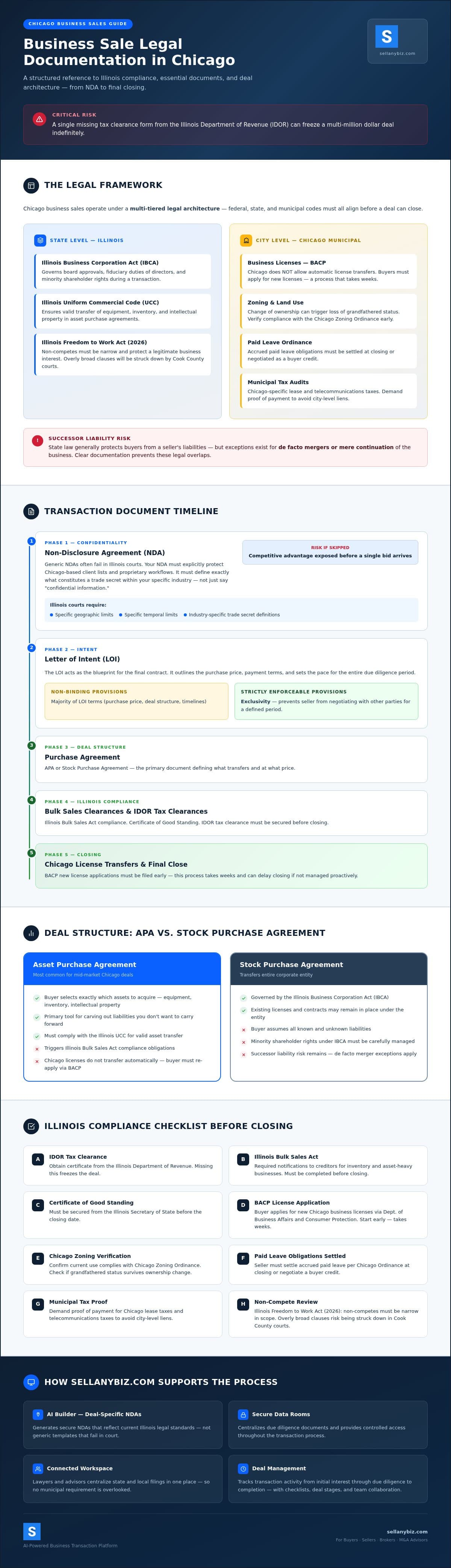
Business Sale Legal Documentation Chicago: The 2026 Reference Guide
Also available in:Italiano

A single missing tax clearance form from the Illinois Department of Revenue can freeze a multi-million dollar deal indefinitely. In the high-stakes environment of Cook County, paperwork isn't a formality. It's the infrastructure of the transaction. Managing business sale legal documentation Chicago requires more than basic templates. It demands a precise understanding of state statutes and local municipal codes. You likely feel the pressure of this complexity. The fear of a deal collapsing during due diligence because of a technical oversight is real. A common frustration for seasoned owners and brokers.
This guide from SellAnyBiz.com helps you navigate the complex landscape of Illinois business laws with a structured reference to essential transaction documentation. We've built this to ensure compliance with the Illinois Bulk Sales Act and streamline your deal execution. Clear steps. Verified requirements. We'll cover initial NDAs, final IDOR clearances, and Chicago-specific licensing transfers. The goal is a professional framework. Use it to move your transaction from initial intent to a successful close.
Key Takeaways
- Understand the regulatory interplay between the Illinois Business Corporation Act and Chicago specific municipal licensing requirements.
- Identify the critical provisions in your business sale legal documentation Chicago to protect trade secrets and define binding deal terms.
- Compare the tax and liability implications of Asset Purchase Agreements versus Stock Purchase Agreements for Illinois transactions.
- Navigate the Illinois Bulk Sales Act by securing mandatory tax clearances and Certificates of Good Standing before closing.
- Leverage SellAnyBiz.com secure data rooms and AI driven document builders to centralize due diligence and accelerate deal flow.
Table of Contents
The Legal Framework for Chicago Business Transactions
Selling a business in Chicago requires a multi-tiered legal architecture. It is not a simple exchange of keys for capital. The process involves a complex interaction between the Illinois Business Corporation Act (IBCA) and specific Chicago municipal codes. This framework dictates everything from how a board approves a sale to how a local liquor license transfers. Precision in business sale legal documentation Chicago is the only way to mitigate risk. Without a structured approach, sellers face post-closing liabilities and buyers inherit unforeseen debts.
Governing Statutes in Illinois
The IBCA provides the baseline for corporate governance during a transaction. It outlines the fiduciary duties of directors and the rights of minority shareholders. Most mid-market deals in the city utilize an asset purchase agreement to define exactly what is being transferred. This document must comply with the Illinois Uniform Commercial Code (UCC) to ensure the valid transfer of equipment, inventory, and intellectual property. It's the primary tool for carving out liabilities you don't want to carry forward.
Successor liability remains a primary concern for Illinois buyers. State law generally protects buyers from a seller's liabilities, but exceptions exist for de facto mergers or mere continuations. Clear documentation prevents these legal overlaps. Additionally, the 2026 landscape for non-compete agreements remains governed by the Illinois Freedom to Work Act. These clauses must be narrow. They must protect a legitimate business interest without being overly restrictive. If they're too broad, Cook County courts will likely strike them down.
Chicago Municipal Requirements
City-level compliance is where many deals encounter friction. The City of Chicago doesn't allow for the automatic transfer of most business licenses. This makes the preparation of business sale legal documentation Chicago even more critical at the local level. The Department of Business Affairs and Consumer Protection (BACP) requires buyers to apply for new licenses, even if the business operations remain unchanged. This process often takes weeks and can delay a closing if not managed early.
- Zoning and Land Use: You must verify the property’s current use complies with the Chicago Zoning Ordinance. A change in ownership can sometimes trigger a loss of grandfathered status in certain neighborhoods.
- Local Employment Law: The Chicago Paid Leave and Paid Sick Leave Ordinance imposes strict requirements on accrued time. Sellers must settle these obligations at closing or negotiate a credit for the buyer.
- Municipal Tax Audits: Chicago has specific lease taxes and telecommunications taxes. Buyers should demand proof of payment to avoid city-level liens.
Professional legal representation is mandatory for navigating these layers. The SellAnyBiz.com platform supports this process by providing a connected workspace where lawyers and advisors can centralize state and local filings. This structure ensures that no municipal requirement is overlooked during the push toward completion. It's about moving forward with confidence rather than crossing your fingers at the closing table.
Essential Preliminary Documentation and NDAs
Every successful Chicago exit begins with a breach of silence. Protecting trade secrets and internal data is the first priority. Without proper business sale legal documentation Chicago, you risk your competitive advantage before a single bid arrives. Initial documents aren't just paperwork. They're the defensive layers of your transaction. They ensure that your intent to sell doesn't destabilize your current operations or alert competitors prematurely.
Confidentiality and NDAs
Generic NDAs often fail in Illinois courts. Judges typically reject "one-size-fits-all" agreements that lack specific geographic or temporal limits. Your NDA must explicitly protect Chicago-based client lists and proprietary workflows. It shouldn't just say "confidential information." It should define exactly what constitutes a trade secret within your specific industry. The SellAnyBiz.com AI Builder streamlines this. It generates secure, deal-specific NDAs that reflect current Illinois legal standards. This ensures your sensitive data room remains a controlled environment throughout the process.
The Letter of Intent (LOI) Structure
The LOI acts as the blueprint for the final contract. It outlines the purchase price and payment terms. It sets the pace for the entire due diligence period. While the majority of an LOI is non-binding, certain provisions are strictly enforceable:
- Exclusivity: Prevents the seller from negotiating with other parties for a set period.
- Confidentiality: Protects the existence of the deal itself from public knowledge.
- Expenses: Dictates who pays for professional fees if the deal collapses.
Chicago buyers use no-shop clauses to lock up a deal while they finalize financing. You must negotiate these periods carefully to avoid being sidelined. It's also the right time to reference IRS guidelines on business sale taxation. Early alignment on asset allocation can prevent significant friction during the final drafting phase. If you're looking to gauge market appetite, you can browse current Chicago listings to see how similar deals are structured.
Market entry requires two distinct documents. The Teaser is your anonymous handshake. It's a high-level summary designed to spark acquisition intent without revealing your identity. Once a buyer is vetted and the NDA is signed, you provide the Information Memorandum. This document is the comprehensive reference for your business. It covers financial history, staff structure, and local market positioning. A professional Information Memorandum is a cornerstone of business sale legal documentation Chicago, signaling to investors that the deal is organized and ready for a deep dive. It reduces friction. It builds trust. It moves the deal forward.
Structuring the Deal: APA vs. Stock Purchase Agreements
The choice between an asset sale and a stock sale dictates the tax consequences and liability exposure for both parties. It's a foundational decision. Most Chicago mid-market transactions utilize an Asset Purchase Agreement (APA). This structure allows the buyer to "cherry-pick" specific assets while leaving the corporate entity and its historical debts with the seller. A Stock Purchase Agreement (SPA) is different. It transfers the entire company, including its history, contracts, and potential skeletons. The structural path you choose will fundamentally alter the drafting of your business sale legal documentation Chicago.
The Asset Purchase Agreement (APA)
An APA offers the cleanest break for a buyer. It's the preferred method for service businesses where the brand and equipment are the primary value drivers. Within your business sale legal documentation Chicago, you must meticulously list "Excluded Assets." These are items not included in the price, such as the seller's personal vehicles, specific cash reserves, or unrelated trademarks. This precision is a hallmark of professional transaction management. The Bill of Sale acts as the final receipt for tangible property. It proves the transfer of title for everything from office furniture to specialized machinery; to understand the nuances of establishing a clear history of ownership, learn more about the chain of title process. By using an APA, buyers effectively bypass the successor liability risks often associated with Illinois corporate law.
Stock sales are less common in the small-to-mid-market range but offer significant advantages for complex entities. If your business holds difficult-to-transfer Chicago municipal contracts or specialized federal certifications, a stock sale ensures continuity. The entity remains the same; only the owners change. This path requires total compliance with the Illinois Securities Law of 1953. You must also account for minority shareholder rights. If you don't have unanimous consent, your bylaws' drag-along provisions will determine the deal's feasibility. For those operating across different jurisdictions, reviewing a Business Transaction Legal Manchester reference can highlight how local equity rules vary by region.
Regardless of the structure, the contract's strength lies in its representations and warranties. These are the seller's formal promises about the company's state. Common reps in an Illinois contract include financial statement accuracy, the absence of pending lawsuits, and full disclosure of environmental issues. To back these promises, most deals include an indemnification clause. This is the buyer's insurance policy. If a rep is breached, the seller is liable for the loss. To secure this, Chicago attorneys often insist on an escrow arrangement. A percentage of the sale price stays in a secure account for a defined period, usually 12 to 24 months. This ensures funds are available if a liability surfaces post-closing. It's a standard mechanism for deal security in the mid-market space.
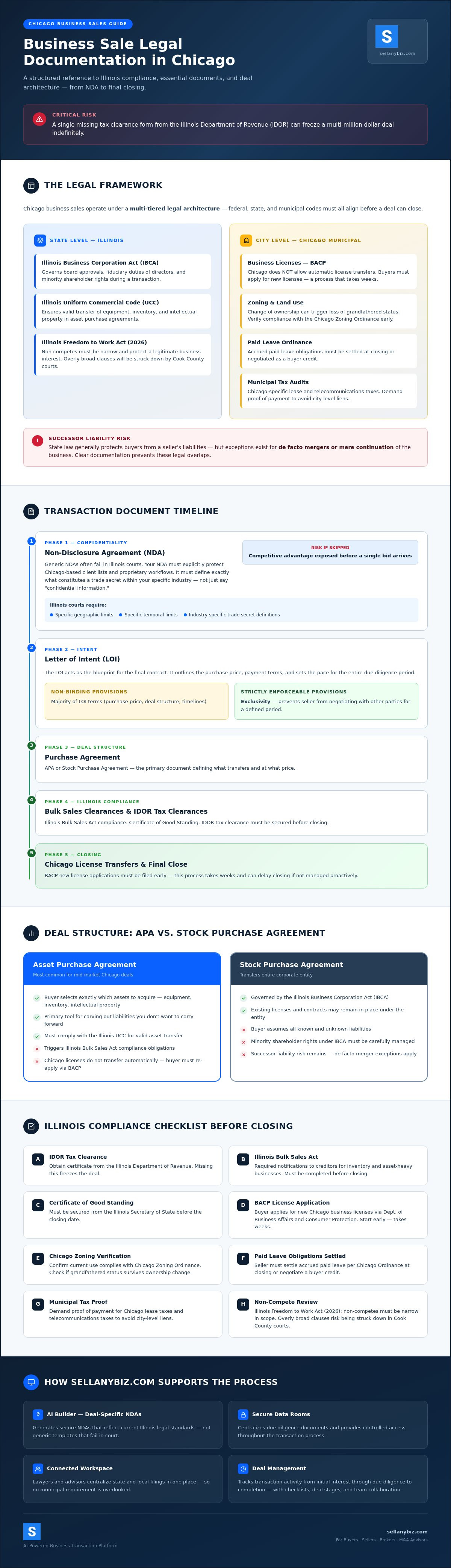
Illinois Compliance: Bulk Sales and Tax Clearances
Illinois law is clear. If you buy the majority of a business's assets without notifying the state, you inherit the seller’s tax debt. This is the core of the Illinois Bulk Sales Act. It exists to ensure the Illinois Department of Revenue (IDOR) collects outstanding balances before a seller exits with the proceeds. Managing this risk is a non-negotiable part of business sale legal documentation Chicago. Precision here protects the buyer's capital and the seller's reputation.
The IDOR Notification Process
The process is strictly procedural. It begins with Form CBS-1, the Notice of Sale, Purchase, or Transfer. Both parties must submit this form at least 10 business days before the transfer occurs. Missing this window is a common error. It can lead to the buyer being held personally liable for the seller's unpaid sales and withholding taxes. It's a heavy price for a clerical oversight.
Once filed, the IDOR reviews the seller’s account. If they find outstanding balances, they issue a "Bulk Sale Stop Order." This isn't a deal-killer. It’s a directive. It requires the buyer to withhold a specific amount from the purchase price at closing. These funds stay in escrow until the IDOR issues a final tax clearance letter. It's a structured safeguard. It ensures the buyer starts with a clean slate.
Local Chicago Closing Requirements
State clearance is only half the battle. The City of Chicago has its own set of hurdles. Before a sale can conclude, you must address municipal debt clearances. This covers everything from unpaid water bills to refuse collection fees. Chicago’s Department of Finance is aggressive. They'll block license transfers if the entity has outstanding warrants or local tax liens. You don't want to discover a three year old parking ticket lien on the morning of your closing.
For restaurants and retail shops, transferring local permits requires a clean slate. You can't simply "take over" a sidewalk cafe permit or a liquor license if the previous owner owes the city money. You must prove compliance. This involves obtaining a Certificate of Good Standing from the Illinois Secretary of State. It confirms the corporation is authorized to do business and has filed its annual reports. It's the final stamp of legitimacy.
Navigating these bureaucratic layers requires organization. The SellAnyBiz.com platform provides the deal management tools needed to track these deadlines. From task lists for Form CBS-1 to secure folders for municipal clearances, the infrastructure is built for compliance. You can view active Chicago opportunities to see how professional brokers structure these requirements in their data rooms. Don't let a missed 10-day window derail your exit. Handle the tax architecture early.
Streamlining Chicago Closings with SellAnyBiz.com
The final push toward a Chicago closing often reveals the friction in traditional M&A. Disconnected email threads. Outdated spreadsheets. Missing tax clearances. SellAnyBiz.com replaces this chaos with a structured transaction management platform. It centralizes the business sale legal documentation Chicago into a single, secure environment. This isn't just storage. It's a deal room designed for execution. It brings order to the final stages of the transaction.
SellAnyBiz.com secure data rooms are the heart of the due diligence process. In Illinois, where Bulk Sales Act compliance is mandatory, organizing IDOR filings and municipal debt clearances is critical. The platform allows sellers to upload sensitive financials and legal contracts with confidence. AI tools scan these documents to surface potential risks early. They identify missing clauses or inconsistent data before they become deal-breakers. This proactive approach saves time and protects deal value.
Centralized Deal Management
For brokers who are also managing the buyer's financing requirements, utilizing DocChaser to automate the collection of mortgage documents can further streamline the path to closing.
Collaboration requires control. Role-based permissions ensure that accountants, lawyers, and brokers see only what is relevant to their specific function. This protects confidentiality while maintaining deal momentum. The platform tracks every Q&A interaction and document version. This creates a robust audit trail for legal teams. For those looking at broader market comparisons, our guide on Strategic Buyer Representation in Glasgow offers insights into international standards for acquisition management.
The Future of Chicago M&A
The 2026 market demands more than static checklists. It requires connected transaction workflows. SellAnyBiz.com bridges the gap between local legal expertise and digital efficiency. You don't just manage a deal. You move it forward. By automating document generation and tracking deal stages, the platform reduces the administrative burden on M&A teams. This results in a faster close and a more secure transition for the new owner.
A successful exit depends on the tools you use to manage the final details. Moving from manual processes to a unified workspace reduces the probability of human error during the closing sequence. It ensures all parties remain aligned on tasks and timelines. Start your Chicago deal in a SellAnyBiz.com workspace to experience a professional, infrastructure-driven approach to business sales. Secure your documentation. Streamline your collaboration. Close with confidence.
Executing Your Chicago Exit Strategy
A successful transaction requires total alignment between Illinois state statutes and Chicago municipal codes. The choice between an asset purchase and a stock transfer dictates your tax exposure and liability profile. Successor liability and bulk sales notifications aren't just procedural details. They are the essential safeguards of your deal proceeds. Precision in your business sale legal documentation Chicago ensures that your hard-earned value isn't eroded by post-closing disputes or state-level stop orders.
The SellAnyBiz.com platform provides the infrastructure to manage these complexities. You gain access to an AI-powered Document Builder for compliant materials and secure, permission-controlled data rooms for due diligence. It's a connected workflow that keeps lawyers, accountants, and brokers focused on the close. By centralizing your tasks and communications, you move from uncertainty to a structured, successful exit.
Manage your Chicago business sale in a SellAnyBiz.com workspace. The right tools turn a high-stakes process into a manageable, professional transition. Your next deal is ready for execution.
Frequently Asked Questions
What is the Illinois Bulk Sales Act and does it apply to my Chicago business?
The Illinois Bulk Sales Act requires sellers to notify the state at least 10 business days before transferring a major portion of business assets. It applies to any Chicago business selling assets outside the ordinary course of trade. This statute protects the buyer from inheriting the seller's unpaid tax liabilities. Compliance is mandatory for brick and mortar shops and service firms to ensure deal proceeds aren't frozen by a state stop order.
How long does it take to get a tax clearance certificate in Illinois?
The initial notification window is 10 business days. However, receiving a final clearance letter from the Illinois Department of Revenue often takes several weeks or months. If the state identifies outstanding debts during the initial review, they'll issue a stop order. This requires the buyer to hold a portion of the purchase price in escrow. The definitive clearance is only issued once all final tax returns are processed and debts settled.
Do I need a Chicago-specific business license transfer for an asset sale?
Chicago does not typically allow for the direct transfer of business licenses between different owners. In an asset sale, the buyer must apply for new licenses through the Department of Business Affairs and Consumer Protection. While the physical location might be approved for the same use, the new owner must meet current municipal code requirements. You should begin this application process early to avoid operational gaps after the closing date.
What are the most common legal documents needed for a business sale in Chicago?
Essential business sale legal documentation Chicago includes the Non-Disclosure Agreement, Letter of Intent, and the definitive Asset Purchase Agreement. You also need a Bill of Sale for tangible assets and an Assignment and Assumption of Lease for the premises. State-specific filings, such as Form CBS-1, are critical for tax compliance. Each document serves to define the specific assets being transferred and the allocation of future liabilities between parties.
Can I use a generic NDA for a business sale in Illinois?
Using a generic NDA is risky because Illinois courts strictly scrutinize restrictive covenants. An effective agreement must be tailored to protect specific Chicago trade secrets and proprietary data. It needs to define confidential information clearly and include enforceable time and geographic limits. Generic templates often lack the precision required to withstand a legal challenge in Cook County, potentially leaving your sensitive financial data exposed during the due diligence phase.
What is the difference between an APA and a Stock Purchase Agreement in Chicago?
An Asset Purchase Agreement involves buying specific items like equipment and goodwill while leaving the corporate entity behind. This is the standard structure for Chicago small businesses looking to avoid legacy liabilities. A Stock Purchase Agreement transfers the entire company, including all historical legal and tax obligations. Buyers typically prefer APAs for risk mitigation, while sellers might prefer stock sales for specific tax advantages or the continuity of complex contracts.
How does SellAnyBiz.com help with legal document management?
SellAnyBiz.com streamlines the transaction using an AI-powered Document Builder to generate deal-specific materials like NDAs and LOIs. The platform provides secure, permission-controlled data rooms to organize sensitive due diligence materials. It connects the seller, buyer, and their legal advisors in a unified workspace. By automating checklists and deal stages, the platform ensures that critical Illinois compliance steps, such as bulk sales notifications, are tracked and completed on schedule.
Is a Letter of Intent (LOI) legally binding in Illinois?
An LOI is generally non-binding regarding the final purchase price, but specific sections are strictly enforceable in Illinois. Clauses covering exclusivity, confidentiality, and the payment of professional fees are typically binding. You must use precise language to distinguish between the intent to negotiate and the legal obligation to close. Illinois courts look at the objective intent expressed in the document to determine which provisions hold legal weight during a dispute.
Disclaimer
Disclaimer: SellAnyBiz provides general business marketplace, brokerage and transaction-support information. Services may be subject to regional legal and regulatory requirements. Please review our Disclaimer & Compliance Notice for full details.