Business Valuation Report: 2026 Strategic Guide
Also available in:Italiano

A business is worth exactly what the market is willing to pay. Yet, 75% of lower-middle-market deals hinge on EBITDA multiples that many owners struggle to defend. You've spent a lifetime building your company. The fear of undervaluing that work is valid. Confusion over SDE versus EBITDA is common. A professional business valuation report shouldn't be a mystery or a bottleneck. Traditional firms are often too slow for the pace of modern M&A.
You want a number that stands up to scrutiny. You need credibility with investors. We understand the high stakes of these transactions. This guide explains how to interpret these documents and leverage them for better terms. We'll examine current 2026 benchmarks, from SBA loan thresholds to shifting interest rates in the US and Europe. You'll learn to move from raw data to a verifiable value. We'll cover how to use these insights to de-risk your business before the sale. It's about more than a final figure. It's about preparation, authority, and structured deal management.
Key Takeaways
- Understand why a professional business valuation report is the essential baseline for price negotiations and a mandatory requirement for securing bank or SBA funding.
- Distinguish between income-based and market-based methodologies to ensure your listing price aligns with current 2026 transaction data.
- Streamline financial normalization using AI-assisted tools to identify critical "add-backs" like personal expenses and one-time costs.
- Learn how to organize three years of P&L statements and balance sheets into a verifiable format that withstands buyer due diligence.
- Transition seamlessly from valuation to marketing by integrating your report directly into a SellAnyBiz.com secure data room.
Table of Contents
The Critical Role of a Business Valuation Report in 2026
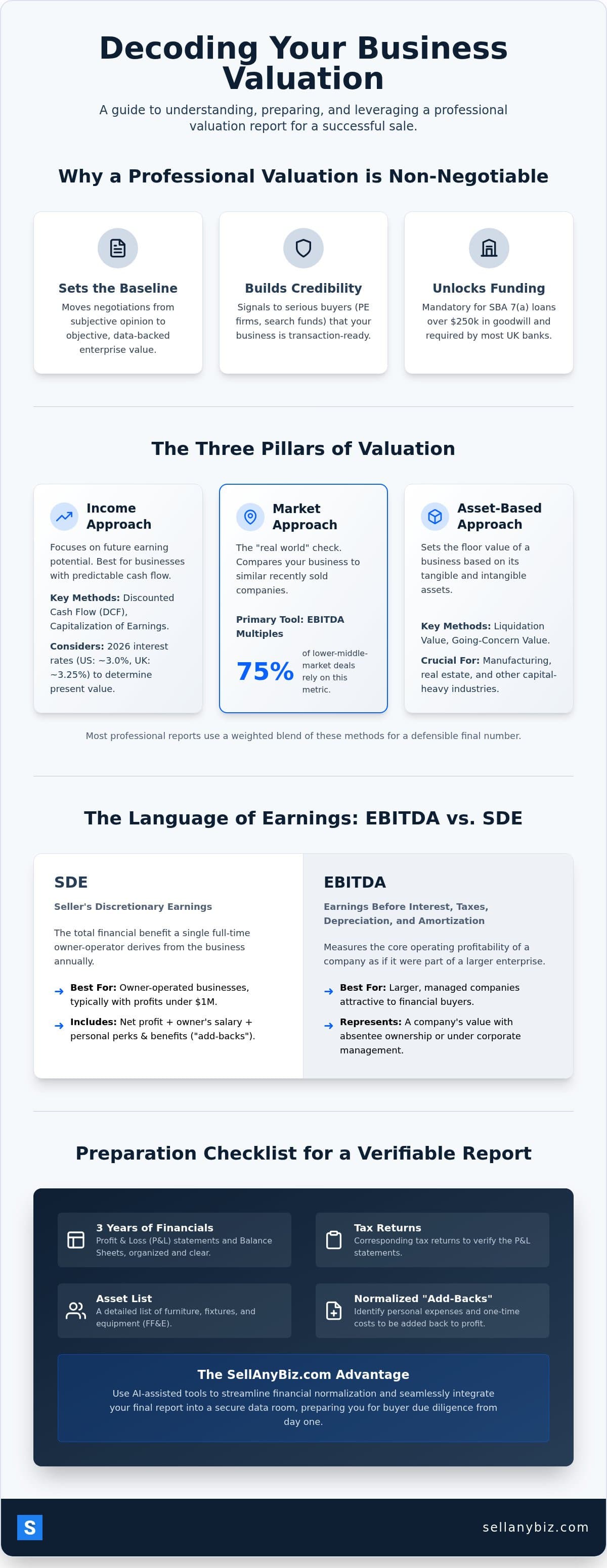
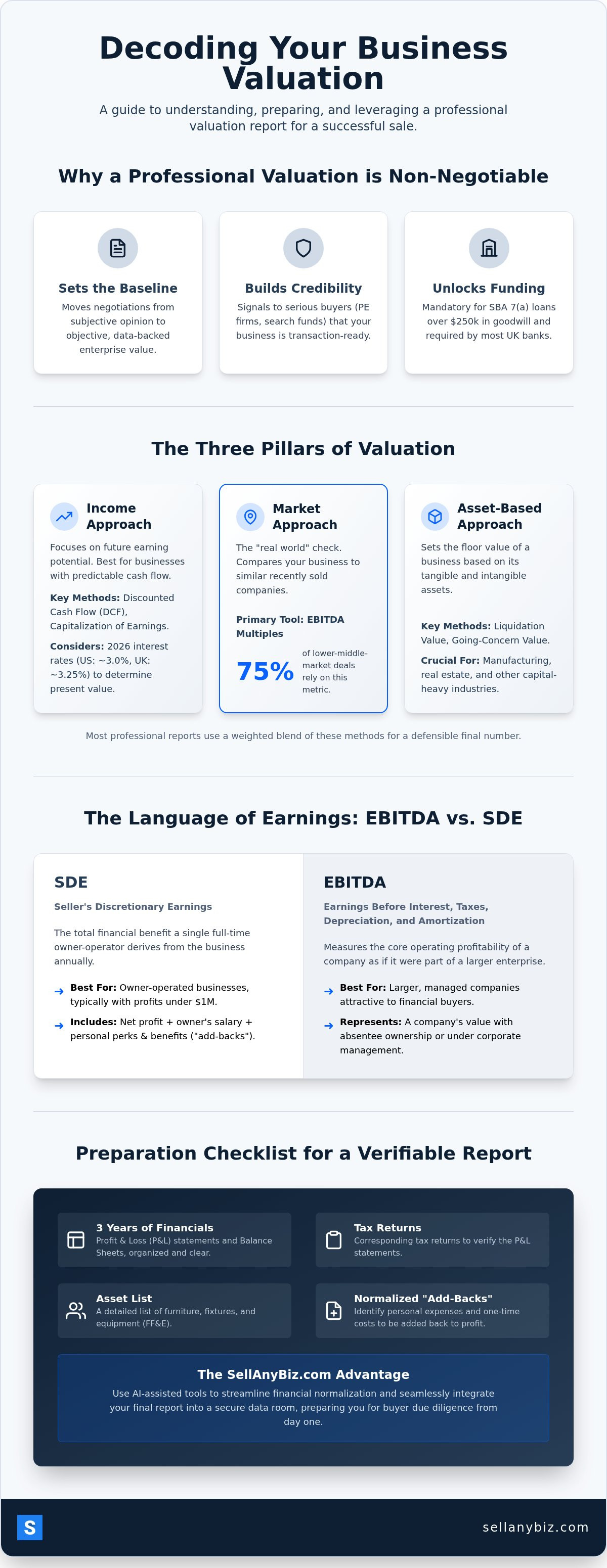
A professional business valuation report acts as the baseline for every serious negotiation. It moves the conversation from subjective gut feelings to objective enterprise value. In the 2026 market, buyers are cautious. They prioritize predictability over raw profit. A structured report signals that a business is transaction-ready. It builds immediate credibility. It creates a psychological advantage. When a seller presents verified data, acquisition intent increases. The friction of the price gap begins to close.
When Do You Need a Formal Report?
Preparation is everything. Exit planning often requires a report 18 months before a listing goes live. This allows time to address value killers like owner dependency. Formal reports are also essential for partner buyouts or internal equity restructuring. If you're targeting private equity or search funds, a report is mandatory. These buyers rely on standardized business valuation methodologies to compare opportunities across their deal flow.
Lenders also drive the need for formal documentation. For US-based SBA 7(a) loans, an independent valuation is mandatory if the goodwill or intangible asset portion of the loan exceeds $250,000. This is governed by SBA SOP 50 10 8. In the UK, high-street banks require similar rigor to justify acquisition funding. Without this document, the deal stops at the bank's desk.
The Difference Between a Valuation and an Appraisal
Terminology matters in M&A. A Broker Opinion of Value (BOV) is often sufficient for testing the market or setting an initial price. It's a fast, efficient tool for discovery before creating business listings. A certified appraisal is more formal. It's usually required for tax compliance, litigation, or complex estate planning. It follows strict standards that a BOV might skip.
During due diligence, the weight of a certified valuation is significant. It provides a structured defense against aggressive buyer re-trading. While a BOV starts the conversation, the business valuation report finishes it. It provides the roadmap for the LOI and the final purchase agreement. It's the difference between a guess and a deal.
Standard Methodologies: How Professional Reports Determine Value
A professional business valuation report relies on three core pillars: Income, Market, and Asset approaches. It's rarely a single formula. It's a synthesis of data. Professional analysts weigh these methods based on the business's size, industry, and maturity. They look for the most defensible number.
The Income Approach focuses on future potential. Discounted Cash Flow (DCF) projects future earnings and discounts them back to present value using a specific rate. With 2026 interest rates stabilizing around 3.0% in the US and 3.25% in the UK, these calculations are more predictable than in previous years. Capitalization of earnings, however, looks backward. It assumes historical performance is the best indicator of future health. It's the standard for stable, mature companies.
The Market Approach is the "real world" check. It compares your company to similar businesses that sold recently. This method is highly effective for active business listings because it reflects actual buyer behavior. Research shows the EBITDA multiple is used in over 75% of transactions in the lower middle market. It's the language of the deal room.
The Asset-Based Approach sets the floor. Liquidation value assumes a fast sale of all physical assets. Going-concern value assumes the business continues to operate. While less common for service-based firms, it's vital for manufacturing or capital-heavy industries. Most professional reports don't just pick one method. They blend them. A firm might apply 70% weight to the market approach and 30% to the income approach. This weighting depends on the data required for a verifiable report and the specific goals of the transaction.
Earnings Multiples: EBITDA vs. SDE
SDE is for owner-operators. It includes the owner's salary and perks. It's the standard for businesses making under $1M in profit. EBITDA is for larger, managed companies. It measures core operating profitability. EBITDA represents a company's operating performance by excluding non-operating expenses and non-cash accounting entries. Understanding which one applies to your business valuation report is critical for setting a credible price.
Industry-Specific Valuation Drivers
Retail value lives in the inventory and lease terms. Location is a primary driver. Healthcare relies on recurring patient revenue and "goodwill." Technology valuations are different. They prioritize IP and scalable growth over immediate profit. Each industry has a unique "value lever." A professional report identifies that lever and pulls it. You can browse verified opportunities to see how these industry drivers influence asking prices in today's market.
AI-Assisted Accuracy vs. Traditional Appraisal Models
The gap between traditional appraisal and digital valuation is closing. Traditional appraisal firms often charge upwards of $5,000 for a single document. These processes frequently take weeks. They rely on manual data entry and static spreadsheets. In contrast, AI-powered platforms offer speed, structure, and lower costs. The choice depends on the complexity of the deal and the required level of certification. For most market-based transactions, the digital approach provides the necessary rigor without the traditional price tag.
Digital environments must prioritize security. Protecting sensitive financial data is non-negotiable. SellAnyBiz.com uses secure infrastructure to ensure confidentiality during the valuation phase. This data eventually moves into a secure data room for due diligence. It's a structured progression from raw data to a closed deal. This workflow minimizes the risk of data leaks that can derail a sensitive transaction.
The Evolution of Valuation Builder Technology
Modern tools do more than calculate numbers. They normalize financials. Bookkeeping is often messy. Personal expenses and one-time costs cloud the true enterprise value. AI-assisted builders identify these anomalies. They automate the cleanup. This reduces human error in complex financial modeling and ensures the business valuation report is built on a clean foundation.
Market multiples aren't static. They shift with interest rates and sector trends. Digital platforms provide real-time updates. They ensure your valuation reflects the current market rather than a six-month-old snapshot. While these models follow established IRS Business Valuation Guidelines, they execute the analysis in a fraction of the time. This speed allows owners to pivot their strategy based on live market conditions.
Why Human Expertise Still Drives the Close
AI has limits. It can't quantify brand reputation. It can't measure the value of a loyal team culture. These "soft" assets often command a premium in a competitive market. Human judgment is required to adjust for these qualitative factors. A machine sees the data; a professional sees the story behind the data.
Negotiation is a human endeavor. A buyer might offer a higher multiple based on strategic synergy. An AI won't see that potential match. Professional advisors use the business valuation report as a starting point. They interpret the data to defend the price and handle the friction of the deal room. SellAnyBiz.com combines these two worlds to offer a complete solution.
- AI Builder efficiency for document preparation
- Structured data for investor credibility
- Professional advisor support for the final close
This hybrid approach ensures accuracy without sacrificing the nuance of the deal. It provides a roadmap for improving value before the sale. Visit SellAnyBiz.com to see how the platform balances technology with transaction expertise.
Preparation Checklist: Data Required for a Verifiable Report
Verification requires precision. A business valuation report is not a creative exercise; it is a forensic one. Credibility depends on the quality of the underlying data. Buyers look for clean numbers. Investors seek transparency. Financial hygiene before the process begins prevents deal fatigue during due diligence. It ensures the listing price is defensible from day one.
Gather the following essentials before starting the valuation:
- Three years of Profit & Loss (P&L) statements.
- Three years of Balance Sheets.
- Federal and local tax returns for the same period.
- Current year-to-date (YTD) financial statements.
- Aged Accounts Receivable and Payable reports.
Legal documentation is equally vital. Leases, key employee contracts, and Intellectual Property (IP) registrations must be organized. If a buyer discovers a month-to-month lease where a five-year term was expected, the valuation collapses. Structure these documents early to maintain momentum.
Normalizing Your Financials
Normalize the earnings to show the true profit potential. This involves identifying "add-backs." These are expenses that won't carry over to a new owner. Common examples include owner salaries above market rate, personal vehicle leases, and one-time legal fees. High-quality add-backs increase the SDE or EBITDA. They directly boost the final enterprise value in your business valuation report.
Poor record-keeping is a major red flag. Inconsistent margins or undocumented cash income will decrease value during due diligence. It signals risk. Professional buyers often penalize risk with lower multiples. You might require a Pre-sale bookkeeping Birmingham service to ensure your records are transaction-ready before engaging with buyers.
The Role of the Information Memorandum
The valuation report is the foundation. The Information Memorandum (IM) is the narrative. A strong IM explains the story behind the numbers. It describes market positioning, growth opportunities, and the strength of the management team. It turns a static financial document into a compelling investment case. It bridges the gap between raw data and acquisition intent.
SellAnyBiz.com provides the infrastructure to bridge this gap. The SellAnyBiz.com AI Builder assists in generating these transaction documents. It organizes your financial inputs into a structured, professional format. This ensures consistency between your valuation and your marketing materials. Once your data is verified, you can confidently create business listings that attract serious corporate buyers and private equity firms.
Leveraging SellAnyBiz.com for Transaction-Ready Reports
A static PDF is a liability in a fast-moving deal. SellAnyBiz.com treats the business valuation report as a strategic tool rather than a final destination. The platform integrates valuation directly into the transaction workflow. This connectivity bridges the gap between financial analysis and a successful close. It ensures your data remains useful throughout the entire lifecycle of the sale.
The SellAnyBiz.com Valuation Builder is the starting point. It organizes complex inputs. It structures assumptions. It provides the clarity needed to defend a listing price. Because it lives within the SellAnyBiz.com Individual Buyer and Seller Workspace, the data is never isolated. It feeds directly into the marketing phase. This allows you to create business listings that are backed by verified financial logic.
Security is handled through role-based access. Sellers control who sees what. This protection is vital when moving from a report to a Secure Data Room. Due diligence becomes a managed process rather than a chaotic exchange of emails. You decide when a buyer has earned the right to see the granular details of your enterprise value.
From Report to Deal Management
Managing acquisition intent requires discipline. You need to track interest. You must protect confidentiality. SellAnyBiz.com handles the friction of the early stage. Digital NDAs are executed before sensitive details are released. This ensures only verified buyers access the full business valuation report. It protects your trade secrets while you search for the right match.
The platform supports collaboration. Invite your lawyer. Add your accountant. They work in the same environment. They organize due diligence documents. They review deal stages. They track tasks. This structure keeps the transaction moving toward completion. It reduces the risk of deal fatigue. It ensures everyone is looking at the same version of the truth.
Winning Mandates with Professional Materials
Brokers use these tools to win more listings. Professional materials signal expertise. They show that an advisor has a structured, modern process. Search funds and private equity firms require this level of detail. They won't engage with poorly prepared deals. High-quality reports pass their scrutiny. They build the credibility needed to move forward in a competitive market.
SellAnyBiz.com provides the infrastructure for this professional delivery. It helps advisors match opportunities with the right buyers. It tracks the deal from initial engagement to the final signature. It turns a complicated process into a repeatable success. Create your free SellAnyBiz.com workspace today.
Securing Your Enterprise Value
A professional business valuation report is more than a calculation. It's the foundation of your entire negotiation strategy. You've seen how standard methodologies like EBITDA multiples and DCF models provide a defensible baseline for listing. You understand that normalization and financial hygiene are non-negotiable for attracting serious buyers. In the 2026 market, successful transactions require speed and data-backed credibility.
The SellAnyBiz.com platform provides the AI-powered accuracy needed to streamline this complex process. M&A advisors, family offices, and private equity firms use these tools to ensure reports pass rigorous due diligence. It's a complete end-to-end deal management solution. It protects your sensitive data while moving you methodically toward a close. This structure reduces friction and builds the trust necessary for a high-stakes transaction.
Start your business valuation with SellAnyBiz.com to organize your transaction materials and connect with qualified buyers. You have the roadmap. Now, take the first step toward a successful exit.
Frequently Asked Questions
How much does a professional business valuation report cost?
Industry costs for a valuation vary by firm size and deal complexity. Traditional M&A firms in London or New York often charge high upfront fees. SellAnyBiz.com utilizes a fixed-fee professional advisory model for administrative tasks. This provides transparency for mid-market owners. Fees generally cover the operational costs of normalizing bookkeeping and preparing the business for the due diligence phase.
How long does it take to generate a valuation report?
A traditional appraisal often takes three to four weeks. Modern technology speeds up this timeline. The SellAnyBiz.com Valuation Builder organizes your financial inputs into professional outputs quickly. The duration depends on how fast you provide clean P&L statements and balance sheets. Once the data is uploaded, the AI Builder generates the report structure. A human advisor then reviews the findings to ensure they are transaction-ready.
Can I use an online calculator for a formal business sale?
Online calculators provide a useful starting point for discovery. They don't suffice for a formal sale. A professional business valuation report requires a deeper analysis of market anomalies and soft assets. Professional buyers in Dubai or Milan require structured documentation to secure funding. Calculators often ignore industry-specific drivers and the normalization of personal expenses. These gaps can lead to significant undervaluing during due diligence.
What is the difference between Enterprise Value and Equity Value?
Enterprise Value (EV) represents the total value of the company's operations. It includes both debt and cash. Equity Value is the portion of that total value belonging to the shareholders. In transactions across London or New York, the Enterprise Value is the headline figure. The final cash received at close is adjusted for net debt. Understanding this distinction is vital for interpreting your financial documents correctly.
Does a valuation report expire?
A report remains valid as long as the underlying financial data and market conditions stay consistent. Most M&A advisors in the UAE or UK consider a valuation stale after six months. Significant changes in interest rates or local tax regulations can impact your enterprise value. If your company experiences a major shift in revenue or customer concentration, you should update your report. Fresh data builds more credibility with investors.
How do I know if a business valuation report is accurate?
Accuracy depends on the defensibility of the inputs. A verifiable report must align with current market multiples and historical performance. It should use a weighted average of multiple methodologies, such as the Income and Market approaches. Professional advisors and search funds look for reports that normalize financials and identify one-time costs. Accuracy is confirmed when your data withstands the scrutiny of a buyer's due diligence team.
What documents do I need to prepare for a business valuation?
Preparation starts with three years of Profit & Loss statements and Balance Sheets. You also need federal tax returns and current year-to-date financials. Organize your lease agreements, IP registrations, and key employee contracts. Having these materials ready in a Secure Data Room prevents deal fatigue. Financial hygiene is the foundation of a credible business valuation report. It ensures you can defend your asking price during intense negotiations.
Why do different valuation methods give different results?
Each methodology examines value from a different perspective. The Income Approach focuses on future cash flow. The Asset-Based Approach looks at the liquidation or replacement value of physical items. The Market Approach compares your business to recent sales in cities like Milan or Houston. These values rarely match. A professional report synthesizes these figures to find a realistic range. The final transaction price often depends on the buyer's specific strategic synergies.
Disclaimer
Disclaimer: SellAnyBiz provides general business marketplace, brokerage and transaction-support information. Services may be subject to regional legal and regulatory requirements. Please review our Disclaimer & Compliance Notice for full details.