Business Valuation Report: A Strategic Guide for Owners
Also available in:Italiano

Most business owners view their company through the lens of sweat equity. A buyer only sees risk and return. This gap in perception is where many deals fail. You might feel uncertain about your true market value or worry about leaving money on the table. It's a common friction point in high-stakes transactions. If you're seeking an SBA 7(a) loan for a change of ownership in 2026, a formal business valuation report is mandatory if goodwill exceeds $250,000.
You deserve clarity. Interpreting EBITDA multiples and complex financial jargon is often frustrating. This guide explains how a professional business valuation report transforms raw data into a strategic narrative for a successful exit. You'll discover the essential structure of these reports. You'll gain the confidence to present your business to sophisticated buyers. We also provide a roadmap for improving your value before listing on SellAnyBiz.com. Preparation. Precision. A closed deal.
Key Takeaways
- Understand how a professional business valuation report transforms raw financial data into a credible narrative that justifies your asking price.
- Identify the core components of a professional report, from the executive summary to the deep-dive economic and industry analysis.
- Learn why financial cleanup and accurate bookkeeping are essential precursors to a high-quality valuation.
- Discover how vetted data reduces friction during negotiations and helps close the price gap between sellers and buyers.
- Explore how SellAnyBiz.com leverages AI precision to move your business from initial valuation to a secure, confidential listing.
Table of Contents
Defining the Business Valuation Report
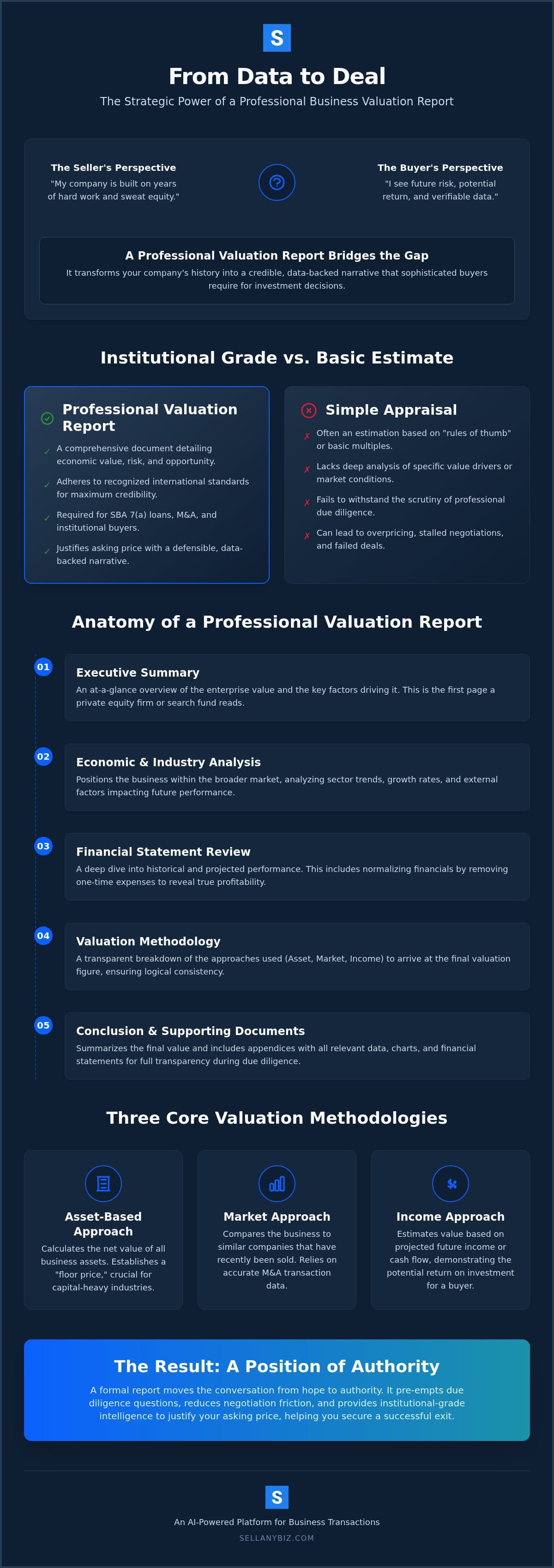
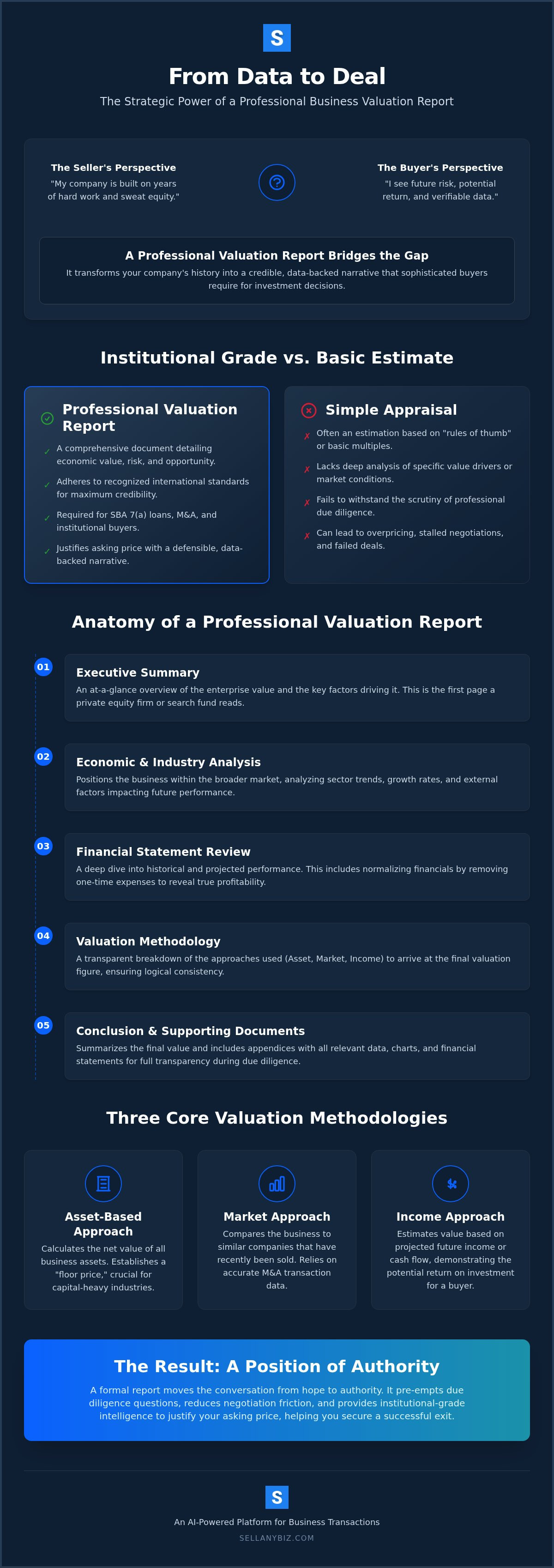
A Business valuation is more than a simple calculation. It's a formal document detailing the estimated economic value of a business entity. Think of it as the bridge between raw financial statements and a credible asking price. Raw data alone doesn't tell a story. A business valuation report translates that data into a narrative of risk, opportunity, and market position. In mid-market transactions, this document is essential. Professional buyers and acquisition teams require rigorous proof of value before they issue an LOI.
This report provides a defensive posture during due diligence. It pre-empts buyer questions by addressing potential red flags upfront. If your financial records are disorganized, the valuation process forces a necessary correction. We often see that financial cleanup services directly impact the quality of the final report. By presenting a structured, data-backed value, you move from a position of hope to a position of authority. You aren't just asking for a price; you're justifying it with institutional-grade intelligence.
The Purpose of a Formal Valuation
A formal valuation serves several critical functions in the transaction ecosystem. It facilitates a confidential business sale by establishing a realistic price floor. This prevents the common mistake of overpricing, which can stall deal flow for months. Buyers also rely on these reports to support acquisition funding requests. Lenders, especially those processing SBA 7(a) loans, demand professional valuations to mitigate their risk. Beyond the sale, these reports are vital for partnership buyouts, estate planning, and tax compliance. They provide a defensible figure that stands up to scrutiny from courts and tax authorities.
Report vs. Simple Appraisal
Simple appraisals often rely on "rules of thumb" or basic EBITDA multiples. These estimations usually fail in professional deal-making. They don't account for specific value drivers like proprietary technology, recurring revenue contracts, or a diversified client base. A formal business valuation report adheres to recognized standards. This standardization is vital for international transactions. Investors in the UAE, UK, and USA look for reports that follow a consistent logic. This consistency builds immediate credibility. It signals that your business is ready for the rigors of a modern deal room. You can browse current confidential business listings to see how professional positioning impacts market reception. A formal report proves the business is an asset, not just a job.
The Anatomy of a Professional Business Valuation Report
A professional business valuation report is a structured, technical document designed for scrutiny. It begins with the executive summary. This section provides an at-a-glance view of the enterprise value and the primary drivers behind it. It's the first page a private equity firm or a search fund will read. Following this, the report provides an economic and industry analysis. This positions your business within the broader market. Buyers don't invest in a vacuum. They need to see how external factors like interest rate shifts or sector-specific growth rates impact your operation. This strategic guide for owners emphasizes how these external benchmarks are vital for long-term growth and exit planning.
The heart of the document is the financial statement review. This is a deep dive into historical and projected performance. It doesn't just list numbers; it normalizes them. This is where financial cleanup services prove their worth. By stripping away one-time expenses or non-operating costs, the report reveals the true profitability of the operation. A transparent financial history builds immediate trust in the deal room. It eliminates the friction that often kills transactions during due diligence.
Key Financial Metrics Included
Professional reports focus on EBITDA and SDE. These metrics demonstrate core earnings power. EBITDA is the standard for mid-market M&A, while SDE is often used for owner-operated businesses. A balance sheet analysis follows. It assesses tangible assets like equipment and inventory alongside intangible assets like proprietary software or customer contracts. Finally, cash flow projections are essential. They demonstrate the future ROI for the buyer. Without clear projections, a buyer cannot model their debt service or return on equity. This level of detail is what separates a serious seller from a casual one.
Methodology Breakdown
The methodology section explains the logic used to arrive at the final figure. It typically uses three primary approaches:
- Asset-based approach: This calculates the net value of what the business owns. It's the floor price for capital-heavy industries.
- Market approach: This compares the entity to similar recent sales. It relies on transaction data from priority markets like the UAE, UK, and USA.
- Income approach: This determines value based on future earning potential. It's the most persuasive method for profitable, scalable companies.
Understanding these methods helps you defend your asking price with confidence. You can see how these valuations translate into professional business listings that attract high-intent acquisition teams. Methodology isn't a guess. It's a formulaic application of logic that stands up to the most rigorous due diligence.
Why a Valuation Report is Your Strongest Negotiation Tool
Negotiating a business sale without a formal document is a tactical error. It leaves you defending a price based on intuition rather than evidence. A professional business valuation report eliminates the "price gap" between your expectations and a buyer's offer. It shifts the conversation from emotion to economics. When a buyer argues that your price is too high for the risk, the report provides the counter-narrative. You can justify a premium for "goodwill" or brand equity by pointing to the specific logic used to calculate those intangibles. This document doesn't just state a number; it defends it.
Vetted data speeds up deal flow. Sophisticated buyers, particularly those from private equity or corporate acquisition teams, won't move forward without verified intelligence. By providing a report upfront, you pre-empt the most common due diligence hurdles. You signal that your operation is transparent and professional. This methodology aligns with institutional standards, such as the IRS Business Valuation Guidelines, which ensure the logic used is defensible under high levels of scrutiny. You aren't just selling a business; you're selling a de-risked investment.
Building Buyer Trust
Transparency is a primary value driver in mid-market transactions. Buyers are naturally skeptical of seller-provided spreadsheets. A third-party business valuation report reduces this perceived acquisition risk. It acts as an independent verification of your earnings power. This trust extends beyond the buyer to their financial partners. If a buyer needs to secure Acquisition Funding Solutions, a professional report is often a prerequisite. Lenders are far more likely to approve a loan when the enterprise value is backed by a structured, professional analysis rather than a simple appraisal.
Identifying Value Drivers
The report is a strategic roadmap. It helps you use the valuation process to highlight hidden strengths, such as low customer concentration or high recurring revenue. Conversely, it pinpoints areas for improvement before you list your business on SellAnyBiz.com. If the report surfaces a weakness in your EBITDA margin, you have the chance to fix it before entering the deal room. Knowing your numbers is the first step toward increasing them. For a deeper look at the mechanics of this process, see our guide on how to value a business. Addressing these factors early ensures you don't leave money on the table when it's time to close.
The Process: From Data Collection to Final Intelligence
The transition from raw accounting to a professional business valuation report requires a methodical five-step workflow. It begins with comprehensive information gathering. We analyze three to five years of financial records, including tax returns, profit and loss statements, and balance sheets. This historical depth is necessary to identify trends and cyclical patterns. Once the data is secured, the process moves into financial cleanup. This "pre-valuation" phase is where many owners fail. Without it, your report will reflect accounting choices rather than economic reality.
Market research follows. Your business is compared against a peer group of similar entities within priority markets like the United States, the United Kingdom, and the United Arab Emirates. We then move to the draft review. This stage involves selecting the specific methodology, such as the income or market approach, that best captures your enterprise value. The final step is the delivery of a structured, institutional-grade valuation report. This document is ready for the scrutiny of private equity firms, search funds, and M&A advisors.
The Importance of Financial Cleanup
Messy books lead to lower valuations and deal fatigue. Buyers view disorganized records as a proxy for operational risk. Financial cleanup involves normalising earnings by removing one-time expenses, personal costs, and non-operating capital expenditures. This adjustment reveals the true earnings power of the company. It's about preparing for due diligence before the first buyer contact. A clean set of books doesn't just improve the valuation; it accelerates the entire deal flow by removing friction early in the transaction.
The Role of Modern Data Tools
Modern business valuation relies on AI to enhance the accuracy of market comparisons. Traditional reports often use historical industry averages that are outdated by the time they're published. Our platform uses real-time data to match your business against current transaction multiples and acquisition intent. This precision is vital in a shifting economic climate. A global network of advisors also helps in assessing cross-border value, ensuring your business is positioned correctly for international investors. This data-driven approach ensures your entity stands out when you are ready to browse confidential business listings and prepare your own market entry. High-quality intelligence is the only way to avoid leaving money on the table.
Leveraging SellAnyBiz for Your Business Valuation
SellAnyBiz.com is an AI-powered platform that helps business buyers, sellers, brokers, M&A advisors and acquisition teams discover opportunities, create professional transaction materials and manage deals from initial engagement through due diligence and completion. Our structured approach to the business valuation report bridges the gap between raw financial data and market-ready intelligence. We don't just provide a static number. We provide a strategic tool designed for high-stakes deal management. By combining AI precision with human advisory, we ensure your valuation reflects the true economic reality of your enterprise.
To help create these professional transaction materials, you can explore Sales of Digital Presentation and Dashboard Templates options from Biz Infographs to find high-quality visual tools that effectively communicate your company's value to potential buyers.
The platform offers seamless integration from the valuation phase to a confidential business listing. Once your report is finalized, the data can be used to populate your listing in the Individual Buyer and Seller Workspace. This saves time and reduces the risk of manual data entry errors. You move from analysis to market outreach in one motion. You also gain access to essential support services, including Bookkeeping & Financial Cleanup and Legal Support & Documentation, all within a single ecosystem. This comprehensive infrastructure is what separates a professional transaction from a frustrated attempt.
The SellAnyBiz Advantage
We focus on the mid-market sector. We understand the specific nuances of brick-and-mortar businesses that generic online calculators often ignore. Our global reach extends across priority markets in the United Kingdom, the United States, the United Arab Emirates, and Italy. This international perspective is vital for attracting cross-border acquisition intent. We maintain a success-based mindset. Every business valuation report we produce is aligned with your ultimate sale goals. We prepare your entity to meet the rigorous standards of our global pool of vetted buyers, search funds, and private equity firms.
Next Steps for Owners
Requesting your initial valuation is the first step toward a successful exit. You'll need to gather your records, including the three to five years of financial history mentioned in our process guide. Preparing this documentation early ensures a frictionless experience. Our platform provides secure data rooms to manage these sensitive files during the due diligence phase. Moving forward in the 2026 market requires a foundation of verified data. With a professional report, you can enter negotiations with confidence. You aren't just guessing your value; you're proving it to the market. Visit SellAnyBiz.com to begin your journey toward a structured, successful transaction.
Securing Your Exit Strategy
A professional business valuation report serves as the foundation for every successful transaction. It bridges the gap between your years of hard work and a buyer's acquisition capital. You've seen how financial cleanup and standardized methodology eliminate friction during due diligence. These steps turn raw numbers into a defensible asset. By positioning your business correctly, you avoid leaving money on the table. You gain a clear roadmap for improvement before the first NDA is even signed.
SellAnyBiz.com provides the essential infrastructure for this transition. Our platform combines AI-powered accuracy with the expertise of a global network of M&A advisors. We focus on the nuances of mid-market reality. We ensure your documentation meets the high expectations of sophisticated buyers in the UK, US, and UAE markets. Don't leave your legacy to chance or intuition. Start your journey with a platform trusted by mid-market sellers worldwide. Precise intelligence is your best defense against deal fatigue.
Get your professional business valuation report from SellAnyBiz and move forward with absolute certainty. Your successful exit is within reach.
Frequently Asked Questions
How long does it take to produce a business valuation report?
A professional business valuation report typically takes 7 to 14 business days to finalize. This timeline depends on the readiness of your financial documentation and the complexity of your operation. Mid-market entities with international footprints or multiple revenue streams may require additional analysis. Providing organized records during the initial intake phase ensures a faster turnaround and prevents delays in your deal flow.
Can I use a free online valuation tool instead of a formal report?
Free online tools provide a surface-level estimate but lack the technical depth required for professional M&A. They often rely on generic industry averages rather than your specific value drivers. Serious buyers and acquisition teams demand a formal business valuation report backed by verified data. A formal document stands up to the rigors of due diligence; a free estimate rarely survives professional scrutiny.
What documents do I need to provide for a business valuation?
You must provide three to five years of profit and loss statements, balance sheets, and tax returns. Detailed lists of tangible assets, proprietary software, and key customer contracts are also necessary. Accurate records are the foundation of a credible report. Organized data prevents deal fatigue and builds immediate trust with sophisticated buyers in the Individual Buyer and Seller Workspace.
How often should I update my business valuation report?
Owners should update their valuation annually or following any major shift in the business or broader economy. Market conditions in 2026 are dynamic. Interest rate fluctuations and industry-specific growth rates can change your enterprise value in a single quarter. Keeping a current report ensures you're always ready to respond to unexpected acquisition intent with institutional-grade intelligence.
Will a valuation report guarantee my business sells at that price?
A report provides a defensible benchmark but doesn't guarantee a final sale price. The market ultimately dictates the value based on buyer demand and current competition. However, a structured valuation acts as your strongest negotiation tool. It justifies your asking price with logic. It helps close the gap between your expectations and a buyer's offer by proving the underlying earnings power.
Is the information in a business valuation report kept confidential?
Confidentiality is a core component of the valuation process. All sensitive financial data is protected by a strict NDA and managed within secure data rooms. SellAnyBiz.com uses institutional-grade security to ensure your proprietary information remains private throughout the transaction. Only verified stakeholders with authorized access can view the specific details of your transaction materials.
Disclaimer
Disclaimer: SellAnyBiz provides general business marketplace, brokerage and transaction-support information. Services may be subject to regional legal and regulatory requirements. Please review our Disclaimer & Compliance Notice for full details.