Buying a Business in London: A Practical Buyer’s Guide
Also available in:Italiano

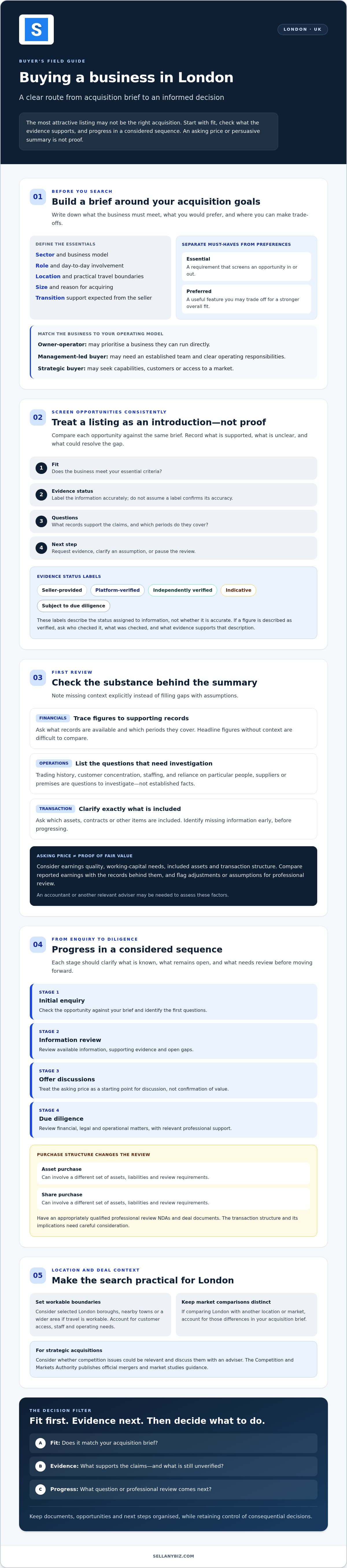
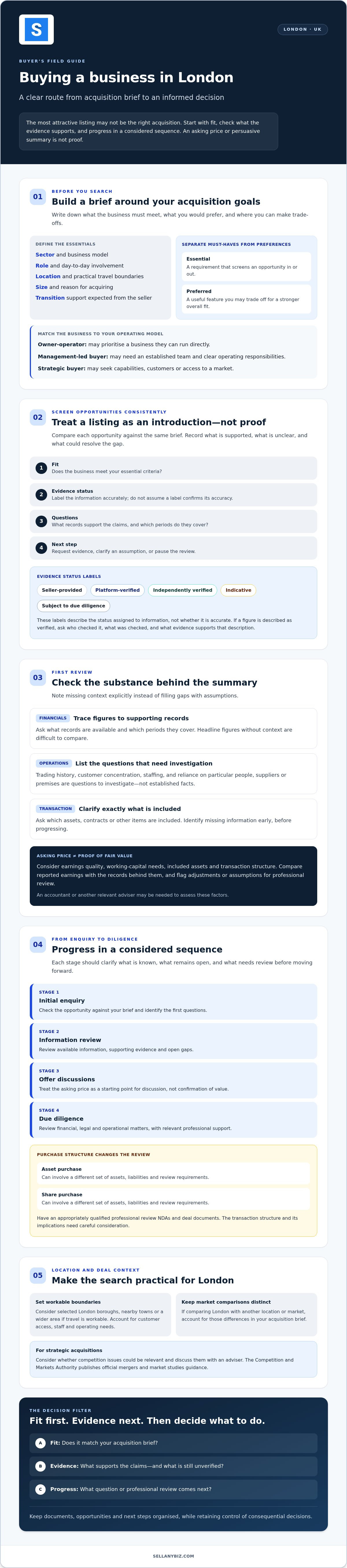
The most attractive listing may not be the right acquisition. When buying a business in London, a clear fit with your experience, capital and operating goals matters more than an asking price or a persuasive summary. Listings can help you find opportunities, but they rarely provide enough evidence to compare them confidently.
It’s reasonable to want a practical way to separate seller-provided claims from information that has been checked. A disciplined process helps you decide which opportunities merit more time, what needs verification and when to bring in professional support.
This guide shows you how to define a realistic acquisition brief, assess London businesses consistently and progress towards an offer. It also outlines common UK transaction stages, including financial, legal and operational due diligence, and explains why choosing between an asset purchase and a share purchase can affect the work required. The aim is a clearer route from initial search to an informed decision, without treating a listing or asking price as proof.
Key Takeaways
- Set clear essentials for sector, role, location, size and acquisition purpose before searching for opportunities in London.
- When buying a business in London, compare each listing against your brief and distinguish seller-provided claims from information that has been independently verified.
- Move from initial enquiry to information review, offer discussions and due diligence in a considered sequence. Have an appropriately qualified professional review NDAs and deal documents.
- Use connected search and deal tools to organise opportunities, documents and next steps, while keeping consequential decisions under your control.
Table of Contents
How to define your brief before buying a business in London
Before browsing, define your target sector, intended role, practical location, preferred business size and reason for acquiring. An acquisition brief is a written set of criteria for screening opportunities against your commercial goals. Separate essentials from preferences, including your desired day-to-day involvement and the transition support you would expect from the seller.
Which London business suits your acquisition profile?
An owner-operator may prioritise a business they can run directly. A management-led buyer may need an established team and clear operating responsibilities. A strategic buyer may be seeking capabilities, customers or access to a market. These are different objectives, so don’t assume a listing fits your operating model just because its sector or asking price looks attractive. Similarly, for prospective owners evaluating structured food-service models alongside independent acquisitions, exploring Own a Russo's New York Pizzeria & Italian Franchise - Pizza Franchise Opportunity offers insight into how franchise systems align with specific operational and growth criteria.
Set practical location boundaries around customer access, staff and operating needs. Your search might cover selected London boroughs, nearby towns or a wider area if travel is workable. If you are comparing London with opportunities in Dubai, Abu Dhabi, Sharjah, Ajman, Manchester, Birmingham, Leeds, Liverpool, Glasgow, Edinburgh, New York, Los Angeles, Chicago, Miami, Dallas, Houston, Milan, Rome, Turin, Naples or Bologna, account for the different locations and markets in your brief. For strategic acquisitions, consider whether competition issues could be relevant and discuss them with an adviser. The Competition and Markets Authority publishes official mergers and market studies guidance.
How should you turn your criteria into a search?
Rank your priorities before applying marketplace filters: sector and business model first, then size and location. Mark each as essential or preferred. For example, you might require a service business but remain flexible on borough, or prefer an existing management team while considering a hands-on role if the opportunity otherwise fits.
Record acceptable trade-offs and the questions each one raises. If you are flexible on location, for instance, decide how far you could travel and whether the business’s customers and staff need to be nearby. This makes comparisons more consistent and helps prevent arbitrary rejections. Use business listings for sale to discover opportunities, then assess each against your brief rather than treating search results as recommendations.
How to assess London business listings before making an offer
Compare each opportunity against your acquisition brief before investing time in negotiations. A listing is an introduction, not a substitute for buyer due diligence. Record what the information supports, what remains unclear and what action would resolve each gap. A simple comparison record can help you apply the same standard to every opportunity:
- Fit: Does the business meet your essential criteria?
- Evidence: Is the information seller-provided, platform-verified, independently verified, indicative or subject to due diligence?
- Questions: What records support the claims, and which periods do they cover?
- Next action: Request evidence, clarify an assumption or pause the review.
These labels describe the status you assign to information, not its accuracy. Don’t treat a platform label or an attractive listing summary as independent confirmation. If a figure is described as verified, ask who checked it, what was checked and what evidence supports that description.
What should buyers check in the first review?
For financial figures, ask whether supporting records are available and which periods they cover. Headline figures without context are difficult to compare. Trading history, customer concentration, staffing and reliance on particular people, suppliers or premises are questions to investigate, not established facts. Note gaps explicitly rather than filling them with assumptions.
Clarify what the proposed transaction includes. An asset purchase and a share purchase can involve different assets, liabilities and review requirements. Ask which assets, contracts or other items are included, and identify missing information early so material gaps can be addressed before you progress. The British Business Bank’s due diligence checklist can help organise further enquiries.
How can you assess value without over-relying on an asking price?
An asking price is a starting point for discussion, not proof of fair value. Consider earnings quality, working-capital needs, included assets and transaction structure. For example, compare a reported earnings figure with the records behind it, then list any adjustments or assumptions that need professional review. These factors need evidence and may require input from an accountant or another relevant adviser. Consult a dedicated London valuation guide for a deeper explanation of valuation methods.
Apply the same review method to each opportunity in business listings for sale. Consistent records help distinguish an appealing summary from an opportunity supported by evidence, an important discipline in buying a business in London.
What happens after finding a business to buy in London?
After identifying a suitable opportunity, progress in stages: make an initial enquiry, agree confidentiality arrangements where appropriate, review available information, discuss offer terms and begin due diligence. The sequence can vary by transaction. An NDA, or non-disclosure agreement, and any offer or transaction documents should be reviewed by an appropriately qualified solicitor. This guidance is not legal advice.
Which documents and advisers may be involved?
Depending on the business and proposed deal, information for review may include accounts, management records, contracts and operational details. Ask what records exist, what periods they cover and which points remain unsubstantiated. A solicitor can advise on legal documents and transaction structure. An accountant can examine financial information and related questions. Other advisers may be relevant to specific operational or commercial issues; for instance, to evaluate commercial energy contracts and ongoing overheads, check out Easy2switch UK Ltd.
In the UK, clarify whether discussions concern an asset purchase or a share purchase. The structures differ, so ask your professional advisers to assess the implications for the specific transaction. For company information, consult current Companies House guidance; for tax matters, check current HMRC guidance. Requirements and implications depend on the facts of the deal.
How should you manage due diligence and offer decisions?
Keep a question log as information arrives. For each issue, record the question, who is responsible for resolving it, what evidence has been requested, the response received and any unresolved risk. For example, if a financial figure needs support, note the relevant record requested and whether the response addresses the period in question. This makes gaps visible and gives advisers a clear basis for review.
Use findings to test the assumptions behind your offer. If records differ from what was initially described, pause to understand the reason and seek professional advice on material issues before deciding how to proceed. A platform can help organise documents and deal activity, but it doesn’t replace independent due diligence or professional judgement.
As you continue buying a business in London, keep your shortlist and next steps organised. Review business listings as you refine your acquisition search.
How SellAnyBiz can organise your London business search
SellAnyBiz combines opportunity discovery with buyer workspaces and deal-execution tools. For buyers in London, this provides a way to organise a search and the transaction activity that follows, while keeping decisions and next steps under your control. The platform brings listings, search, documents, data rooms and deal management into a connected workflow.
What can a buyer organise in one workspace?
AI Smart Search lets you describe the opportunity you’re looking for in natural language and use intelligent filters to refine results. SellAnyBiz Workspaces provide role-based operating environments, while Deal Management supports stages, checklists, tasks, documents, approvals, Q&A and activity history. These tools can help you keep opportunity information and transaction activity organised as your search develops.
Document Builder supports the creation of transaction materials, and Secure Data Rooms provide permission-controlled access to documents after NDA approval. Review access and confidentiality arrangements with the relevant parties and advisers. AI can assist with preparation and workflow, but it does not replace human judgement or professional review. When you’re ready to explore opportunities, browse business opportunities.
What is the next practical action for a London buyer?
Prepare a concise brief covering your target sector, preferred locations, intended operating role and evidence requirements. Separate firm requirements from preferences. Add any deal-breakers, such as a location you cannot reach regularly or an operating role that does not suit your plans. This gives you a consistent basis for comparing opportunities and deciding which questions to raise.
Use the brief to guide discovery and organise follow-up as your search develops. Build my acquisition brief to set a clear direction for your next steps.
Turn your London acquisition criteria into a focused search
A disciplined approach to buying a business in London starts with a brief that reflects your sector, operating role and practical location boundaries. Use it to compare opportunities consistently, distinguish seller-provided claims from independently verified evidence, and identify questions that need answers before you progress.
Keep that discipline as the process moves forward. An asking price isn’t proof of value, and a listing isn’t a substitute for independent due diligence. Professional advisers can help assess transaction structure, financial information and material risks.
SellAnyBiz connects opportunity discovery with deal activity. AI Smart Search supports natural-language searches with intelligent filters, while buyer workspaces connect opportunities with documents, data rooms and deal management. AI assistance can help organise next steps, but your review and professional judgement remain central.
Start with clear criteria, then refine them as you learn more. Build my acquisition brief and use it to guide your search.
Frequently Asked Questions
How do I start buying a business in London?
Start with a written acquisition brief covering your target sector, location boundaries, purpose, operating role and evidence requirements. Use it to screen opportunities before making enquiries, including whether a business in central London or another part of the city fits your practical needs. For each listing, identify which information is seller-provided and what evidence you still need. Seek appropriate professional advice before making binding decisions.
What should I check before making an offer on a London business?
Check whether financial figures have supporting records and clarify the periods they cover. Understand how the business operates, then investigate potential dependencies, such as a key customer, supplier or member of staff. Confirm what the proposed transaction includes and record unanswered questions. An asking price does not establish fair value. Ask qualified advisers to review material financial, legal and operational issues before you commit.
What is the difference between an asset purchase and a share purchase in the UK?
Broadly, an asset purchase concerns selected business assets, while a share purchase concerns shares in the company that owns the business. The legal, financial and tax consequences depend on the company, documents and transaction terms. Neither structure is automatically preferable. Before proceeding, ask a UK solicitor and accountant to assess the proposed structure, liabilities and tax implications for your circumstances.
Do I need a solicitor and accountant to buy a business in London?
Solicitors and accountants can provide relevant support, though the advisers you need depend on the opportunity and proposed transaction structure. A solicitor can review legal documents and contractual issues; an accountant can examine financial information and relevant tax questions. Confirm each adviser’s scope and ask them to review matters within their expertise. A platform or broker can support the process but doesn’t replace independent professional advice.
How can I find businesses for sale in London?
Search business-for-sale marketplaces and broker networks, then screen opportunities against a written acquisition brief. Check the location, sector and information available before investing time in an enquiry. SellAnyBiz combines opportunity discovery with buyer workspaces and deal tools, including AI Smart Search and tools to organise documents and deal stages. Confirm current listing availability and assess information through due diligence; a listing alone doesn’t verify its claims.
Disclaimer
Disclaimer: SellAnyBiz provides general business marketplace, brokerage and transaction-support information. Services may be subject to regional legal and regulatory requirements. Please review our Disclaimer & Compliance Notice for full details.