How to Sell a Business: Strategic 2026 Exit Guide

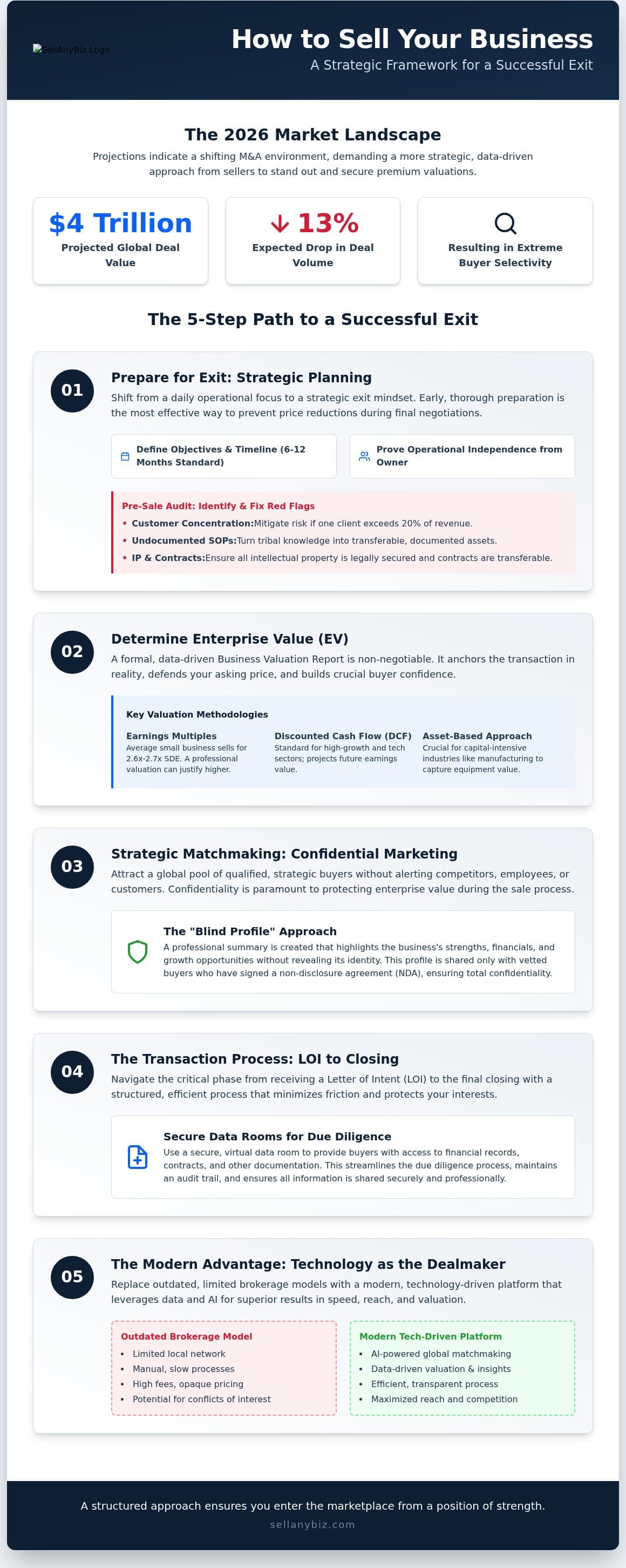
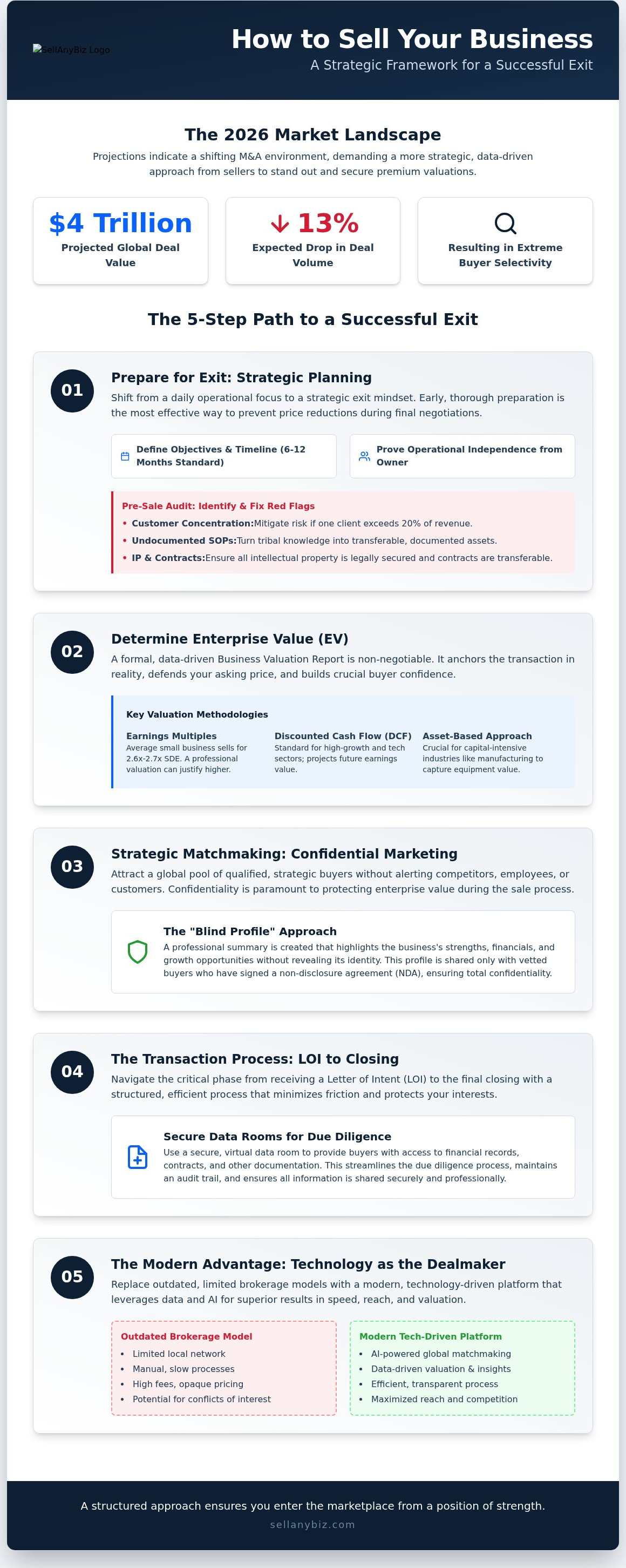
Global deal value is projected to hit $4 trillion in 2026. Total deal volume is expected to drop by 13 percent. This gap signals a market defined by extreme buyer selectivity. Knowing how to sell a business in this climate requires more than a simple listing. It requires a structured, data-driven strategy. You've built an enterprise with real value. You deserve an exit that reflects it.
The path to divestment is often stalled by deal fatigue and unqualified buyers. Information leaks to competitors can compromise years of growth. We understand the friction. This guide provides a professional framework for navigating the complexities of your exit with confidence. You'll discover how to secure an accurate valuation, maintain strict confidentiality, and maximize enterprise value. We'll map the transition from initial preparation to the final close. A clean, efficient transaction is the goal. A smooth transition for your employees and customers is the priority.
Key Takeaways
- Shift from an operational focus to a strategic exit mindset. Early preparation prevents price re-trading during final negotiations.
- Establish a firm foundation with a professional Business Valuation Report. Accurate Enterprise Value is essential for a successful close.
- Protect your brand with a "Blind Profile." Attract qualified buyers while maintaining total confidentiality throughout the process.
- Master the transition from Letter of Intent to final closing. Use secure data rooms to manage due diligence efficiently.
- Learn how to sell a business using modern matchmaking. Replace outdated brokerage models with AI-driven speed and global reach.
Table of Contents
- Preparing for Exit: Why Strategic Planning Dictates Sale Price
- Determining Enterprise Value: The Foundation of the Deal
- Strategic Matchmaking: Marketing Without Compromising Confidentiality
- The Transaction Process: From LOI to Successful Closing
- The Modern Brokerage: Why Technology is the New Dealmaker
Preparing for Exit: Why Strategic Planning Dictates Sale Price
Selling a business is not an operational task. It's a strategic transaction. This shift from daily management to high-level positioning is the first step in learning how to sell a business for its maximum potential. Preparation is the antidote to deal friction. It stops "re-trading" before it begins. Clean records. Secure contracts. Verified data. When a buyer discovers undocumented risks during due diligence, the offer price often drops. Avoid this by cleaning the house early.
Strategic planning dictates the final number on the check. You must identify your ideal buyer profile before the business ever hits the market. Are you targeting a strategic competitor looking for market share? Or perhaps a private equity firm seeking a platform company? Each buyer type values different assets. Knowing your target allows you to highlight the specific metrics they care about most. Early preparation is the foundation of how to sell a business with confidence.
Defining Your Objectives and Timeline
Clarify your goals. Some owners want the highest possible cash exit at the closing table. Others prioritize the long-term legacy of the brand or the job security of their staff. Establish a realistic horizon. A 6 to 12 month timeline is standard. It provides the necessary runway for financial cleanup and tax planning. This period is also critical for preparing your management team. They must prove the business can thrive without your daily involvement. Professional mergers and acquisitions (M&A) processes rely on this operational independence. If you are the business, the business has less value.
The Pre-Sale Audit: Identifying Operational Red Flags
Buyers look for reasons to say no. They hunt for risks that justify a lower multiple. A pre-sale audit surfaces these red flags while you still have time to fix them. Focus on these core areas:
- Customer Concentration: If a single client represents more than 20 percent of your revenue, you have a concentration risk. Diversify your base or secure long-term, transferable contracts to mitigate this.
- Standard Operating Procedures (SOPs): Tribal knowledge is a liability. Documented systems are transferable assets. They guarantee the buyer that the machine keeps running after you leave.
- Intellectual Property: Ensure all trademarks, patents, and proprietary software are legally secured. Review change-of-control clauses in vendor and employment contracts.
Market timing also plays a role. Selling when the industry is peaking, rather than when you are burnt out, ensures a better outcome. A structured approach ensures you enter the marketplace from a position of strength. It protects your enterprise value and your peace of mind. Don't leave the final result to chance.
Determining Enterprise Value: The Foundation of the Deal
Enterprise Value (EV) is the anchor of your transaction. It represents the total value of the business, including all debt and equity. This is the actual cost a buyer pays to acquire the entity. Many owners make the mistake of using "rule of thumb" multiples. These are often broad or outdated. Every business has unique value drivers. A formal Business Valuation Report is non-negotiable for a professional exit. It moves the conversation from speculation to data-driven reality. This report provides the evidence needed to defend your price when an LOI arrives.
Clean financial records are the primary engine of buyer confidence. When a buyer sees organized data, they see lower risk. Lower risk leads to higher multiples. Learning how to sell a business effectively means understanding that your books are a marketing tool. They aren't just for the tax man. They're the proof of your success. If your records are messy, the buyer will assume the operations are messy too. They'll price the deal accordingly. Professional transparency is the fastest way to build trust.
Common Valuation Methodologies
Professional valuations use a blend of methods to find the right range. Discounted Cash Flow (DCF) is the standard for high-growth sectors. It calculates the present value of future earnings. It's complex but necessary for tech-heavy firms. Most mid-market owners focus on earnings multiples. In 2026, the average small business sells for approximately 2.6x to 2.7x its SDE. However, a data-driven assessment often surfaces hidden value that pushes you beyond these averages. Capital-intensive industries, like manufacturing, rely on an asset-based approach. This ensures equipment and inventory values are accurately captured. Using multiple lenses ensures no value is left on the table.
Financial Cleanup and Bookkeeping
The goal is to show the true earning power of the business. This requires normalizing your earnings through add-backs. Add-backs are expenses that won't continue under new ownership. Personal vehicle leases. Discretionary bonuses. One-time legal fees. These items are added back to the bottom line to show a "normalized" profit. Buyers expect to see at least three years of consistent tax returns and P&L statements. Consistency suggests stability. SellAnyBiz streamlines this via specialized bookkeeping for business sale. We identify red flags before the buyer does. If your financials need a professional review, our team can provide a pre-listing financial cleanup to ensure you are deal-ready. This is a critical step in how to sell a business without leaving money behind.
Strategic Matchmaking: Marketing Without Compromising Confidentiality
Marketing a business is a delicate paradox. You need maximum exposure to drive competition. You need absolute secrecy to protect your operations. If employees or competitors learn about the sale too early, value erodes. This is the central challenge in how to sell a business without destabilizing it. The solution is a structured, multi-stage disclosure process. It begins with broad, anonymous outreach and narrows down to verified, high-intent prospects.
The "Blind Profile" serves as your first point of contact. It is a high-level teaser. It summarizes your sector, geographical footprint, and key financial metrics like EBITDA or SDE. It does not name the company. It does not provide enough detail for a competitor to guess the identity. This document filters for interest while shielding the brand. Only after a buyer demonstrates clear acquisition intent and financial capability do you move to the next stage. This protects your market position while testing buyer appetite.
Vetting is about efficiency. The median time to close a small business sale in 2025 was 170 days. You cannot afford to spend months on unqualified prospects. We verify funds. We confirm industry experience. We separate the strategic buyers from the window shoppers. Strategic buyers often seek new technologies or market expansion. Financial buyers look for stable cash flow. Both are valuable; both must be vetted. A disciplined screening process ensures your time is spent only on deals likely to close.
The Role of the Non-Disclosure Agreement (NDA)
A standard NDA is a starting point, not a complete shield. For mid-market deals, the agreement must be specific. It must cover trade secrets, proprietary processes, and employee non-solicitation. Information flow should be staged. You don't hand over your customer list on day one. You release sensitive data in layers as the buyer's commitment increases. This protects your stability even if the deal fails to close. Confidentiality is not a single event; it is a sustained practice.
Leveraging AI-Powered Buyer Matching
Traditional brokerage relies on local rolodexes. Modern matchmaking uses smart automation to surface high-intent investors globally. AI-driven tools scan markets in the UK, US, and UAE to find the perfect match. This technology reduces "time-wasters" by analyzing historical acquisition behavior. It matches your specific profile with buyers who have a documented history of closing similar deals. This global reach is a fundamental part of how to sell a business in a selective market. Speed and precision are the new dealmakers.
The Transaction Process: From LOI to Successful Closing
The Letter of Intent (LOI) is the handshake that starts the clock. It outlines the purchase price, deal structure, and exclusivity period. While mostly non-binding, it sets the trajectory for the entire transaction. Discipline is vital here. Many owners lose focus once an LOI is signed. This is when the heavy lifting begins. Learning how to sell a business means staying disciplined during this phase. Mastering the process requires a steady hand through the final months of scrutiny.
Negotiations often hit a "valley of death" just before the finish line. Fatigue is real. Buyer queries become more invasive. Small disagreements can feel like deal-breakers. Stay focused on the enterprise value established in your initial valuation. The process is a marathon of details. The transition from an LOI to a signed Purchase and Sale Agreement (PSA) is a test of organizational endurance. Keep the momentum. A stalled deal is a dying deal.
Navigating Due Diligence Without Deal Fatigue
Due diligence is where deals go to die. The "Data Room" is your primary defense. It is a secure digital vault for your legal, financial, and operational records. Organize it before the LOI is signed. 2026 security standards require audited access logs and multi-factor authentication. Be proactive. If a buyer asks for a document you haven't prepared, you look disorganized. Disorganization invites price re-trading. Our Legal Support & Documentation experts ensure your data room is bulletproof and your disclosures are complete.
Understanding Deal Structure
Price is a vanity metric; structure is reality. You must decide between an asset sale and a stock sale. Buyers prefer asset sales. They can step-up the basis of assets for depreciation. Sellers usually prefer stock sales to access lower capital gains rates. In 2026, the effective top federal capital gains rate is 23.8 percent for high earners. Deal structure also involves how you get paid. Cash at closing is ideal. Earn-outs or seller financing might be necessary to bridge a valuation gap. Each carries different risks. Representations and warranties allocate that risk between you and the buyer. The wire transfer arrives. The business moves forward under new leadership.
The Modern Brokerage: Why Technology is the New Dealmaker
The traditional brokerage model is failing. It's too slow. It relies on local networks and manual outreach. In a market where global deal value is hitting $4 trillion but volume is dropping, efficiency is the only real advantage. Mid-market owners deserve better than a static listing. They need a platform that integrates legal, financial, and brokerage services into a single workflow. This is why technology has become the new dealmaker in how to sell a business. Speed is the currency of the 2026 market.
SellAnyBiz uses AI-driven matchmaking to bridge the gap. We don't just list; we surface intent. Our platform identifies vetted buyers who are actively seeking acquisitions in specific sectors. This isn't broad-spectrum marketing. It's surgical precision. By aligning our success-based commissions with your exit goals, we ensure our incentives are identical. We also offer Acquisition Funding Solutions. This helps buyers secure capital faster. It reduces the risk of deal collapse during the final stages. We provide the infrastructure for a certain close.
Global Reach, Local Support
Selling across borders requires more than an algorithm. It requires an understanding of market dynamics in the UK, US, and UAE. Cross-border deals often command higher multiples due to strategic synergies. While our AI finds the buyers, our global network of advisors provides the human support needed for final negotiations. This combination increases the probability of a premium exit. You get the scale of a global firm with the focus of a local partner. It's the most effective way to navigate how to sell a business in a selective landscape. Professionalism meets global reach.
Taking the First Step
A successful exit starts with clarity. Your Business Valuation Report is your most powerful negotiation tool. It provides the data needed to defend your price and command respect in the data room. You can begin this process without public exposure. We prioritize confidentiality at every stage. Our infrastructure is built to protect your brand while we build your deal flow. Don't wait for market shifts to dictate your future. Take control of your transition now. Request a confidential business valuation to begin your exit journey.
Securing Your Enterprise Legacy
A successful exit is a matter of structure. You've moved from operational focus to strategic positioning. You've established enterprise value through data. You've navigated the complexities of confidentiality and due diligence. Understanding how to sell a business in 2026 means embracing these disciplined steps. The market rewards preparation. It favors those who treat the transaction as a deliberate exercise rather than a high-pressure sale. A clean transition protects your legacy. It ensures stability for your employees and customers alike.
SellAnyBiz provides the infrastructure for this high-stakes transition. We leverage AI-powered buyer matching to surface high-intent investors across the UK, US, and UAE. Our global network of vetted advisors supports you through every stage of negotiation. With a success-based commission structure, our incentives remain perfectly aligned with your goals. The path to a clean, efficient close is ready. Start your structured exit with a professional Business Valuation Report. Your next chapter begins with a verified foundation. Move forward with confidence.
Frequently Asked Questions
How long does it typically take to sell a business?
The median time to close a small business sale is approximately 170 days. This timeline accounts for the period from the initial listing to the final wire transfer. Factors such as industry demand, valuation accuracy, and the quality of your documentation influence this duration. Strategic preparation and a vetted buyer pool can help reduce the time spent in the due diligence phase.
Do I need a business broker to sell my company?
You aren't legally required to use a broker, but navigating the process alone is high-stakes and often inefficient. A professional advisor provides the infrastructure for a confidential exit and manages the flow of sensitive data. Modern brokerage models use AI to surface high-intent buyers globally. This increases your chances of a premium exit while allowing you to focus on daily operations.
What documents do I need to prepare for a business sale?
You must provide three years of pristine tax returns and profit and loss statements. Buyers also require documented standard operating procedures (SOPs), employee contracts, and a clear list of physical or digital assets. Ensuring your intellectual property is legally secured is also vital. Organizing these files in a secure data room before the LOI is signed prevents deal fatigue later.
How can I sell my business without my employees finding out?
Discretion is maintained through the use of a "Blind Profile" that describes the opportunity without naming the company. Disclosure happens in stages only after a buyer has signed a specific NDA and demonstrated financial capability. This structured approach is a core part of how to sell a business while protecting internal stability. Confidentiality remains the priority until the final closing.
What is the difference between an asset sale and a stock sale?
In an asset sale, the buyer acquires specific items like equipment, inventory, and goodwill. This allows them to step-up the basis of assets for future depreciation. A stock sale involves the transfer of the entire legal entity, including all assets and liabilities. Sellers often prefer stock sales because they are generally simpler to execute and often carry lower capital gains tax implications.
How is the final sale price of a business determined?
Final price is usually based on a multiple of Seller's Discretionary Earnings (SDE) or EBITDA. In 2026, the average small business sells for approximately 2.6x to 2.7x its SDE. Strategic buyers may offer a higher multiple if the acquisition provides immediate market expansion or proprietary technology. A professional valuation report provides the data-driven foundation needed to defend your asking price during negotiations.
Can I sell a franchise business the same way as an independent one?
The process is similar, but it requires the additional step of franchisor approval. Most franchise agreements include a "right of first refusal" clause that you must navigate. You'll also need to account for transfer fees and specific training requirements for the new owner. Professional franchise sales management ensures these extra legal layers don't stall the transaction or compromise the timeline.
What are common reasons business deals fall through during due diligence?
Deals often collapse due to financial discrepancies found during the audit of your books. High customer concentration, where one client represents a large portion of revenue, is another common deal-killer. Undisclosed legal liabilities or messy intellectual property records can also cause a buyer to withdraw. Conduct a pre-sale audit to identify and fix these red flags before you begin how to sell a business to outside parties.
Disclaimer
Disclaimer: SellAnyBiz provides general business marketplace, brokerage and transaction-support information. Services may be subject to regional legal and regulatory requirements. Please review our Disclaimer & Compliance Notice for full details.