Top BizBuySell Alternatives for Mid-Market Businesses in 2026
Also available in:Italiano

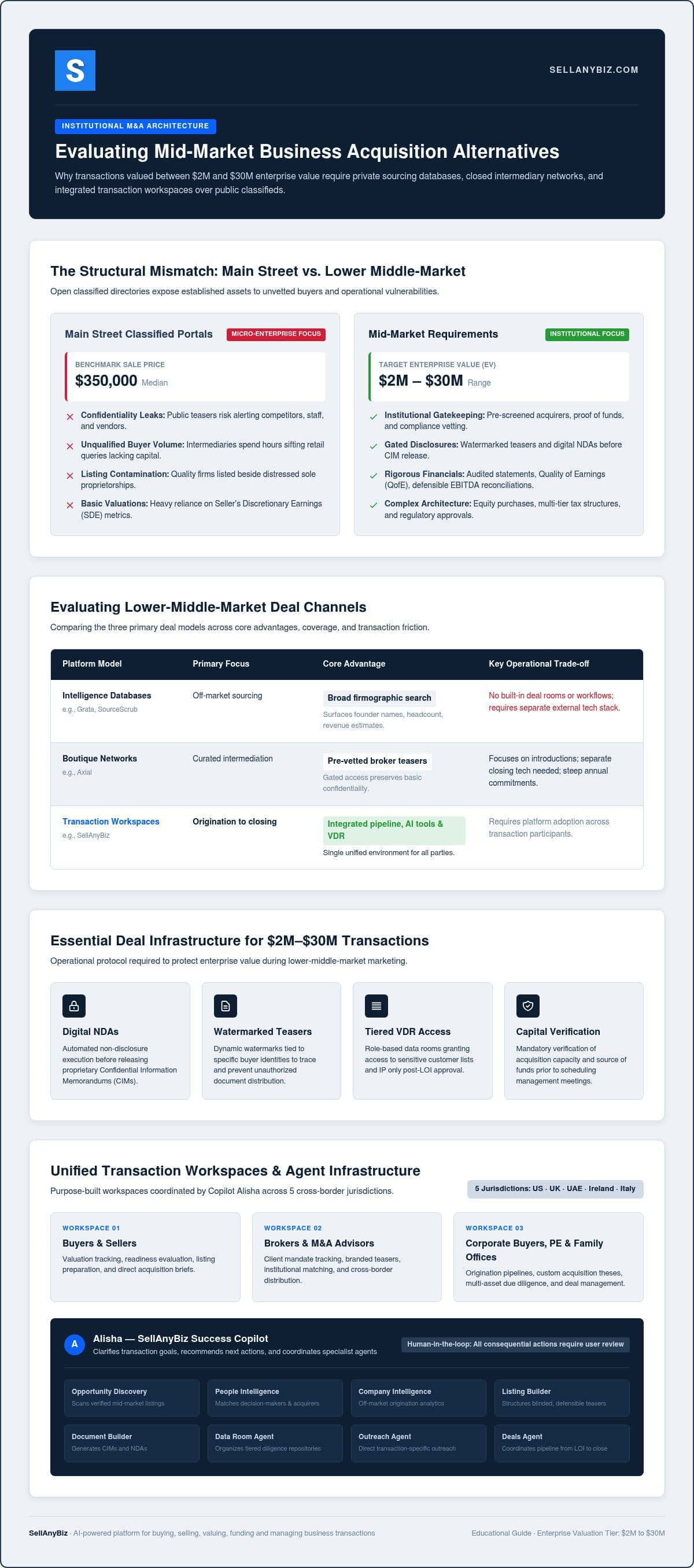
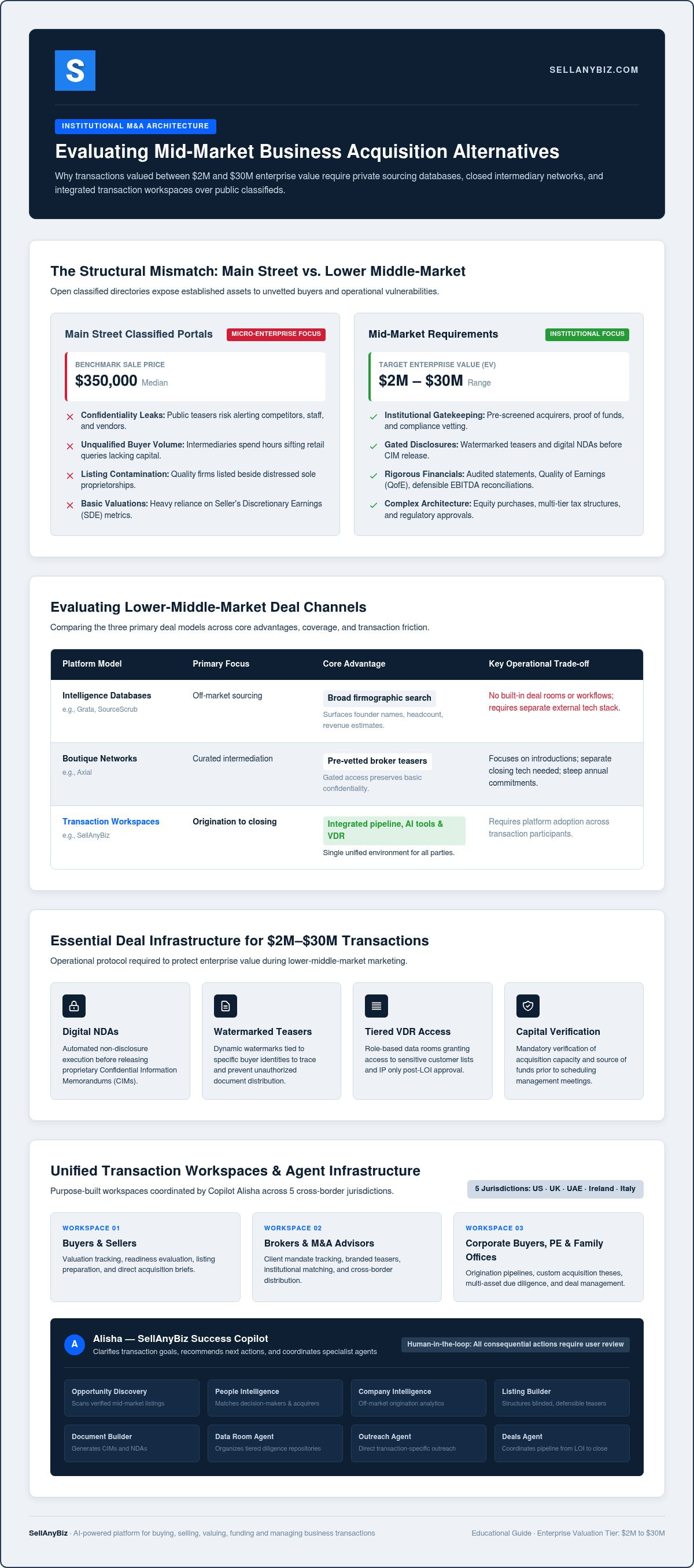
A public classified board built around a $350,000 median sale price cannot protect a $15 million company. When institutional buyers and private business owners search for BizBuySell alternatives for mid market businesses, they are usually trying to solve a structural mismatch. Main Street portals focus on unvetted micro-business listings and public visibility; mid-market acquisitions require institutional confidentiality, Quality of Earnings metrics, and disciplined transaction workflows.
You already know that advertising sensitive financial records on open boards risks tipping off your competitors, unsettling key staff, and straining vendor relationships. Sifting through thousands of micro-business listings with incomplete books wastes valuable transaction time. In this guide, you will discover the leading platforms designed for transactions between $2 million and $30 million enterprise value, alongside practical methods to market confidentially to vetted institutional acquirers.
Below, we evaluate the premier private deal networks, proprietary sourcing databases, and integrated transaction workspaces reshaping lower-middle-market acquisitions in 2026.
Key Takeaways
- Explore why public classified directories expose sensitive operational details, whereas dedicated BizBuySell alternatives for mid market businesses enforce strict confidentiality.
- Compare how private sourcing databases and curated intermediary networks differ across research depth, buyer vetting, and transaction execution.
- Identify the core deal infrastructure needed for $2M to $30M transactions, including tiered data room permissions, watermarked teasers, and digital NDAs.
- Learn how modern transaction workspaces streamline cross-border deal origination and due diligence across the US, UK, UAE, Ireland, and Italy.
Table of Contents
Why Traditional Classified Portals Fail Mid-Market Business Transactions
Lower middle-market transactions typically involve entities with $2 million to $30 million in enterprise value. At this tier, transactions depart sharply from Main Street storefront sales. Broad directories group high-performing firms alongside sole proprietorships, creating operational drag. For transactions of this scale, relying on general classifieds exposes sellers to unqualified enquiries and compromises transaction security. This operational mismatch is why institutional acquirers seek dedicated bizbuysell alternatives for mid market businesses that support institutional workflows.
The Limits of Open Classified Listings for Established Companies
Open platforms rely on public discovery. For established companies, this model introduces clear commercial vulnerabilities:
- Confidentiality leaks: Descriptive teasers on public boards often reveal location, customer concentration, or headcount. Competitors capitalize quickly. Key employees depart, and vendor terms tighten.
- Unqualified buyer volume: Thousands of retail searches rarely yield institutional buyers. Intermediaries spend countless hours filtering retail buyers who lack committed capital or acquisition capacity.
- Listing contamination: Quality assets lose credibility when placed beside distressed micro-enterprises with unverified financials.
Operational Demands of Lower Middle-Market M&A
Main Street sales focus on asset transfers priced against Seller's Discretionary Earnings (SDE). Conversely, transactions involving middle-market companies require audited financial statements, Quality of Earnings (QofE) analyses, and defensible EBITDA reconciliations. Structural requirements diverge completely:
- Complex transaction architecture: Mid-market sales demand formal equity purchases, multi-tier tax structuring, and regulatory reviews rather than basic inventory handovers.
- Institutional gatekeeping: Serious transactions require verifiable non-disclosure agreements, proof of funds, and compliance cross-checks before releasing proprietary confidential information memorandums (CIMs).
Managing this diligence across detached email threads and open forums invites closing friction. Scaled operations require specialized, secure environments built specifically for institutional execution.
Evaluating the Leading BizBuySell Alternatives for Mid-Market Buyers and Sellers
Mid-market acquirers evaluate deal channels across three categories: static intelligence databases, closed intermediary matching networks, and modern transaction workspaces. Each addresses a different phase of the institutional mergers and acquisitions process. Choosing the right BizBuySell alternatives for mid market businesses depends on whether your priority is raw market research, boutique broker introductions, or unified deal execution.
| Platform Model | Primary Focus | Core Advantage | Key Operational Trade-off |
|---|---|---|---|
| Intelligence Databases (e.g., Grata, SourceScrub) | Off-market sourcing | Broad firmographic search | No built-in deal rooms or workflows |
| Boutique Networks (e.g., Axial) | Curated intermediation | Pre-vetted broker teasers | Focuses on introductions; separate closing tech |
| Transaction Workspaces (e.g., SellAnyBiz) | Origination to closing | Integrated pipeline, AI tools, and VDR | Requires platform adoption across parties |
Private Market Intelligence Platforms vs. Transaction Workspaces
Intelligence databases deliver massive scale. They map millions of private companies missed by public boards, surfacing founder names, headcounts, and estimated revenue. However, data scraping solves only top-of-funnel origination. These platforms do not manage digital NDAs, maintain secure data rooms, or coordinate buyer diligence. Dealmakers still need an external tech stack to structure discussions and move deals forward.
Curated M&A Marketplaces and Deal Networks
Closed networks connect boutique brokers with private equity funds and family offices. They preserve confidentiality through gated access and verified mandates. While effective for passive discovery, their pricing models often demand steep annual commitments or variable closing fees. Transaction workspaces solve this fragmentation by pairing targeted discovery with active pipeline tools. Buyers and intermediaries can review verified mandates directly through curated transaction listings without disjointed systems.
Essential Deal Infrastructure Required to Execute Mid-Market Acquisitions
Completing transactions between $2 million and $30 million enterprise value requires more than simple introduction directories. Serious dealmakers avoid broad ad boards because unvetted exposure threatens commercial relationships. Purpose-built BizBuySell alternatives for mid market businesses replace static classified listings with robust operational infrastructure, combining verifiable identity gatekeeping, encrypted document hosting, and coordinated diligence workflows.
Confidentiality Protocols and Gated Document Disclosures
Protecting an operating business requires strict, phased information release. Professional infrastructure secures commercial value through structured milestones:
- Anonymized profile teasers: Summaries communicate industry, operational size, and normalized financial performance without identifying the target entity.
- Integrated digital NDAs: Interested parties must execute enforceable non-disclosure agreements and clear identity verification before receiving confidential materials.
- Tiered document access: Initial access covers high-level confidential information memorandums (CIMs). Granular customer contracts, IP documentation, and detailed payroll records remain locked until buyers submit viable letters of intent.
Integrated Diligence and Pipeline Coordination
Disorganized document sharing slows transactions down and creates closing friction. A dedicated virtual data room (VDR) provides strict document watermarking, user-level permission hierarchies, and complete audit logging. Sellers and advisors can see exactly when prospective buyers review specific financial files, contracts, or tax schedules.
Centralized Q&A trackers eliminate scattered email chains, organizing legal, tax, and environmental inquiries into structured audit trails. This unified environment accelerates review times for commercial lenders, mezzanine funds, and legal teams alike. You can explore how structured workflows protect sensitive transactions by reviewing our confidential business listings to see these protections in practice.
Modernising Mid-Market Deal Flow with SellAnyBiz Workspaces
Executing middle-market transactions requires an infrastructure that connects discovery directly to closing. While standard directories leave dealmakers managing disjointed tools, SellAnyBiz provides dedicated workspaces configured around institutional requirements. It operates as one of the premier BizBuySell alternatives for mid market businesses, uniting company intelligence, deal-document preparation, and virtual data rooms within a single environment across the US, UK, UAE, Ireland, and Italy.
Role-Based Environments for Principals, Advisors, and Acquirers
Middle-market M&A involves distinct stakeholder priorities. SellAnyBiz structures workflows into three dedicated workspaces:
- Buyers and Sellers: Principals track their pipeline, generate a Business Valuation Report, and prepare transaction documentation without technical overhead.
- Brokers and M&A Advisors: Intermediaries assemble listings using Listing Builder, run staged buyer verification, and control confidential teaser disclosures.
- Corporate Buyers, Private Equity, and Family Offices: Institutional teams manage active mandates, screen direct origination targets, and organize proprietary sponsor pipelines.
Streamlined Execution from Mandate to Closing
Disconnected tech stacks cause deal fatigue. SellAnyBiz streamlines deal flow using specialized intelligence agents coordinated by Alisha, the platform's Success Copilot. The Opportunity Discovery Agent and Company Intelligence and Origination Agent identify off-market acquisition candidates matching specific criteria. Document Builder then drafts core transaction agreements, while the Data Room Agent manages watermarking and user-level permissions. Consequential transaction, outreach, and legal actions always remain subject to user review and approval.
The Deals Agent organizes the diligence checklist and buyer audits in real time, keeping transactions on track. Intermediaries and institutional buyers can explore mid-market opportunities to review active, pre-vetted corporate transactions across key commercial sectors.
Executing Lower Middle-Market Deals with Confidence
Main Street classified portals simply lack the structural controls required for complex company transfers. Mid-market transactions between $2 million and $30 million enterprise value demand verified identities, gated document releases, and reliable diligence tracking. Evaluating purpose-built BizBuySell alternatives for mid market businesses allows owners and acquirers to preserve commercial value while conducting targeted outreach.
SellAnyBiz provides the infrastructure to bridge that operational gap. By pairing role-based workspaces for buyers, sellers, brokers, and private equity teams with built-in virtual data rooms and Document Builder tools, the platform coordinates cross-border transactions across the US, UK, UAE, Ireland, and Italy. You get full control over diligence without leaking market reputation.
Whether you want to expand an existing commercial footprint or structure an orderly corporate exit, the right deal environment makes all the difference. Take the next step in your transaction strategy and explore mid-market business opportunities to connect with vetted counterparties today.
Frequently Asked Questions
Why is BizBuySell often unsuitable for mid-market business acquisitions?
BizBuySell focuses primarily on Main Street small businesses, with median transaction values hovering around $350,000. Operating companies generating millions in revenue require institutional confidentiality, adjusted EBITDA audits, and phased disclosures. Public classified directories lack built-in virtual data rooms and buyer identity verification. This structural gap exposes mid-market sellers to staff anxiety and competitor intelligence gathering rather than qualified institutional acquirers.
What defines a mid-market business sale compared to main-street classifieds?
Mid-market transactions generally range between $2 million and $30 million in enterprise value. Unlike Main Street sales priced on simple Seller's Discretionary Earnings (SDE), mid-market deals rely on audited EBITDA, formal Quality of Earnings reports, and complex share or equity structures. Acquirers evaluate management depth, working capital targets, and compliance histories. These operational complexities explain why acquirers use dedicated BizBuySell alternatives for mid market businesses.
How do modern platforms maintain confidentiality during mid-market business sales?
Modern platforms safeguard commercial reputation through gated disclosure workflows. They market anonymized blind profiles that highlight operational metrics without disclosing identifying brand details. Interested counterparties must complete identity verification and sign digital non-disclosure agreements before viewing high-level summaries. Detailed customer registries, employee contracts, and financial schedules remain locked behind permissioned, watermarked virtual data rooms until serious, qualified letters of intent are formally submitted.
Can buyers source off-market mid-market acquisitions without cold calling brokers?
Yes. Modern transaction platforms replace manual cold calling with integrated company intelligence and origination tools. Acquirers can filter commercial registries, financial filings, and industry databases across key commercial hubs like London, New York, or Dubai. Specialist search agents identify off-market companies matching exact acquisition criteria. Buyers can then deploy structured, transaction-specific outreach directly to verified business owners while managing initial responses inside a unified pipeline workspace.
What role does AI deal infrastructure play in lower middle-market M&A?
AI deal infrastructure streamlines manual administrative tasks across the transaction lifecycle. Automated tools assist in organizing valuation models, compiling initial confidential teasers, indexing diligence documents, and structuring buyer Q&A logs. On platforms like SellAnyBiz, specialist agents work under human oversight, ensuring advisors and principals review all critical filings and outreach. This automation cuts preparation time while letting dealmakers focus on negotiation, debt structuring, and due diligence.
Disclaimer
Disclaimer: SellAnyBiz provides general business marketplace, brokerage and transaction-support information. Services may be subject to regional legal and regulatory requirements. Please review our Disclaimer & Compliance Notice for full details.