Acquisition Funding Miami: The 2026 Strategic Guide to Financing Business Purchases
Also available in:Italiano

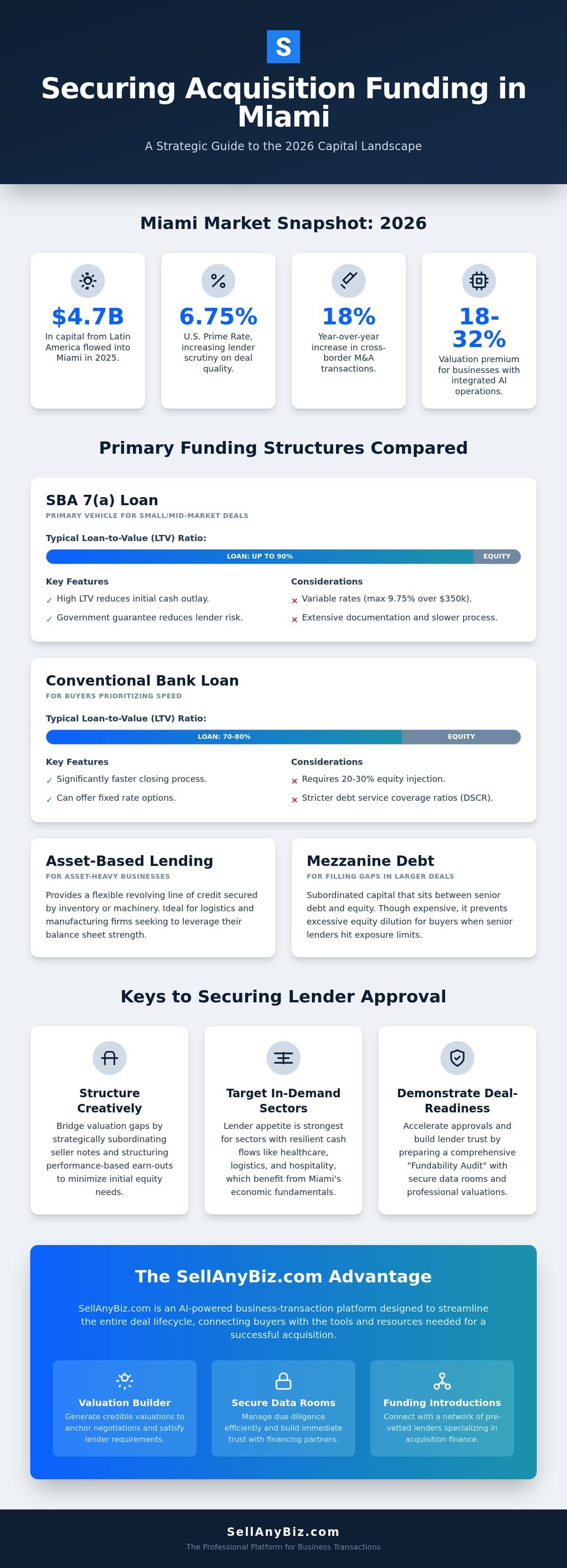
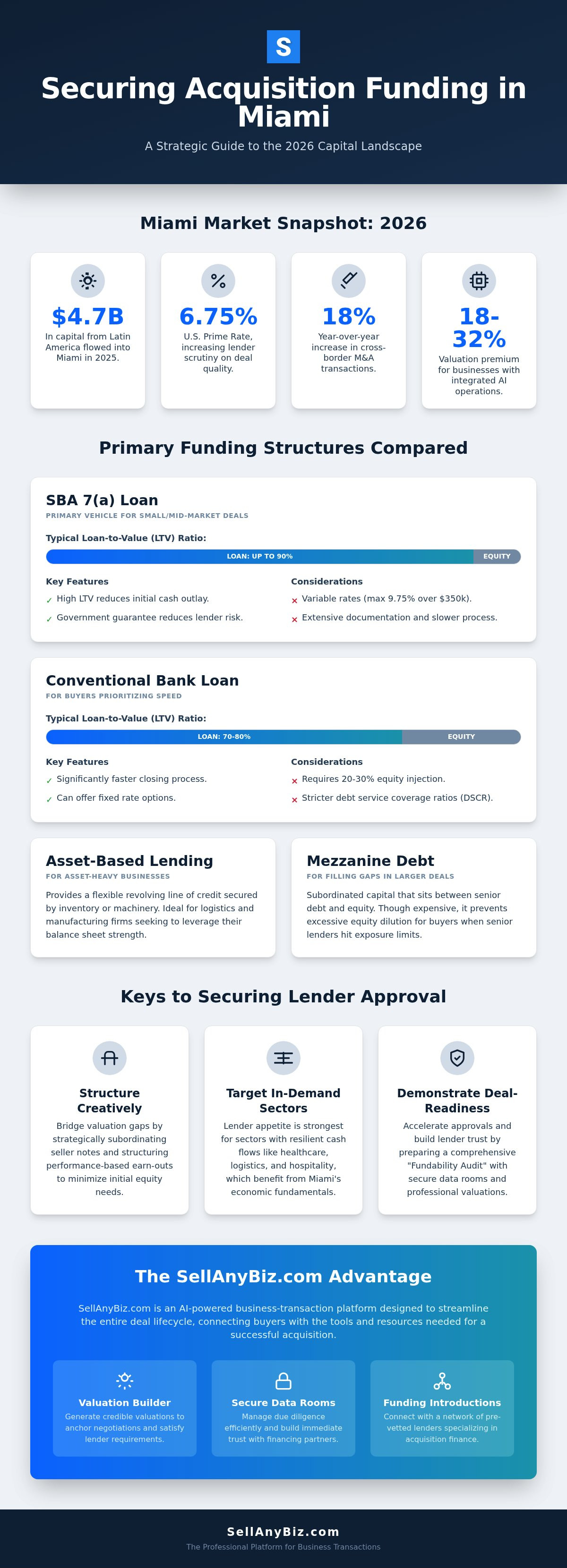
A record $4.7 billion in capital from Latin America flowed into the Miami metro area in 2025. Despite this liquidity, local buyers face a 6.75% Prime Rate and tightening lender scrutiny. Securing acquisition funding Miami requires more than a solid balance sheet; it demands a structured approach to deal-readiness. The frustration of volatile interest rates and rigid SBA 7(a) requirements is a known friction point. Industry-specific expertise in sectors like healthcare or hospitality is often missing from traditional banking relationships.
This guide provides a strategic breakdown of the 2026 financing landscape. The following sections detail how to secure a competitive LTV ratio while minimizing personal equity injection. We'll explore the mechanics of SBA 504 fixed rates, private capital trends, and platform-driven deal management. By leveraging the SellAnyBiz.com Valuation Builder and secure data rooms, buyers can speed up the time-to-close and build immediate lender trust. This is the framework for financing a Miami business purchase with precision.
Key Takeaways
- Understand how sector-specific demand in healthcare and logistics dictates lender appetite within the South Florida market.
- Navigate the 2026 interest rate environment to secure competitive acquisition funding Miami through structured SBA and conventional bank programs.
- Learn to bridge valuation gaps and minimize equity requirements by effectively subordinating seller notes and structuring earn-outs.
- Leverage the SellAnyBiz.com Valuation Builder and secure data rooms to demonstrate deal-readiness and accelerate lender approval.
- Discover how AI-powered workspaces streamline the transaction lifecycle by connecting buyers with pre-vetted funding introductions.
Table of Contents
- The 2026 Miami Acquisition Landscape: Trends and Capital Availability
- Comparing Primary Funding Structures for Miami Acquisitions
- Strategic Use of Seller Financing and Earn-Outs
- The Fundability Audit: Preparing Your Acquisition for Approval
- Streamlining Miami Deals with SellAnyBiz.com Funding Solutions
The 2026 Miami Acquisition Landscape: Trends and Capital Availability
Miami has solidified its position as a premier destination for both domestic search funds and international capital. In 2025, a record $4.7 billion in investment flowed from Latin America into the Miami metro area. Preliminary data from 2026 indicates an 18% year over year increase in these cross-border transactions. This influx of capital creates a highly competitive environment for Mergers and acquisitions (M&A) within the South Florida corridor. Professional buyers are no longer just competing with local rivals; they're bidding against global family offices and well capitalized searchers.
Securing acquisition funding Miami requires navigating a higher cost of capital than in previous cycles. With the U.S. Prime Rate holding at 6.75%, lenders are placing intense focus on debt service coverage ratios (DSCR). Buyers can't rely on cheap debt to bridge valuation gaps. Instead, they must demonstrate operational resilience. High performing sectors such as healthcare, logistics, and hospitality remain the primary targets for lenders. Healthcare businesses command attention due to their recession resistant cash flows. Logistics firms benefit from Miami's role as a global trade hub. Hospitality assets continue to attract capital as tourism infrastructure expands.
Private equity firms are also active. A global pool of $2.1 trillion in dry powder is exerting upward pressure on mid market valuations. In Florida, this translates to aggressive bidding for established businesses that show technological maturity. Businesses that have successfully embedded AI into their core operations are commanding valuation premiums of 18% to 32% above sector medians in 2026.
Miami Market Dynamics for Business Buyers
The local market has seen a sharp shift toward owner-absentee models. Strategic buyers and individual entrepreneurs alike prioritize businesses that don't depend on the daily presence of a founder. This preference is driving higher acquisition multiples for service sector companies with robust middle management. Competition is fierce. Individual buyers often find themselves outbid by corporate acquisition teams. These teams leverage existing balance sheets to absorb higher interest costs and move faster during due diligence.
Regional Funding Nuances in South Florida
Lender appetite varies significantly based on business structure. Local Florida banks often prefer brick and mortar operations with tangible assets, such as logistics warehouses or medical facilities. For tech enabled service businesses, buyers often find better terms through Florida based credit unions. These institutions have become increasingly aggressive in the sub $5M acquisition space. South Florida also offers specific incentives for minority owned and veteran owned business acquisitions. These programs can provide the necessary leverage to offset the 3.8% inflation rate recorded in early 2026. Using the SellAnyBiz.com platform allows buyers to identify these opportunities and manage the transaction lifecycle through a unified workspace.
Comparing Primary Funding Structures for Miami Acquisitions
Selecting a capital structure in 2026 requires a balance between leverage and velocity. For most buyers seeking acquisition funding Miami, the decision hinges on the target company's asset base and the buyer's available liquidity. The choice isn't just about the interest rate. It's about how the debt affects the post-close balance sheet and the speed of the transaction.
The SBA 7(a) loan program remains the primary vehicle for small to mid-market purchases. It offers high loan-to-value (LTV) ratios, often reaching 90%. In the current 6.75% Prime Rate environment, these loans carry variable rates that typically max out at 9.75% for amounts over $350,000. While the government guarantee reduces lender risk, the documentation requirements are extensive. Buyers who prioritize speed over leverage often pivot to conventional bank financing. Conventional loans close faster but require 20% to 30% equity injections and stricter debt service coverage ratios.
For Miami-Dade businesses with heavy inventory or machinery, asset-based lending (ABL) provides a flexible alternative. Logistics and manufacturing firms use their balance sheet strength to secure revolving lines of credit. Mezzanine debt serves a different purpose. It sits between senior debt and equity, filling the "gap" in larger mid-market deals where senior lenders hit their exposure limits. It's expensive capital, but it prevents excessive equity dilution for the buyer.
SBA 7(a) vs. Conventional Term Loans
The primary friction point between these two structures is the down payment. SBA loans allow for 10% down, preserving the buyer's working capital. Conventional loans demand more skin in the game. Amortization also differs. SBA loans typically offer 10-year terms for business acquisitions, which lowers the monthly debt burden compared to the 5-year or 7-year windows common in conventional banking. In 2026, personal guarantees remain a mandatory fixture for SBA deals, while some conventional lenders may waive them for buyers with significant collateral or professional management teams.
Alternative Debt: Revenue-Based and Mezzanine
High-margin Miami SaaS firms often bypass traditional collateral requirements through revenue-based financing. Lenders provide capital in exchange for a percentage of future gross revenues. It's a non-dilutive way to fund a purchase without a fixed repayment schedule. In contrast, mezzanine debt in 2026 carries high single-digit or low double-digit coupons. It's a strategic tool for search funds that need to bridge a valuation gap but want to retain majority ownership. Reviewing available business listings can help buyers identify targets where these advanced debt structures are most applicable.
Strategic Use of Seller Financing and Earn-Outs
Closing the valuation gap is the primary hurdle in 2026 Miami deals. Seller financing isn't just a convenience. It's a strategic necessity. High valuations in the South Florida market often exceed lender appraisals. Seller debt bridges this divide. It serves as a critical component of acquisition funding Miami. This structure signals the seller's confidence. It assures the buyer that the transition will be supported. Without this layer of capital, many mid-market transactions fail during the final stages of due diligence.
Structuring the Seller Note
A seller note requires careful integration into the capital stack. Buyers using SBA loans must account for the mandatory "standby" period. Sellers often cannot receive principal payments for the first 24 months of the new ownership. Interest rates for seller-carried debt in Miami currently range from 6% to 10%. This debt is almost always subordinated to the senior bank loan. It functions as skin in the game. Lenders view this as a risk mitigation tool. It's a standard practice when financing a business acquisition because it preserves the buyer's cash reserves.
Common terms for a South Florida seller note include:
- Interest Rates: Typically 2% to 4% above the senior debt floor.
- Subordination: Full subordination to senior bank lenders is often mandatory for the life of the loan.
- Amortization: Often five to seven years, matching the business's projected cash flow cycle.
Earn-Outs and Performance Milestones
Earn-outs align buyer and seller interests after the deal closes. They defer part of the purchase price based on future performance. For Miami retail acquisitions, EBITDA remains the standard metric. High-growth sectors may prefer gross profit targets to account for scaling costs. The "clutch" period refers to the initial 12 to 18 months post-close. This is when the earn-out is won or lost. Buyers should search available business listings to identify targets where sellers are already predisposed to performance-based structures.
Vague language leads to litigation. Definitions of "operating expenses" or "capital expenditures" must be exact. Buyers need the freedom to manage. Sellers need protection against artificial margin suppression. Performance-based deferred payments require transparent tracking. SellAnyBiz.com provides the infrastructure to manage these transaction documents and track milestones. This ensures the earn-out remains a tool for growth rather than a source of friction. Professional deal management keeps both parties focused on the enterprise value.
The Fundability Audit: Preparing Your Acquisition for Approval
Securing acquisition funding Miami requires more than a signed Letter of Intent. It demands a rigorous "Fundability Audit." Lenders in 2026 aren't just looking at the buyer's credit. They're stress-testing the target business against a 6.75% Prime Rate and 3.8% inflation. A disorganized deal room is the fastest way to kill lender confidence. Preparation must be clinical. Data over gut feeling. This audit bridge is where most Miami deals either accelerate or stall.
The process follows a structured five step sequence:
- Step 1: Secure a professional Business Valuation Report to justify the purchase price to underwriters.
- Step 2: Conduct a pre funding financial cleanup. Remove discretionary owner expenses and recast EBITDA.
- Step 3: Organize the SellAnyBiz.com Secure Data Room for instant, permission controlled lender access.
- Step 4: Craft an Executive Summary and Pro-Forma projections that show clear debt service coverage.
- Step 5: Manage business transaction legal requirements early to prevent red flags during the final closing stages.
Valuation as a Funding Catalyst
Lenders reject "rule of thumb" valuations in volatile markets. They demand precision. The SellAnyBiz.com Valuation Builder generates the professional outputs that bank credit committees expect. In Miami's service and hospitality sectors, the "Goodwill" component is often the largest asset on the balance sheet. Lenders need to see this value quantified through customer retention data and brand strength metrics. A generic multiple won't suffice when interest rates are high.
Organizing Due Diligence Materials
A "Lender Ready" data room is a non negotiable asset. It must include three years of verified tax returns, interim financials, and detailed accounts receivable aging reports. Common financial red flags, such as co-mingled personal expenses or poor bookkeeping, kill Miami acquisition loans instantly. The Information Memorandum acts as the narrative for the funding process. It explains the "why" behind the financial trends. When the data is organized, the lender moves faster. Friction disappears.
Review available business listings to identify targets that have already completed an initial fundability screening.
Streamlining Miami Deals with SellAnyBiz.com Funding Solutions
The final stage of any transaction is often the most fragile. Managing acquisition funding Miami requires a centralized infrastructure that connects buyers, brokers, and lenders without friction. SellAnyBiz.com provides this environment. It's an AI-powered business-transaction platform designed to move deals from initial intent to completion. By integrating funding solutions directly into the deal management workspace, the platform removes the siloed communication that typically delays closing. It transforms a scattered process into a structured workflow.
Centralizing communication is essential. In a typical deal, information is lost in email chains. SellAnyBiz.com solves this by hosting all interactions within a single workspace. Buyers can track the status of their funding applications alongside their due diligence checklists. This transparency reduces the anxiety often associated with high-stakes South Florida acquisitions. Every participant knows the exact stage of the deal. Every document is accounted for. This is the infrastructure of a modern deal room.
The SellAnyBiz.com Connected Ecosystem
Buyers can transition seamlessly from listing discovery to the funding phase. The platform's AI Smart Search filters for businesses with existing SBA pre-approvals. This immediately narrows the field to high-probability targets. Within the workspace, role-based permissions allow buyers to invite their lenders directly into the transaction environment. Lenders gain instant, permission-controlled access to the Secure Data Room. This accelerates due diligence by eliminating the back-and-forth of document requests. Automated tools also handle the generation of transaction documents, including digital NDAs and LOIs. This keeps deal momentum high while maintaining strict confidentiality and security.
Winning Mandates and Securing Capital
Miami brokers use SellAnyBiz.com to package deals specifically for financing. The platform's Valuation Builder ensures that asking prices are grounded in market data rather than owner expectations. This professional presentation builds immediate credibility with bank credit committees. Verified financials within the marketplace further reduce lender skepticism. When a deal is structured correctly from the start, the path to capital is clear. The connected ecosystem supports the entire lifecycle. It ensures that data is secure and communication is purposeful. For search funds and corporate acquisition teams, this infrastructure is a competitive advantage. Start your acquisition journey on SellAnyBiz.com today.
Executing Your 2026 Miami Acquisition Strategy
The Miami market remains a high stakes environment where capital is available but scrutiny is intense. Success in securing acquisition funding Miami depends on more than just identifying a high growth target. It requires a clinical approach to deal readiness and financial recasting. Buyers must balance the leverage of SBA 7(a) programs with the strategic flexibility of subordinated seller notes to close the valuation gap. This dual approach protects cash flow while satisfying lender requirements in a volatile interest rate climate.
SellAnyBiz.com provides the essential infrastructure to manage this complexity. By using the AI-powered Valuation Builder and Secure Data Rooms for lenders, buyers can demonstrate the transparency required to satisfy credit committees. Access to a global network of vetted M&A advisors ensures that every transaction is grounded in verified data and professional oversight. The path to a successful closing is found in a connected, professional workspace rather than a fragmented marketplace. It's about moving from intent to completion with efficiency.
Register as a Buyer on SellAnyBiz.com to access acquisition funding introductions.
Your next transaction deserves a structured foundation. Move forward with the tools designed for sophisticated deal management and secure your position in South Florida's competitive landscape.
Frequently Asked Questions
What is the typical down payment for a business acquisition in Miami?
The typical down payment for a business acquisition in Miami ranges from 10% to 30% of the purchase price. SBA 7(a) loans are the most accessible, often requiring only a 10% equity injection from the buyer. Conventional bank loans generally demand a higher commitment, typically between 20% and 30%. These requirements depend on the business's debt service coverage ratio and the buyer's industry experience. High margin sectors like healthcare sometimes see more flexible terms.
Can I use an SBA loan to buy a business in Miami if I am not a US citizen?
Non-US citizens can use SBA loans to acquire a Miami business if they hold Lawful Permanent Resident status. Lenders also consider applicants with specific work visas, such as E-2 or L-1, provided they can demonstrate a long term commitment to the US business. Eligibility often hinges on the applicant's collateral and the management team's strength. Borrowers should consult with an SBA preferred lender to verify current 2026 residency requirements for the Florida district.
How long does it take to get acquisition funding for a Miami business?
Securing acquisition funding Miami usually takes between 45 and 90 days from the signed Letter of Intent. SBA loans typically sit on the longer end of this spectrum due to rigorous government documentation and appraisal requirements. Conventional financing can close in as little as 30 to 45 days if the target business has verified financials. Using a centralized workspace to organize due diligence materials can significantly reduce these timelines by preventing document bottlenecks.
What is the minimum credit score required for a business acquisition loan in 2026?
Most lenders require a minimum personal credit score of 680 for a business acquisition loan in 2026. While the SBA doesn't set a hard floor, individual banks use credit scores to gauge the borrower's reliability. Scores above 720 often unlock more competitive interest rate spreads and lower down payment requirements. Lenders also look beyond the score to analyze the borrower's debt-to-income ratio and historical management of commercial credit lines.
Is seller financing mandatory for SBA-backed acquisitions?
Seller financing isn't legally mandatory for SBA backed acquisitions, but many lenders require it to bridge valuation gaps. A seller note usually covers 5% to 15% of the purchase price. This structure provides "skin in the game" that reassures senior lenders of the seller's confidence in the transition. In the competitive Miami market, including a seller note can make a buyer's offer more attractive by reducing the total bank debt required.
How does a business valuation report impact my funding chances?
A professional business valuation report is a critical catalyst for funding approval. Lenders use these reports to verify that the purchase price aligns with the company's actual enterprise value and cash flow. Without a structured valuation, bank credit committees often default to conservative appraisals that may not cover the full loan request. Using the SellAnyBiz.com Valuation Builder helps buyers present a credible, data driven case that justifies the requested LTV ratio.
What happens if the Miami business appraises for less than the purchase price?
If a Miami business appraises for less than the purchase price, the lender will likely reduce the loan amount. This creates a funding gap that the buyer must address. Common solutions include renegotiating the purchase price with the seller or increasing the personal equity injection. Alternatively, the buyer can structure the difference as a subordinated seller note. This keeps the deal moving forward without requiring the buyer to exhaust their liquid cash reserves.
Are there specific grants for business acquisitions in Miami-Dade County?
Direct government grants for business acquisitions in Miami-Dade County are rare. Most local grants focus on operational expansion, job creation, or technology adoption rather than the initial purchase price. However, buyers should investigate the Miami-Dade Economic Advocacy Trust for potential incentives related to underserved communities. While grants don't typically cover acquisition funding Miami, they can provide essential working capital to support the business immediately after the transaction completes.
Disclaimer
Disclaimer: SellAnyBiz provides general business marketplace, brokerage and transaction-support information. Services may be subject to regional legal and regulatory requirements. Please review our Disclaimer & Compliance Notice for full details.