Franchise Transfer Fee: 2026 Strategic Guide for Resales
Also available in:Italiano

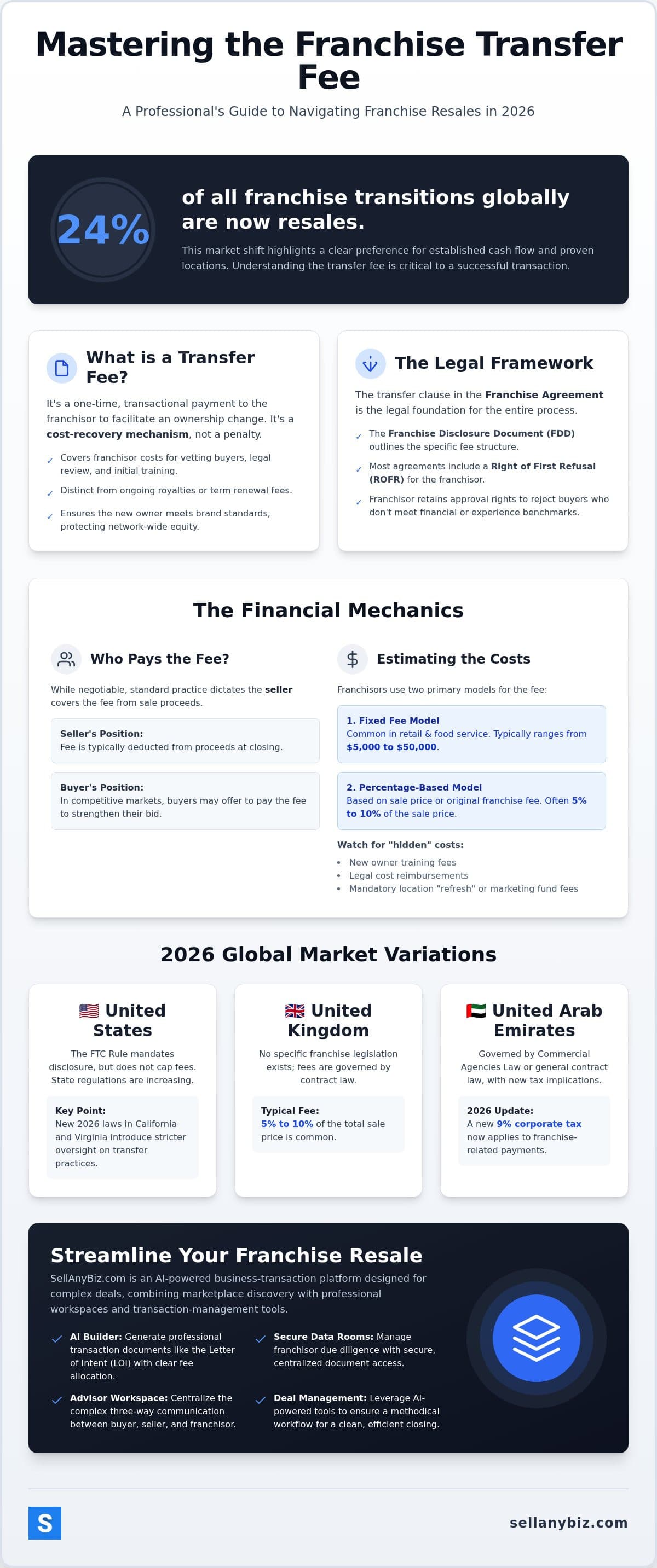
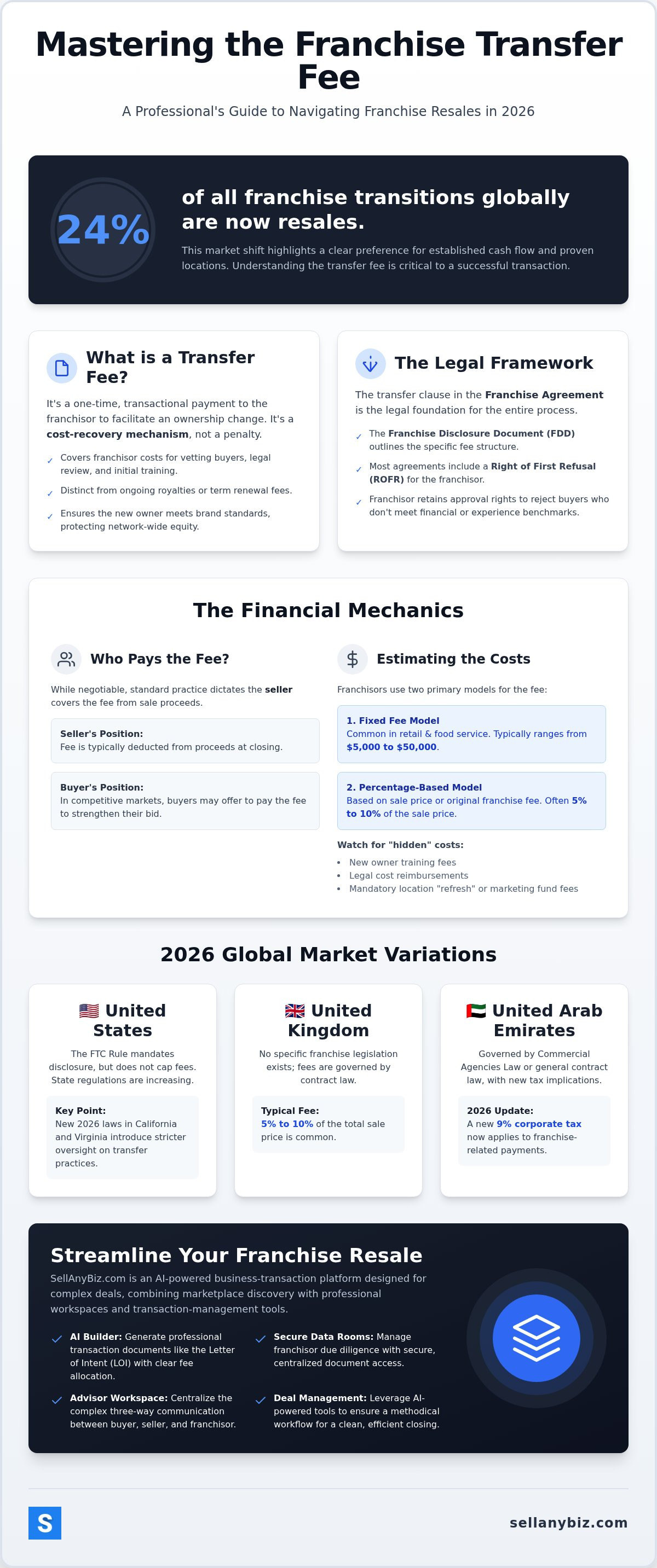
Twenty four percent of all franchise transitions globally are now resales. This 2026 data reflects a clear market preference for established cash flow and proven locations. Yet, many transactions falter at the final stage. The culprit is often a misunderstood franchise transfer fee.
You understand that a resale is more than a simple asset purchase. It's a high-stakes, three-way negotiation. Unexpected costs and complex franchisor approval processes can easily derail momentum. We're here to provide the structure. This guide outlines professional deal management strategies to help you navigate these financial obligations. You'll learn how to execute a clean transfer while minimizing transaction friction.
We'll analyze current fee benchmarks and the specific documentation required for franchisor due diligence. Using the SellAnyBiz.com AI Builder and secure data rooms ensures your deal stays on track. We'll examine the mechanics of a successful transfer.
Key Takeaways
- Define the franchise transfer fee as a strategic cost that covers franchisor vetting and new owner training.
- Identify standard industry practices for fee allocation to protect your net proceeds during the negotiation.
- Execute a methodical workflow by reviewing the Franchise Disclosure Document (FDD) for specific transfer conditions.
- Utilize the SellAnyBiz.com Broker and M&A Advisor Workspace to manage the complex three-way interaction between all parties.
- Leverage AI-powered transaction management tools to generate the professional documentation required for a clean closing.
Table of Contents
Understanding the Franchise Transfer Fee in 2026 Transactions
A franchise transfer fee is a one-time payment required by the franchisor to facilitate an ownership change. It isn't a penalty; it's a cost recovery mechanism. When a franchisee exits, the franchisor must vet the new buyer, review legal documents, and provide initial training. This fee is distinct from ongoing operational costs. While royalties support brand marketing and support, Understanding Franchise Fees helps clarify that the transfer fee is strictly transactional. It differs from renewal fees, which apply when an existing owner extends their term.
The scope of this fee covers the franchisor’s administrative burden. This includes background checks, credit reviews, and the legal costs of drafting a new franchise agreement for the buyer. It ensures the incoming owner meets brand standards from day one. Without this vetting, brand equity could diminish across the entire network. Managing these requirements through the SellAnyBiz.com platform centralizes the communication required between the three parties.
The Legal Foundation: The Franchise Agreement
The transfer clause is the most critical section for exiting owners. It dictates the conditions under which a sale can occur. Most agreements include a Right of First Refusal (ROFR). This allows the franchisor to match any third-party offer and buy back the unit. Approval rights are also standard. The franchisor can reject a buyer if they don't meet financial or experience benchmarks. You'll find the specific fee structure in Item 20 of your Franchise Disclosure Document (FDD). Exiting owners can browse current franchise resales to benchmark their own exit strategy. Delays often stem from missing documentation or late notifications to the corporate office.
Regional Variations: London, Dubai, and New York
Market norms vary significantly by jurisdiction. In the United States, the FTC Rule sets disclosure requirements but doesn't cap fees. New 2026 regulations in California and Virginia have introduced stricter oversight on franchise sales to prevent predatory transfer practices. In the United Kingdom, no specific franchise legislation exists. Fees are governed by contract law and often range from 5% to 10% of the sale price. The United Arab Emirates relies on the Commercial Agencies Law or general contract law. Recent 2026 updates include a 9% corporate tax on franchise-related payments in the UAE. These regional nuances mean your deal management must be localized and precise. Understanding these local requirements prevents unexpected transaction friction during the closing phase.
Financial Mechanics: Who Pays the Fee and Typical Costs
Standard practice dictates that the seller covers the franchise transfer fee. This amount is usually deducted from the sale proceeds at closing. It isn't an absolute rule. In competitive markets like Dubai or London, or for premium units, a buyer might absorb the cost to strengthen their bid. Understanding the legal considerations in franchise resales is vital. While the Franchise Agreement may name a default payer, the parties can negotiate specific terms in the Asset Purchase Agreement.
The fee serves as a strategic lever during Enterprise Value discussions. A seller might offer to cover the fee instead of lowering the asking price. Conversely, a buyer may request a credit at closing to offset the expense. These funds are typically held in escrow. They are released to the franchisor only after formal approval and the execution of the new agreement. Clear communication at this stage prevents friction. You can browse established franchises to see how different brands structure these requirements.
Estimating the Cost: Percentage vs. Fixed Fees
Franchisors generally use two models for these charges. Fixed-fee models are common in retail and food service, often ranging from $5,000 to $50,000. Percentage-based fees are calculated against the original franchise fee or the current resale price. This can result in significant variance for high-value acquisitions. Beyond the primary franchise transfer fee, several hidden costs often surface during due diligence:
- Training fees for the incoming owner or manager.
- Legal reimbursements for the franchisor’s internal counsel.
- Marketing fund contributions or "refresh" requirements for the physical location.
Negotiating the Transfer Fee in the LOI
Precision in the Letter of Intent (LOI) is essential. Ambiguity regarding fee responsibility often leads to deal fatigue. The SellAnyBiz.com AI Builder allows users to generate transaction documents with clear allocation terms. This transparency protects the seller’s net exit proceeds and the buyer’s capital reserves. The fee's impact must be reflected in the Business Valuation Report. A high transfer cost can shift the effective multiple paid for the business. Professional advisors use these valuations to ensure the deal remains commercially viable for both parties.
Why Franchisors Require Transfer Fees: Beyond Administration
The franchise transfer fee isn't merely a revenue line item for the franchisor. It represents the cost of brand preservation. Vetting an incoming buyer involves deep due diligence that extends far beyond a simple credit check. Franchisors conduct background investigations, financial audits, and multi-stage interviews. This rigorous process ensures the new operator possesses the capital and competence to maintain the network's reputation. A single failing unit can depress the market value of neighboring territories. The fee funds the insurance policy against operational decline.
Brand protection is the primary objective. Franchisors use these funds to prevent distress sales where a desperate seller might hand over the keys to an unqualified buyer. Beyond vetting, the fee covers the logistical burden of a transition. This includes updating operational manuals, granting technology stack access, and reconfiguring supply chain permissions. It's a structured investment in the buyer's day-one readiness. Without this financial hurdle, the barrier to entry might drop, inviting instability into the franchise ecosystem.
The Franchisor as a Transaction Participant
Smart deal management treats the franchisor as a critical third-party participant. They aren't just an approving body; they're a stakeholder with specific data requirements. Managing this interaction requires a dedicated deal environment. Role-based collaboration is essential here. You can streamline this by inviting franchisor representatives into specific SellAnyBiz.com Workspaces. This centralized approach ensures they receive the Information Memorandum and financial disclosures promptly. Secure access prevents the deal from stalling in a corporate inbox. It projects professionalism and builds trust with the brand's executive team.
Training and Support Justification
A significant portion of the fee often subsidizes the Initial Training Program. This isn't a suggestion. It's a contractual mandate. The buyer must master the brand's proprietary systems before taking control. For the seller, this training is a form of risk mitigation. A well-trained buyer is less likely to fail, which significantly reduces the risk of post-sale clawbacks or legal disputes. Documentation of training completion serves as a vital closing condition. It confirms the franchisor's satisfaction with the new owner's capabilities. Clear records protect the exit proceeds and ensure a clean break for the departing franchisee.
Navigating the Transfer Process: A Transactional Checklist
The transfer process is a methodical workflow. It requires strict adherence to the underlying contract. Treat this as a project management exercise rather than a casual handover. Successful exits follow a specific sequence of actions to ensure the franchisor’s approval is secured without delaying the closing date.
- Step 1: Review Documents. Audit the current Franchise Agreement and FDD. Identify the exact franchise transfer fee specified in Item 20.
- Step 2: Confidential Notification. Notify the franchisor of your intent to sell. Use secure channels to maintain staff and customer confidentiality.
- Step 3: Buyer Qualification. Filter prospects through SellAnyBiz.com AI Smart Search. This ensures the buyer meets the franchisor's specific net worth and experience benchmarks.
- Step 4: Information Memorandum. Prepare a comprehensive deal package. Complete a financial cleanup to present a transparent view of unit performance.
- Step 5: Written Consent. Secure the formal "Consent to Transfer" document. This is the final hurdle before the buyer executes the new agreement.
Managing these stages effectively prevents deal fatigue. If you are ready to begin the process, list your franchise confidentially to connect with verified buyers.
Preparing the Buyer for Franchisor Approval
Franchisors act as the ultimate gatekeeper. They will demand a complete dossier on the incoming owner. This typically includes detailed business plans, personal financial statements, and professional resumes. You can organize these sensitive files within SellAnyBiz.com Secure Data Rooms. This provides a professional environment for the franchisor’s due diligence team. Respect the timeline; most franchisors require 30 to 60 days to process an approval request. Early preparation of the buyer's package can compress this window.
The Role of Professional Brokerage
A seasoned business broker is essential for managing the three-way negotiation between seller, buyer, and brand. They act as a buffer and a facilitator. This is particularly important when aligning the business transaction legal Manchester requirements with the franchisor's global standards. The broker ensures that the assignment and assumption agreement is drafted correctly. This document legally transfers the rights and obligations from the seller to the buyer. Professional oversight ensures that no detail, including the final settlement of the franchise transfer fee, is left to chance during the closing meeting.
Streamlining Franchise Resales with SellAnyBiz.com
SellAnyBiz.com operates as an AI-powered business-transaction platform. It replaces fragmented communication with a connected ecosystem. For franchise resales, the platform centralizes the interaction between seller, buyer, and franchisor. Professional advisors utilize the SellAnyBiz.com Broker and M&A Advisor Workspace to manage these high-stakes transitions. This environment tracks every task. It ensures the franchise transfer fee is accounted for within the final settlement. Secure. Structured. Transaction-ready.
The platform facilitates the entire lifecycle. From initial engagement to final due diligence. It offers tools that move the deal forward. Automated NDA workflows ensure only vetted buyers see sensitive unit data. This protects the brand reputation during the search phase. Integrated deal management provides a clear roadmap for franchisor approval stages. It removes the guesswork from the transition.
AI-Powered Documentation for Franchisors
Franchisors demand precision. The SellAnyBiz.com AI Builder generates professional teasers and Information Memorandums that meet global brand standards. It standardizes inputs to satisfy rigorous corporate requirements. This reduces the administrative drag that often kills momentum in a resale. By providing structured data, you accelerate the franchisor’s due diligence process. It turns a complex paperwork hurdle into a managed workflow. Every document is stored in secure data rooms for immediate access by the approving authority.
Global Reach for Franchise Buyers
Finding the right successor requires a broad reach. SellAnyBiz.com connects sellers with qualified investors in Dubai, London, and New York. Certain regional hubs, such as franchise sales Liverpool, benefit significantly from this global buyer pool. The platform encourages serious acquisition intent through free buyer mandates. This ensures a high-probability match for your specific brand.
A global pool increases competition. It helps maintain the enterprise value of the unit. Vetted buyers arrive prepared. They understand the financial obligations, including the franchise transfer fee and training requirements. The platform’s matching logic surfaces candidates who meet the franchisor’s net worth and experience benchmarks. This alignment minimizes the risk of rejection at the final approval stage. It secures the exit and protects the brand’s future.
Executing a Precise Franchise Exit
Managing a resale requires balancing the interests of three distinct parties. The franchise transfer fee is a central component of this negotiation; it serves as the financial bridge to a new owner's success. By treating this fee as a structured transaction cost rather than a simple administrative hurdle, you protect your net proceeds and ensure brand continuity. Clear documentation and early franchisor engagement are the keys to a clean closing.
Professional results depend on the quality of your deal environment. SellAnyBiz.com provides the institutional infrastructure needed for high-stakes transitions. Drawing on 15+ years of transaction experience, our platform offers AI-powered transaction management and Secure Data Rooms for rigorous due diligence. These tools remove the administrative drag from franchisor approval and legal review, ensuring every milestone is tracked and verified.
You don't have to navigate these complexities alone. Register your acquisition mandate for free on SellAnyBiz.com to access a global network of verified buyers and professional workspaces. It's time to move your deal forward with confidence and clarity.
Frequently Asked Questions
Is the franchise transfer fee negotiable with the franchisor?
Most franchisors treat the franchise transfer fee as a non-negotiable contractual obligation. It is clearly defined in Item 20 of the Franchise Disclosure Document. While the fee itself is fixed, you can often negotiate other transition terms. This includes royalty waivers or temporary marketing fund reductions. Professional deal management ensures these nuances are addressed during the LOI stage to protect your enterprise value.
What happens if the franchisor refuses the transfer to my buyer?
If a franchisor rejects a buyer, the transaction cannot proceed. Franchisors hold absolute approval rights based on financial benchmarks and operational experience. The seller must then identify a new candidate who meets the brand's specific requirements. Using the SellAnyBiz.com AI Smart Search helps filter for qualified buyers early. This reduces the risk of a late-stage rejection and prevents wasted time in the due diligence phase.
Can the transfer fee be financed as part of the acquisition loan?
Yes. Many lenders allow the franchise transfer fee to be rolled into the total acquisition loan. This is common with SBA loans in the US and commercial acquisition funding in the UK. Including the fee in the financing package preserves the buyer's working capital for post-closing operations. Sellers should ensure the Business Valuation Report accounts for this cost to provide a transparent view of the total investment required.
Does the transfer fee include the cost of training for the new owner?
This depends on the specific Franchise Agreement. In many cases, the fee covers both administrative vetting and the initial training program for the new owner. However, some brands separate these costs. You might encounter a base transfer fee plus a dedicated new-owner training charge. Always verify these details in the FDD before finalizing the purchase price to avoid unexpected transaction friction during the closing process.
Who typically pays the franchise transfer fee in the UK and UAE?
Standard practice in London, Manchester, and Dubai assumes the seller pays the fee from the final sale proceeds. It is an exit cost. However, in high-demand markets, buyers may agree to absorb the fee as a competitive incentive. This is a key negotiation point in the Asset Purchase Agreement. Professional advisors in the UAE and UK use these levers to balance the net proceeds for the exiting owner.
How does a transfer fee differ from a franchise renewal fee?
A franchise transfer fee is a one-time transactional cost triggered by a change in ownership. It covers the franchisor’s burden of vetting a new participant. Conversely, a renewal fee applies when an existing franchisee chooses to extend their term for an additional period. While both fees support brand infrastructure, they occur at different stages of the lifecycle. One facilitates an exit; the other secures continued operational rights.
What documents are required by the franchisor before they approve a sale?
Franchisors require a comprehensive buyer dossier to ensure network stability. This includes personal financial statements, credit reports, and a professional resume. The buyer must also submit a detailed business plan outlining their growth strategy for the unit. Organizing these documents in SellAnyBiz.com Secure Data Rooms allows the franchisor’s legal team to conduct due diligence efficiently. Missing paperwork is the primary cause of deal delays in franchise resales.
How can SellAnyBiz.com help me reduce the time to close a franchise resale?
SellAnyBiz.com reduces administrative drag through AI-powered transaction management. The SellAnyBiz.com AI Builder generates the Information Memorandum and teasers required by franchisors in minutes. Integrated deal management tools track every approval task and milestone in a single workspace. This structured approach ensures all participants remain aligned. It moves the transaction from initial engagement to final consent with professional precision and significantly less friction.
Disclaimer
Disclaimer: SellAnyBiz provides general business marketplace, brokerage and transaction-support information. Services may be subject to regional legal and regulatory requirements. Please review our Disclaimer & Compliance Notice for full details.