Mid-Market Business Valuation NYC: 2026 Strategic Reference
Also available in:Italiano

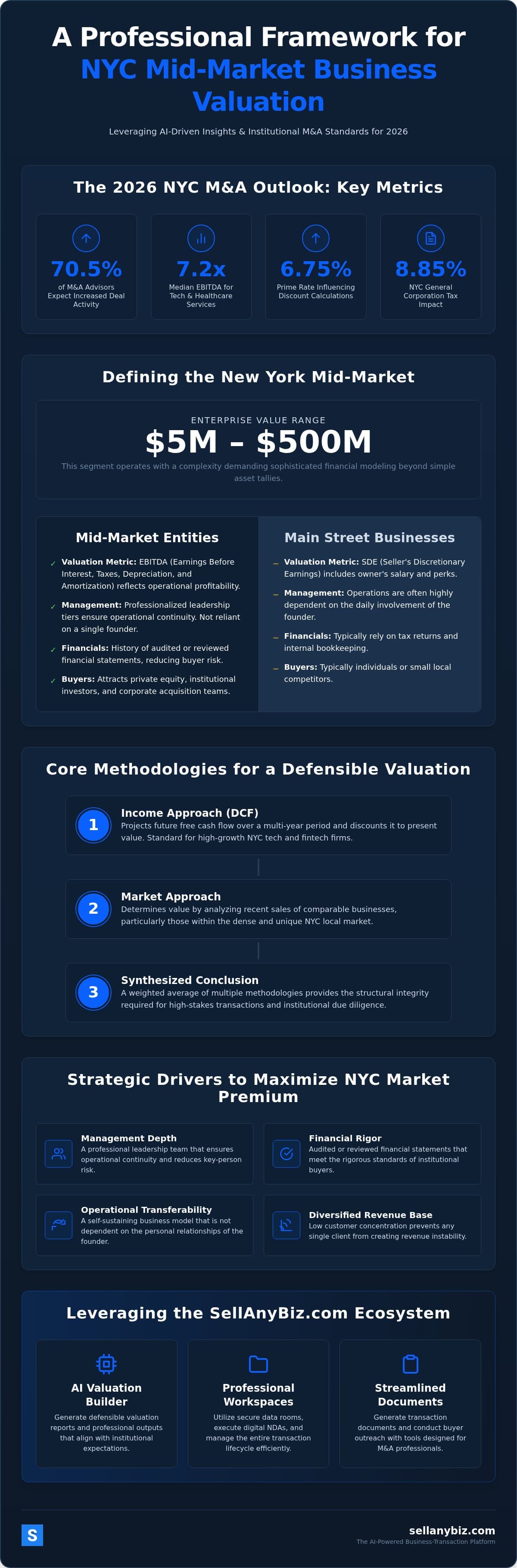
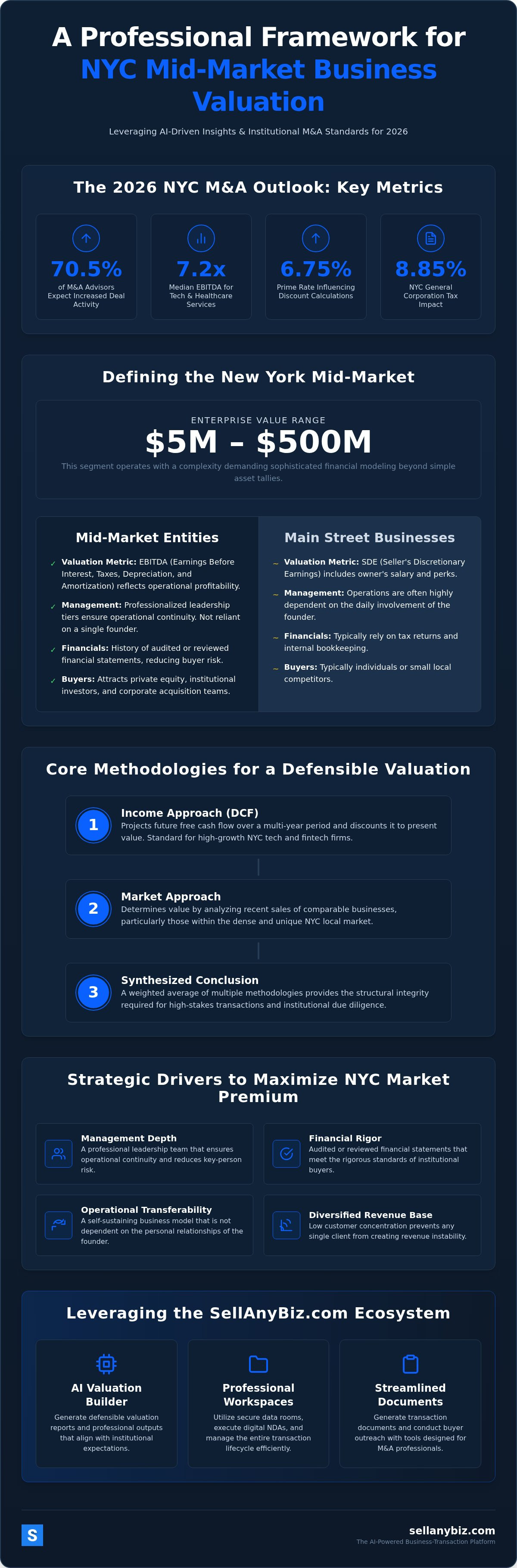
Recent data indicates that 70.5% of M&A advisors expect 2026 deal activity to surpass previous levels. In a city where healthcare and tech-enabled services command a median 7.2x EBITDA multiple, a generic appraisal is no longer sufficient. Securing an accurate mid-market business valuation NYC requires more than just historical spreadsheets. It demands a sophisticated analysis of real-time transferability and local market premiums. You likely recognize that national data sets often fail to capture the unique density and competitive landscape of the five boroughs.
This guide provides a professional framework for valuing New York City companies using modern AI-driven insights and institutional M&A standards. We've structured this reference to help you move past the high fees of traditional boutique banks and the lack of transparency in legacy processes. You'll discover how to leverage the SellAnyBiz.com | AI-Powered Business Marketplace & M&A Platform Valuation Builder to generate defensible, professional outputs. We examine current 2026 sector multiples, tax implications like the 8.85% NYC General Corporation Tax, and the steps required to prepare your entity for a confidential sale.
Key Takeaways
- Define the specific parameters of the New York mid-market, focusing on firms with enterprise values between $5M and $500M.
- Master institutional methodologies like DCF and market comparables to secure a precise mid-market business valuation NYC.
- Evaluate key strategic drivers, including revenue quality and operational transferability, to maximize the 2026 New York market premium.
- Organize financial data and normalize balance sheets to meet the rigorous due diligence standards of private equity and institutional buyers.
- Utilize the SellAnyBiz.com AI Builder and professional workspaces to generate defensible valuation reports and streamlined transaction documents.
Table of Contents
Defining Mid-Market Business Valuation in the NYC Landscape
In the New York City ecosystem, the mid-market label applies to firms with an enterprise value ranging from $5 million to $500 million. This segment operates with a complexity that smaller Main Street businesses rarely encounter. Achieving an accurate mid-market business valuation NYC requires a shift from simple asset tallies to sophisticated financial modeling. These firms often feature complex capital structures, multiple legal entities, and a reliance on institutional debt that demands professional oversight.
Generic rules of thumb or national industry averages often fail in this environment. Manhattan's service and tech sectors possess unique intangible assets that simple multiples can't quantify. When presenting a valuation to NYC-based private equity firms or family offices, your data must be bulletproof. These buyers scrutinize the quality of earnings and the robustness of your underlying Core Methodologies for Business Valuations. Without a defensible report, deal fatigue sets in, and valuation gaps widen during due diligence. SellAnyBiz.com provides the infrastructure to bridge this gap, ensuring that outputs align with institutional expectations.
Mid-Market vs. Main Street Valuations
The transition from Main Street to mid-market is marked by structural maturity. While small businesses are often valued on Seller Discretionary Earnings (SDE), mid-market entities utilize EBITDA. This shift reflects a business that no longer relies on the daily involvement of a single founder. Buyers at this level aren't just purchasing cash flow; they're acquiring a self-sustaining machine.
- Management depth: Professionalized leadership tiers that ensure operational continuity.
- Financial rigor: A history of audited or reviewed financial statements that reduce buyer risk.
- Operational costs: The specific weight of NYC commercial real estate and high-tier labor costs on the bottom line.
- Customer concentration: A diversified revenue base that prevents any single client from holding the business hostage.
The 2026 NYC Economic Outlook for M&A
As of August 2026, the NYC deal environment has stabilized. Despite a prime rate of 6.75%, capital remains available for high-quality assets in Manhattan's core clusters. Fintech, Healthcare, and Professional Services continue to command the highest interest. Sector-specific data shows median multiples of 7.2x EBITDA for tech-enabled services, while traditional professional services hover around 5.8x. The NYC Premium is a valuation multiplier derived from the city's extreme market density and its concentrated access to a global talent pool. You can explore current market activity and active mandates through the SellAnyBiz.com marketplace to see how these premiums manifest in real-time transactions.
Core Methodologies for New York Mid-Market Valuations
A professional mid-market business valuation NYC relies on three primary pillars. These methodologies align with established IRS Valuation Guidelines. While each method offers a distinct perspective, institutional buyers expect a report that synthesizes these approaches into a single, defensible conclusion. Relying on a single metric creates vulnerability during due diligence. A weighted average provides the structural integrity required for high-stakes transactions.
Income Approach: Capitalization of Earnings
The income approach focuses on the future economic benefits of the entity. For high-growth NYC tech firms or fintech platforms, the Discounted Cash Flow (DCF) method is the standard. It projects free cash flow over a multi-year period and discounts it back to present value. This requires a precise determination of the discount rate, which must account for the current 6.75% prime rate and the specific risk profile of the mid-market segment.
Normalizing EBITDA is a critical step in this process. You must strip away non-recurring NYC-specific expenses that don't reflect ongoing operations. Common adjustments include Manhattan lease premiums, one-time relocation costs, or owner-specific compensation structures. Accurate forecasting in a volatile metropolitan economy demands a sober look at historical performance against projected market shifts. The SellAnyBiz.com Valuation Builder helps organize these inputs to ensure the final output is both realistic and professional.
Market Approach: The Power of Local Comparables
The market approach determines value by comparing the subject company to similar businesses recently sold. Local data is indispensable here. National averages often overlook the specific premiums found in the New York landscape. Buyers pay more for established Manhattan footprints and access to the city's concentrated client base.
Effective analysis requires sourcing data from specialized repositories. Professionals often utilize the SellAnyBiz.com Companies & Contacts database to find verified transaction data. When using comparables, you must adjust multiples for size, growth trajectory, and borough-specific market share. For instance, a professional services firm in Midtown may command a higher multiple than a similar firm elsewhere due to its strategic location and talent access. To see how these factors influence current asking prices, you can browse current NYC listings to see real-market data.
The Asset Approach and Final Synthesis
The asset-based approach calculates the net value of a company’s tangible and intangible assets. In the NYC mid-market, this often serves as the liquidation floor. It's particularly relevant for asset-heavy sectors like manufacturing in Long Island City or distribution hubs in the Bronx. However, for most service-oriented NYC firms, the asset value is significantly lower than the enterprise value derived from earnings. A professional report weights these three methods based on the specific industry and business health, creating a valuation that stands up to the scrutiny of private equity groups and family offices.
For business owners who also manage undeveloped property as part of their broader investment strategy, you can check out BuyVacantLand.com to learn about liquidating real estate parcels to free up capital for business expansion or exit preparation.
Strategic Value Drivers for NYC Mid-Market Companies
Value in the New York market isn't a static number. It's a reflection of risk and growth potential. When conducting a mid-market business valuation NYC, institutional buyers look beyond EBITDA to the underlying mechanics. They seek assets that can thrive without the constant intervention of the current ownership. A professional report must isolate these qualitative factors to justify a premium multiple.
Transferability is the primary hurdle. If a Manhattan-based founder is the sole source of client relationships, the business carries significant "key person" risk. A professional valuation will discount for this. Companies with robust middle-management command higher multiples. These entities represent a lower risk for private equity firms seeking operational continuity. They're buying a machine, not a job.
Building a scalable sales engine through automated lead generation for consultants further de-risks the business by proving that growth is driven by systems rather than individual effort.
Revenue quality also dictates the final price. In the competitive NYC B2B sector, recurring revenue is king. Contractual, multi-year agreements provide a predictable cash flow that justifies aggressive business valuation methods. Transactional businesses face higher scrutiny. Their value depends on the volatility of the local economy and the constant need for new client acquisition.
Operational Excellence and Systems
Governance and compliance are non-negotiable in the five boroughs. NYC businesses face a complex regulatory environment. This includes the 8.85% General Corporation Tax for S-corps and specific labor laws. A firm with clean, automated compliance systems is inherently more valuable. Modern AI integration also plays a role. It streamlines deal flow and internal operations, directly impacting the bottom line. Service-based firms can learn more about leveraging AI-powered platforms to optimize these internal processes before a sale. You can explore a deeper driver analysis in our guide on How to Value a Business in 2026.
NYC Specific Value Influencers
Location provides a unique competitive edge. A Manhattan headquarters offers prestige that resonates globally. This brand equity isn't just vanity; it's a market reach tool. Access to the NYC talent pool serves as a vital intangible asset. The city's concentration of skilled professionals allows for rapid scaling that is difficult to replicate elsewhere. The logistical advantages of the Tri-State area further support high-margin supply chains.
Customer diversification is the final piece of the puzzle. Relying on a single NYC giant, like a major investment bank or healthcare system, creates a dangerous trap. Buyers prefer a spread of clients across the boroughs. This diversification ensures the business remains resilient even if a major local sector faces a downturn. Scalability beyond New York is the ultimate value driver. It proves the business model can succeed in any metropolitan environment.
Preparing for a Mid-Market Valuation Report
Institutional buyers expect a level of financial clarity that exceeds standard bookkeeping. When preparing for a mid-market business valuation NYC, the quality of your documentation directly correlates with your final multiple. You must bridge the gap between internal management reports and the rigorous standards of a formal Business Valuation Report. Preparation typically begins 12 to 24 months before an intended exit. It requires a connected approach to financial normalization and documentation management.
The SellAnyBiz.com Valuation Builder serves as the central infrastructure for this phase. It organizes your financial inputs into a professional format that aligns with M&A standards. This ensures that when you engage with potential buyers, your data is structured, verified, and defensible. You don't want to be caught scrambling for records during the high-pressure environment of a live deal room.
Financial Hygiene and Bookkeeping
Review your general ledger to identify and remove non-recurring expenses. Personal travel, owner-specific perks, and one-time legal fees must be added back to EBITDA to show the true earning power of the business. In the New York market, tax complexities like the Unincorporated Business Tax (UBT) or the 8.85% General Corporation Tax for S-corps must be clearly addressed in your valuation model. If these aren't accounted for correctly, you risk a significant valuation gap during the buyer's quality of earnings review.
Normalizing the balance sheet is equally vital. Many NYC mid-market firms hold long-term Manhattan leases or commercial real estate that may be undervalued on current books. Adjusting these to fair market value ensures the enterprise value reflects current economic reality. Clear, audited financials for the last three years provide the necessary foundation for any serious buyer inquiry. It's about building trust through transparency before the first LOI is even signed.
The Role of Due Diligence Preparation
Establishing a secure data room early prevents deal friction. You should organize all NDAs, LOIs, and key employee contracts before beginning the outreach phase. Buyers look for "Red Flags" such as high customer concentration or unresolved litigation that could depress NYC market multiples. The SellAnyBiz.com Document Builder streamlines this phase by generating standardized transaction documents that meet institutional requirements. By automating the creation of essential paperwork, you reduce the administrative burden on your internal team. This allows you to focus on maintaining operational performance while the deal progresses. If you're ready to see how prepared businesses are positioned in the current market, you can review active NYC business listings to understand the standard of professional presentation.
Leveraging the SellAnyBiz.com Ecosystem for NYC Deals
A valuation report is a static document. The SellAnyBiz.com ecosystem turns that data into deal momentum. Our platform functions as a connected, AI-powered business-transaction platform. It bridges the gap between assessment and execution. You move from a mid-market business valuation NYC to a structured deal room without friction. This infrastructure supports the entire transaction lifecycle, from initial engagement to completion.
Professional SellAnyBiz.com Workspaces provide the environment for this transition. Sellers and their advisors manage every phase in one location. You don't need siloed tools. The platform integrates marketplace discovery with transaction-management tools. This includes executing digital NDAs and conducting buyer outreach. It's a rational, structured solution to a high-stakes process. It's built for those who value efficiency and professional rigor.
The SellAnyBiz.com AI Builder accelerates the creation of professional Information Memorandums. It uses your verified valuation inputs to generate high-quality transaction documents. Institutional buyers expect this level of precision. They want clear data. They want defensible figures. Our AI Outreach tools then target qualified buyers globally while maintaining strict confidentiality. You connect with the right acquisition intent without compromising your market position.
Beyond the Valuation: Closing the Deal
A professional valuation is the foundation. Closing the deal requires active engagement. You can transition from a report to an active listing with a single click. This exposes your business to a vetted network of NYC investors and global acquisition teams. Utilize our Secure Data Rooms to manage sensitive information during due diligence. You control access. You track intent. You move the deal forward with confidence. To see how these tools work in practice, explore our platform and discover active mandates.
The SellAnyBiz.com Advantage in New York
The New York market moves fast. Traditional brokerage models often struggle to keep pace. We combine AI speed with human M&A expertise and a global network of advisors. The platform offers role-based workspaces. These are tailored for brokers, advisors, and private equity firms. Specifically, The SellAnyBiz.com Broker and M&A Advisor Workspace allows professionals to manage multiple mandates simultaneously. SellAnyBiz.com Deal Management tools ensure that no detail is overlooked. It's about organized, credible execution. Every step is deliberate. Every tool is functional. If you're ready to secure your exit, get your mid-market valuation started today.
Securing Your Position in the New York Mid-Market
The New York City M&A environment in 2026 requires a shift from static appraisals to dynamic, defensible models. Successful exits depend on understanding the unique market density and addressing local complexities like the 8.85% General Corporation Tax. You've seen how institutional buyers prioritize earnings quality and management depth over founder-led growth. A professional mid-market business valuation NYC serves as your strategic roadmap, identifying value gaps before they become deal-breakers during due diligence.
Preparation is a structured process, not a last-minute scramble. By normalizing your financials and utilizing professional deal management tools, you protect your enterprise value. SellAnyBiz.com brings over 15 years of transaction experience to your side. Our platform combines a sophisticated AI-powered Valuation Builder with secure Data Rooms to ensure your sensitive information remains protected throughout the transaction lifecycle. You now have the infrastructure to move from assessment to a successful close with professional assurance.
Access Professional Mid-Market Valuation Tools and begin your transaction journey today.
Frequently Asked Questions
How long does a mid-market business valuation take in NYC?
A standard mid-market business valuation NYC typically takes between two and four weeks. This timeline depends on the complexity of the company structure and the availability of verified financial data. Firms with multiple legal entities or complex Manhattan real estate holdings may require additional time for normalization. Using the SellAnyBiz.com platform speeds up this process by organizing documentation in a structured environment.
What is the average EBITDA multiple for NYC mid-market firms in 2026?
As of June 2026, median valuation multiples in the NYC lower middle market vary significantly by sector. Healthcare and tech-enabled services lead with 7.2x EBITDA. Professional services hover around 5.8x, while manufacturing and distribution sectors sit at 4.9x. These figures reflect the current prime rate of 6.75% and the high market density found within the five boroughs.
Can I use a business valuation report for IRS or tax purposes?
Yes, a formal business valuation report is essential for IRS compliance and tax planning. It provides a defensible basis for gift taxes, estate planning, or addressing the 8.85% NYC General Corporation Tax. Professional reports generated through SellAnyBiz.com follow institutional standards to ensure they withstand regulatory scrutiny. This level of rigor is required for any transaction involving private equity or family offices.
How does SellAnyBiz.com ensure confidentiality during the valuation process?
SellAnyBiz.com protects sensitive data through secure data rooms and integrated digital NDAs. The platform utilizes role-based access control to ensure that only verified parties see specific transaction details. This connected ecosystem allows you to manage the entire transaction lifecycle without exposing your intent to the broader market. Confidentiality is maintained through encrypted workspaces and structured buyer outreach protocols.
What is the difference between a broker opinion of value and a formal valuation?
A broker opinion of value is an informal market estimate, while a formal valuation is a defensible, institutional document. Mid-market transactions require the latter to satisfy the due diligence requirements of sophisticated buyers. Formal reports use weighted averages of income, market, and asset approaches. They provide the structural integrity needed to justify a premium multiple during high-stakes negotiations.
Why are NYC business valuations typically higher than the national average?
New York City valuations are typically higher due to the NYC Premium, which accounts for extreme market density and talent access. Manhattan-headquartered firms benefit from prestige and proximity to global financial hubs. This brand equity allows for higher margins and faster scalability compared to businesses in smaller markets. Buyers pay more for the concentrated client base available in the Tri-State area when conducting a mid-market business valuation NYC.
What documents are required for a mid-market valuation in New York?
You need three years of audited or reviewed financial statements and federal tax returns. Documentation should also include current Manhattan lease agreements, employee contracts, and a list of top customers to assess concentration risk. Organizing these items early in a secure workspace prevents deal friction. The SellAnyBiz.com Valuation Builder helps you categorize these inputs to ensure a professional output for potential acquirers.
How does the SellAnyBiz.com AI Builder assist in the valuation process?
The SellAnyBiz.com AI Builder streamlines the valuation process by organizing complex financial inputs into professional report outputs. It reduces manual entry errors and ensures that all data points align with institutional M&A standards. This tool allows owners and advisors to focus on strategic value drivers rather than administrative tasks. It provides a rational, structured solution for generating defensible transaction documents in the competitive New York market.
Disclaimer
Disclaimer: SellAnyBiz provides general business marketplace, brokerage and transaction-support information. Services may be subject to regional legal and regulatory requirements. Please review our Disclaimer & Compliance Notice for full details.