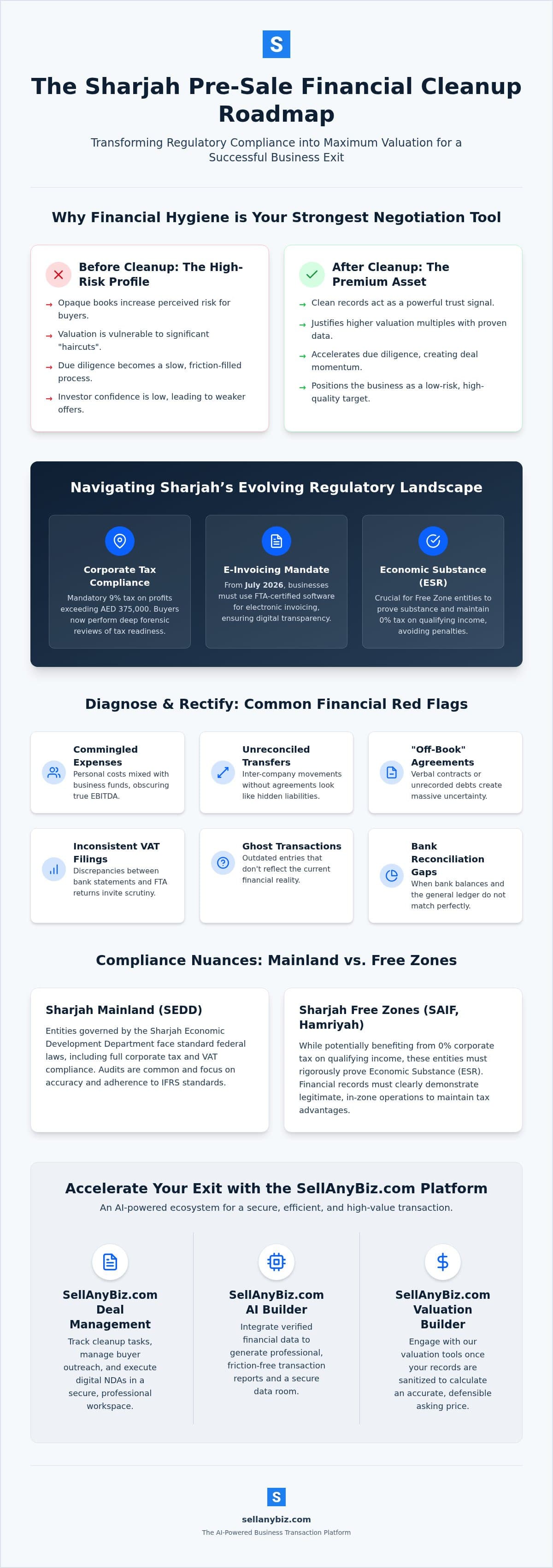
Sharjah Financial Cleanup: 2026 Pre-Sale Bookkeeping Guide
Also available in:Italiano

What if the most significant threat to your exit isn't a lack of buyers, but a single discrepancy in your 2025 tax filings? In Sharjah's evolving regulatory landscape, "good enough" bookkeeping no longer suffices. You know that the introduction of the 9% corporate tax and the July 2026 e-invoicing mandate have raised the stakes for every mainland and free zone entity. It's natural to feel concerned about how these layers of compliance might impact your final valuation or stall a potential deal.
A professional financial cleanup Sharjah strategy ensures your accounts are transparent, compliant, and optimized for a high-multiple sale. This guide provides a structured roadmap to sanitise your records before you engage with the SellAnyBiz.com Valuation Builder. We'll examine IFRS 18 presentation standards, tax-readiness for the September 2026 filing deadline, and the specific steps needed to build an audit-ready data room. You'll learn to eliminate friction, prove your profitability, and move toward a successful closing with absolute confidence. Every entry matters. Every record tells a story. We'll make sure yours justifies the highest possible price.
Key Takeaways
- Clean records act as a trust signal for international investors. Learn how transparent bookkeeping directly increases your business valuation multiples.
- Identify and rectify common red flags like commingled expenses or unreconciled transfers. A structured financial cleanup Sharjah strategy is the foundation of a successful exit.
- Navigate the specific reporting nuances between the SAIF Zone, Hamriyah Free Zone, and Mainland SEDD. We'll clarify audit requirements for each jurisdiction.
- Use SellAnyBiz.com Deal Management to track your preparation tasks. Integrate your verified data into the SellAnyBiz.com AI Builder for friction-free transaction reporting.
Table of Contents
The Strategic Role of Financial Hygiene in Sharjah Transactions
Financial hygiene is no longer a back-office administrative task. In Sharjah's maturing market, it's a strategic lever for value creation. Buyers don't just acquire assets. They acquire the certainty of future cash flows. If your books are opaque, the perceived risk increases. This risk directly triggers valuation haircuts. A comprehensive financial cleanup Sharjah process transforms your accounting from a compliance burden into a trust signal for international investors.
2026 marks a turning point for UAE business transactions. The implementation of corporate tax and stricter reporting standards means buyers now conduct deeper forensic reviews. They look for historical accuracy. They look for tax readiness. Moving from retrospective bookkeeping to transaction-ready reporting is essential. It ensures that when a buyer enters your data room, they find a professional, structured narrative of growth rather than a chaotic list of expenses.
This shift toward verified financial narratives mirrors trends in the broader fintech sector, where you can learn more about Tyrian Trade and how they establish trust through community engagement and verified participation.
From Admin Burden to Value Creation
Disorganized ledgers are deal killers. When a buyer discovers unreconciled inter-company transfers or commingled personal expenses, they lose confidence. This lack of trust translates into lower offers. Every day spent hunting for source documents during due diligence is a day the deal could sour. Speed is a currency in M&A. Clean books facilitate a faster due diligence process. This involves understanding financial statements as dynamic tools for negotiation, not just static records for the tax authorities.
Consistency builds value. By presenting verified data, you prove the stability of your margins. You demonstrate that your profit reporting is accurate. This transparency allows you to defend your asking price with data-backed conviction. It positions your business as a low-risk, high-quality acquisition target. Clear records. Verified profits. Secure exits.
Sharjah’s Evolving Regulatory Environment
The Sharjah Economic Development Department (SEDD) and federal authorities have significantly increased oversight. 2026 is a critical year. The mandatory electronic invoicing mandate begins in July 2026. Businesses must use FTA-certified accounting software. Additionally, the 9% corporate tax on income exceeding AED 375,000 is now a standard part of the financial landscape. Buyers in 2026 won't touch a business with a history of late filings or non-compliance.
Economic Substance Regulations (ESR) also play a vital role. For free zone entities, proving substance is mandatory to maintain 0% tax status on qualifying income. A pre-sale financial cleanup Sharjah strategy ensures these regulatory boxes are checked. It eliminates the fear of post-transaction penalties. Using tools like the SellAnyBiz.com AI Builder helps organize these complex inputs into professional reports, ensuring you stay ahead of Sharjah’s evolving requirements and maintain a friction-free transaction path.
Diagnosing the Damage: Common Financial Red Flags
Before you list your business, you must adopt the mindset of a forensic auditor. Buyers in Sharjah search for vulnerabilities to justify lower offers. Identifying red flags early allows you to control the narrative rather than reacting to discovery during due diligence. A thorough financial cleanup Sharjah process starts with isolating business operations from personal interests. Commingled expenses remain a primary concern. When personal travel or household costs appear on the company ledger, the true EBITDA becomes obscured. Professional buyers will discount these "add-backs" if they aren't documented with absolute precision.
Unreconciled inter-company transfers within UAE groups often signal systemic weakness. Without formal loan agreements or settlement records, these balances look like hidden liabilities. Similarly, "off-book" supplier agreements or verbal contracts create uncertainty. If a buyer discovers unrecorded debt, the trust is broken. Inconsistent VAT filing history is another major hurdle. Your bank statements must mirror your FTA returns exactly. Discrepancies here invite regulatory scrutiny and stall the transaction. Reviewing active business listings shows how verified financial data separates premium opportunities from high-risk ventures.
The Bank Reconciliation Fault Line
Ghost transactions haunt many Sharjah balance sheets. These are old entries, pending transfers, or unpresented checks that no longer reflect reality. Standardising these records is vital for AI-driven valuation tools. You must verify opening balances from previous fiscal years to ensure a clean audit trail. Accurate cash flow records are the backbone of a credible data room. If the bank balance doesn't match the general ledger, the entire financial statement loses credibility.
Accounts Receivable and Payable Integrity
Aged debtors require immediate attention. Buyers won't pay for receivables they can't collect. You must decide whether to write off or aggressively collect balances older than 90 days. Supplier statements must also match internal ledgers. Discrepancies here suggest poor internal controls. For service-based businesses, unearned revenue is a common trap. Recording cash as income before the service is delivered inflates profits artificially. This creates a liability that a sophisticated buyer will surely deduct from the final purchase price.
A Step-by-Step Guide to Sharjah Pre-Sale Cleanup
Executing a financial cleanup Sharjah project requires a methodical, phase-based approach. It isn't merely about correcting past errors. It's about repositioning your financial narrative for a sophisticated buyer. You're moving from a tax-minimisation mindset to a value-maximisation strategy. This transition requires discipline, precise documentation, and the right digital infrastructure. By following a structured roadmap, you eliminate the "surprises" that often derail Sharjah transactions during the final stages of negotiation.
Phase 1: Documentation and Access
Transaction readiness begins with a central repository. You can't afford to hunt for trade licenses or lease agreements once due diligence starts. Gather all VAT certificates and the last three years of audited statements. Establishing a "Single Source of Truth" prevents conflicting data from reaching the buyer's analysts. We recommend utilising SellAnyBiz.com Secure Data Rooms for document staging. This ensures your finance team works in a secure, controlled environment. It signals to the buyer that your business is organised, transparent, and ready for institutional scrutiny.
Phase 2: Normalisation and Add-backs
Normalising the Income Statement is where you surface hidden value. For Sharjah SMEs, this often involves defining Seller’s Discretionary Earnings (SDE). You must identify non-recurring expenses that won't repeat under new ownership. One-time repairs. Legal fees for a specific dispute. Personal expenses commingled with business operations. These should be "added back" to the profit to show the true earning potential. Don't forget to adjust for market-rate salaries. If you're an owner-operator taking a below-market draw, a buyer will adjust the profit downward to account for professional management costs. Be proactive. Define these adjustments before the buyer’s team does.
Phase 3: Final Review and Certification
A professional financial cleanup Sharjah strategy ends with a rigorous final review. Conduct a "Mock Due Diligence" to identify remaining gaps in your VAT reconciliation or payroll records. Every bank entry must have a corresponding invoice. This level of detail is essential before you generate your final business valuation report. Once your ledger is airtight, seek sign-off from a certified UAE chartered accountant. This institutional endorsement builds immediate credibility with private equity firms and corporate acquisition teams. It reduces the perceived risk and accelerates the path from initial inquiry to a signed LOI.
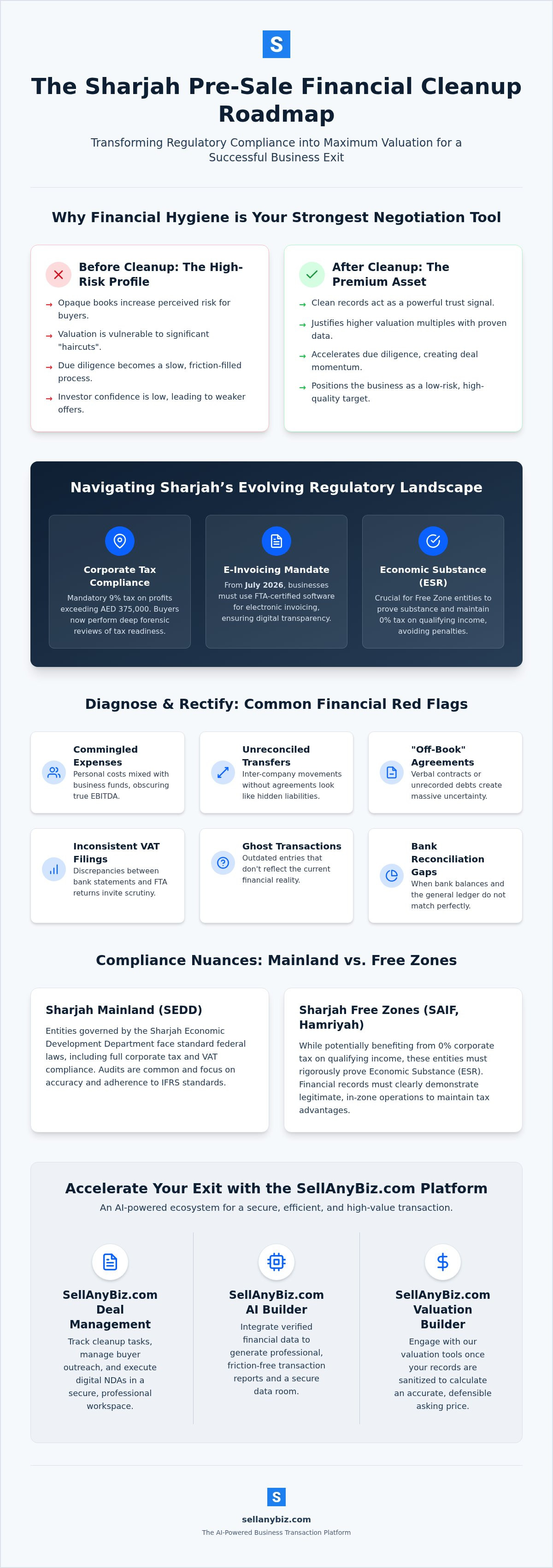
Compliance Nuance: Sharjah Free Zones vs. Mainland
A successful exit in Sharjah depends on your ability to navigate the specific regulatory requirements of your jurisdiction. While the UAE Federal Tax Authority (FTA) sets the broad framework, the documentation expected during due diligence differs significantly between mainland entities and free zone companies. A mainland business registered with the Sharjah Economic Development Department (SEDD) follows standard reporting protocols. However, entities in the Sharjah Airport International Free Zone (SAIF Zone) or Hamriyah Free Zone must adhere to additional authority-specific mandates. Your financial cleanup Sharjah strategy must account for these differences to avoid last-minute deal friction.
Mainland companies are subject to the standard 9% corporate tax rate on taxable income exceeding AED 375,000. In contrast, free zone entities have the potential to maintain a 0% tax rate on qualifying income. This distinction is a massive value driver during a sale. If you can't prove your income is "qualifying" through airtight bookkeeping, a buyer will price in a 9% tax liability, immediately reducing your valuation. Accurate record-keeping isn't just about compliance; it's about protecting your equity. You can browse Sharjah business listings to see how high-value targets present their jurisdictional compliance.
Free Zone Specific Cleanup
If your business operates within a "Designated Zone" like Hamriyah Free Zone, VAT management is a priority. You must track the movement of goods with precision to justify the VAT-free status of specific transactions. Cleanup here involves reconciling customs declarations with your sales ledger. Audit deadlines are also stricter. Companies in the Hamriyah Free Zone must submit audited financial statements within 6 months from the end of their financial year. Missing these deadlines creates a red flag for buyers, suggesting poor internal governance. Handling offshore-onshore transaction records requires clear transfer pricing documentation, especially if related party transactions exceed AED 40 million.
UAE Corporate Tax Readiness
The role of financial cleanup Sharjah is critical for corporate tax registration and ongoing compliance. For free zone persons, proving "Qualifying Income" requires a granular breakdown of revenue streams. You must demonstrate real economic substance within the UAE to benefit from tax incentives. This means your books must clearly segregate qualifying activities from non-qualifying ones. Buyers in 2026 will demand at least two years of tax-compliant records before signing an LOI. Utilizing SellAnyBiz.com Deal Management helps you track these jurisdictional tasks, ensuring your data room meets the rigorous FTA standards expected by institutional acquirers.
Accelerating Your Exit with SellAnyBiz.com
A successful financial cleanup Sharjah strategy concludes with a transition from internal preparation to external engagement. SellAnyBiz.com provides the institutional infrastructure to leverage your verified data. You aren't just listing a business. You're deploying a transaction-ready asset into a sophisticated ecosystem. The platform moves you beyond the limitations of manual spreadsheets. It offers a structured path from documentation to deal closure. By centralising your efforts here, you ensure that the hard work of sanitising your books translates directly into a higher valuation and a faster transaction timeline.
Your verified records flow directly into the SellAnyBiz.com AI Builder. This tool organises complex financial inputs into professional, standardised reports. It removes the ambiguity that often stalls Sharjah deals. Buyers don't have to guess your profitability. They see it through a lens of transparency. Furthermore, SellAnyBiz.com Deal Management allows you to track remaining cleanup tasks with precision. You can assign document collection to your finance team and monitor VAT reconciliation progress in real time. This methodical approach maintains momentum. It prevents the fatigue that often sets in during prolonged due diligence phases.
From Data Cleanup to Deal Flow
Clean books populate the SellAnyBiz.com Valuation Builder with accuracy. This tool creates a credible baseline for your asking price. It allows you to defend your position with data backed by the cleanup you've executed. Transaction friction is significantly reduced through ready-to-view Data Rooms. When a buyer executes a digital NDA, they gain immediate access to a structured environment. They find the 2026 tax filings and audited statements they expect. This transparency attracts serious buyers. It signals that your business is managed with institutional discipline, making it a low-risk acquisition target.
Collaborative cleanup happens within our professional workspaces. You can invite your UAE chartered accountant or M&A advisor to review the ledger before it goes live. This secure environment protects your sensitive data while ensuring every entry is airtight. It's a deal-management tool designed for the high-stakes reality of the Sharjah market.
Next Steps: Your Pre-Sale Roadmap
Preparation is the only hedge against deal failure. Your first step is to register for a professional workspace on SellAnyBiz.com. This gives you access to the tools needed to manage your financial cleanup Sharjah process. Once your data is organised, you can connect with vetted M&A advisors for a preliminary valuation. They can help you identify any remaining gaps before you go to market. To understand the current landscape, browse active Sharjah listings to benchmark your performance against competitors. See how the most successful sellers present their financial health. Then, use our ecosystem to surpass them. Move forward with confidence. Close with certainty.
Secure Your Legacy with Transaction-Ready Financials
A successful exit in Sharjah requires more than just a profitable operation. It demands the institutional transparency that only a rigorous financial cleanup Sharjah process can provide. You've seen how sanitising your records defends your valuation against aggressive due diligence and ensures compliance with the 2026 e-invoicing mandates. Whether you're navigating the nuances of the SAIF Zone or a mainland SEDD license, your books are the ultimate proof of your business's stability.
SellAnyBiz.com provides the infrastructure to turn this data into deal flow. Our AI-powered Valuation Builder and Secure Data Rooms are designed for Sharjah sellers who prioritise precision and confidentiality. By leveraging our end-to-end deal management ecosystem, you move from administrative burden to a structured, friction-free closing. Don't leave your final sale price to chance. Start your valuation process on SellAnyBiz.com today and transform your financial history into a compelling acquisition narrative. Your ideal exit is within reach.
Frequently Asked Questions
How long does a typical financial cleanup take in Sharjah?
A typical financial cleanup Sharjah project takes between four and twelve weeks. This timeframe depends on the volume of unreconciled transactions and the availability of source documents. For businesses with complex inter-company transfers or multi-year VAT discrepancies, the process may extend toward the upper limit. Starting early ensures your ledger is transaction-ready before you engage with potential acquirers through the SellAnyBiz.com ecosystem.
Can I sell my business if my books are currently messy?
You can list a business with disorganized records, but you'll likely face a significant valuation penalty. Savvy buyers interpret messy books as a hidden operational liability, often leading to retracted offers during the due diligence phase. Completing a financial cleanup Sharjah project before listing protects your equity. It transforms perceived risks into verified trust signals, allowing you to defend a higher asking price with confidence.
What is the difference between bookkeeping and financial cleanup?
Bookkeeping is the routine recording of daily transactions; cleanup is a forensic, retrospective project. While bookkeeping maintains the status quo, cleanup identifies historical errors, removes personal expenses, and normalises the income statement for an exit. It prepares your balance sheet for the SellAnyBiz.com Valuation Builder by ensuring every entry is accurate, defensible, and aligned with IFRS 18 standards.
Do I need a Sharjah-based accountant for pre-sale cleanup?
Local expertise is vital for navigating specific SEDD and Free Zone mandates. An accountant familiar with Sharjah's regulatory landscape understands the specific audit requirements for SAIF Zone and Hamriyah Free Zone entities. They ensure your reporting aligns with regional standards and customs rules. This reduces the risk of non-compliance penalties or delays during the high-stakes transaction process.
How does UAE Corporate Tax affect my business valuation in 2026?
The 9% corporate tax rate directly reduces the net cash flows used to calculate business valuations. In 2026, buyers will scrutinise your tax registration and filing history with the Federal Tax Authority. If your records don't clearly segregate qualifying income from non-qualifying streams, acquirers may price in the maximum tax liability. This effectively lowers your final sale price and complicates the deal structure.
What documents are essential for a Sharjah business due diligence?
You must provide trade licenses, VAT certificates, and audited financial statements for the last three fiscal years. Additionally, signed lease agreements, employee records, and documentation for related-party transactions above AED 40 million are essential. Organising these in SellAnyBiz.com Secure Data Rooms prevents delays. It demonstrates professional governance and transparency to private equity firms and corporate acquisition teams.
Can SellAnyBiz.com help me find an accountant for cleanup?
SellAnyBiz.com provides the end-to-end transaction ecosystem and Professional Workspaces needed to manage a cleanup. While the platform focuses on deal management and AI-powered valuation tools, it enables seamless collaboration between you and your chosen accounting team. You can manage tasks, share documents securely, and track progress toward an audit-ready state within a single, secure environment designed for Sharjah sellers.
Is a financial cleanup required for Sharjah Free Zone companies?
Financial cleanup is critical for Free Zone companies to maintain their 0% tax incentives. Authorities in Hamriyah and SAIF Zone require audited statements within six months of the financial year-end. Without clean books, you cannot prove the "Economic Substance" required to qualify for tax exemptions. This lack of proof makes your business a higher risk for international investors and domestic buyers alike.
Disclaimer
Disclaimer: SellAnyBiz provides general business marketplace, brokerage and transaction-support information. Services may be subject to regional legal and regulatory requirements. Please review our Disclaimer & Compliance Notice for full details.