Business Valuation Mistakes: Avoiding the Errors That Kill Deals in 2026
Also available in:Italiano

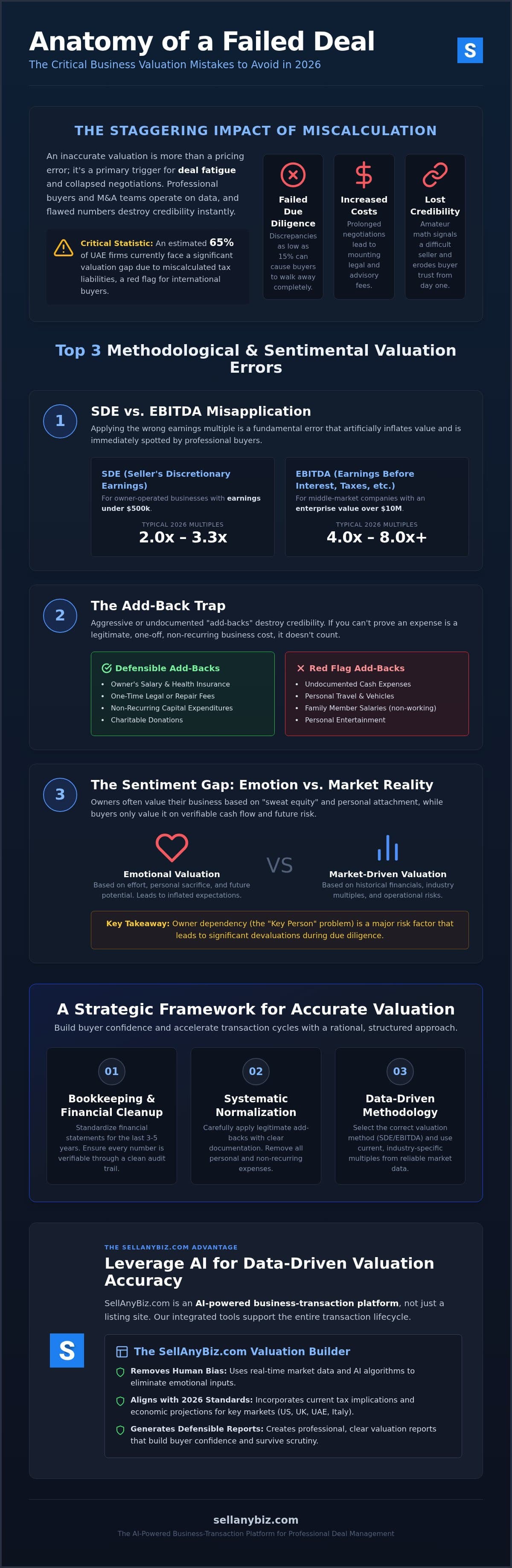
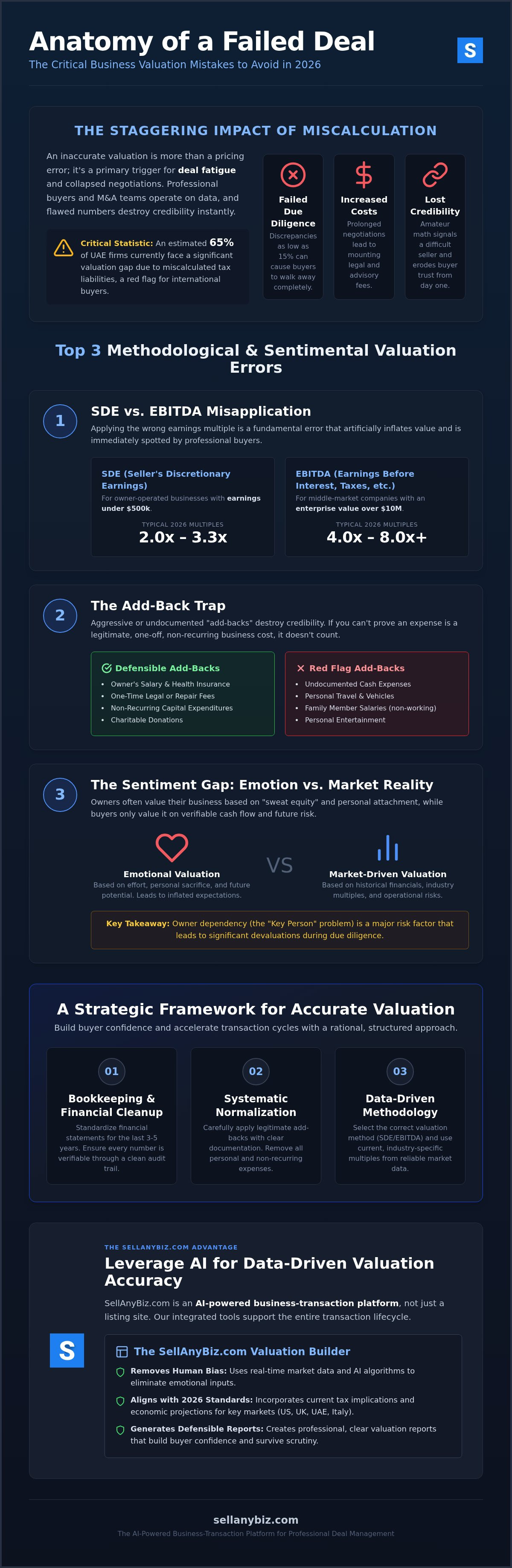
An estimated 65% of UAE firms currently face a significant valuation gap due to miscalculated tax liabilities. In the US and UK, deal fatigue often sets in when buyers uncover inconsistencies in owner-dependent earnings. These business valuation mistakes don't just delay transactions. They kill them. You've seen the frustration of a stalled LOI. The friction of failed due diligence. The feeling of leaving money on the table. It's a high-stakes environment where sentiment often clouds the data.
You need a rational, structured solution. We'll identify the critical errors that trigger deal fatigue and provide the framework to rectify them. This guide promises a clear path to a defensible, professional valuation report. One that builds buyer confidence. We'll cover the impact of 2026 regulatory shifts, the necessity of financial cleanup, and how the SellAnyBiz.com Valuation Builder removes bias from your inputs. Expect faster transaction cycles. Expect a narrative that survives the scrutiny of professional acquisition teams. Let's move forward.
Key Takeaways
- Understand how inaccurate pricing triggers immediate skepticism from institutional buyers and leads to terminal deal fatigue.
- Identify and rectify common business valuation mistakes, such as misapplying industry multiples or confusing SDE with EBITDA.
- Discover why owner dependency and emotional "sweat equity" frequently lead to significant devaluations during the due diligence phase.
- Implement a strategic framework for Bookkeeping & Financial Cleanup to normalize statements and present a defensible financial history.
- Utilize the SellAnyBiz.com Valuation Builder to remove human bias and align your asking price with 2026 market standards.
Table of Contents
The High Cost of Business Valuation Mistakes in 2026
Professional acquisition teams operate on data. They don't buy potential without proof. When a seller presents an inflated figure, the transaction usually stalls before it begins. These business valuation mistakes create an immediate credibility gap. Buyers assume that if the pricing is flawed, the underlying operations might be too. Trust is the primary currency in M&A. Once it's lost, it's rarely recovered.
Standard business valuation methodologies rely on verifiable cash flows and market comparables. An asking price is merely a starting point. Enterprise value is the reality. It accounts for debt, cash, and risk. In 2026, with UK inflation projected at 2.5% and the UAE's 9% corporate tax rate affecting net income, buyers are more disciplined than ever. They look for precision. They expect a data-driven narrative.
Credibility and the Buyer's Perspective
Amateur math is visible. Institutional buyers, private equity firms, and corporate M&A teams spot inconsistencies in seconds. If the Seller’s Discretionary Earnings (SDE) don't align with industry benchmarks, interest evaporates. An unrealistic price signals a difficult seller. It suggests the owner is emotionally anchored to a number rather than market reality. The buyer's mindset shifts from finding value to finding flaws. This skepticism often leads to more aggressive due diligence and lower final offers.
Financial Consequences of Mispricing
Pricing disputes cause deal fatigue. Negotiations drag on. Legal fees mount. Advisory costs escalate. Every month a business remains on the market, its perceived value drops. This leads to the stale listing problem. On platforms like SellAnyBiz.com listings, sophisticated buyers track how long a profile has been active. A business that hasn't sold in six months suggests hidden issues. The opportunity cost is high. You lose time. You lose leverage. Most importantly, you lose the deal momentum required to close.
Avoidable business valuation mistakes often lead to failed due diligence. When a buyer's audit reveals a 15% discrepancy between the reported value and the actual books, they walk away. They don't just renegotiate. They exit the data room. The cost of a failed deal is not just the lost sale price. It's the thousands spent on bookkeeping cleanup and legal support for a transaction that never happened.
Methodological Errors: Why Most Valuations Fail Due Diligence
Precision in methodology is the difference between a closed deal and a collapsed negotiation. Many sellers rely on "back of the napkin" calculations. This leads to terminal business valuation mistakes that professional buyers identify within minutes of opening the data room. Establishing a framework for accurate valuation requires more than a simple multiplier. It demands a rigorous analysis of cash flow quality and operational risk.
One primary error is the misapplication of SDE versus EBITDA. Seller’s Discretionary Earnings (SDE) are appropriate for owner-operated small businesses, typically those with under $500,000 in earnings. In 2026, average US sale multiples for these entities range from 2.0x to 3.3x SDE. Conversely, middle-market companies with an enterprise value over $10M use EBITDA. Applying an EBITDA multiple to an SDE figure artificially inflates value. Buyers walk away when they see this lack of financial literacy.
Working capital requirements and the "Key Person" discount are also frequently ignored. A buyer expects the business to include enough cash, inventory, and receivables to operate on day one. If you haven't accounted for this, you're essentially asking the buyer to pay twice. Similarly, if the business relies entirely on your personal relationships or technical skill, a buyer will apply a significant discount. They aren't buying a job. They're buying a self-sustaining asset.
The Add-Back Trap
Normalization is a critical step in preparing for a sale. Sellers often try to "add back" every personal perk to boost the bottom line. While legitimate business expenses like one-time legal fees or owner health insurance are acceptable, personal travel and undocumented cash expenses are red flags. These business valuation mistakes trigger immediate skepticism. M&A advisors reject aggressive add-backs that lack a clear audit trail. If you can't prove it, it doesn't count toward the value. Reliable Confidential Business Listings prioritize clean, verified financials to maintain buyer trust.
Multiple Mismanagement
Rules of thumb are dangerous in a 2026 market. Multiples are not static. They vary wildly by geography and sector. A retail business in London faces different inflationary pressures than a tech firm in Dubai. While middle-market private equity multiples averaged 7.2x to 7.5x EBITDA in 2025, specific 2026 industry benchmarks like HVAC (3.0x to 5.0x SDE) or SaaS (2.4x to 4.0x SDE) show the need for niche precision. Growth rates also play a role. A business growing at 15% annually commands a higher multiple than a stagnant one, regardless of current profit. Don't guess. Use local market data to justify your position.
The Sentiment Gap: Emotional vs. Market-Driven Valuations
Owners see a legacy. Buyers see a cash flow stream. This disconnect is the sentiment gap. It's the psychological barrier that stalls more negotiations than any other factor. Sellers often view their business through the lens of sacrifice. They remember the late nights and the personal risks. However, sentiment is not a line item. Buyers are indifferent to your history. They focus exclusively on future return on investment.
The "sweat equity" fallacy is a common trap. Years of effort do not inherently increase enterprise value. If high effort results in low margins, the valuation remains suppressed. Similarly, relying on replacement cost is a strategic error. Building a similar facility might cost $2M, but if that facility generates no profit, its market value is negligible. In 2026, buyers prioritize predictability over physical assets. They want to know the cost of the cash flow, not the cost of the equipment.
Ignoring market saturation is another of the critical business valuation mistakes. You might have the best restaurant in the district, but if the local market is oversupplied, your multiple will suffer. 2026 data shows single-unit restaurants often trade between 1.5x and 2.5x SDE. If you're holding out for 4x based on emotional attachment, you'll likely face a stale listing. Market reality always wins.
The 'Potential' Problem
Buyers pay for what you built. They don't pay for what they have to build. Sellers frequently price their business based on where it *could* be in three years. This is a fundamental error. If the growth requires new capital and new management, that value belongs to the buyer. You can bridge this gap using earn-outs or performance milestones. This structure allows you to capture a portion of future growth while reducing the buyer's immediate risk. A professional Information Memorandum generated through SellAnyBiz.com can help document these projections without overreaching on the current asking price.
Market Realism and Comparables
Verified transaction data is the only defense against low-ball offers. Anecdotal evidence from "a friend who sold for 5x" is useless in a professional deal room. You need hard data from recent sales in your specific sector. Retail, healthcare, and hospitality sectors have distinct 2026 benchmarks that vary by region. Italian firms now face updated Italian Valuation Principles (PIV) that demand greater transparency. Use the SellAnyBiz.com AI Smart Search to find comparable listings in the UK, US, or UAE. This tool provides the market-driven evidence required to justify your position and move the transaction forward. Let the data speak for you.
A Strategic Framework for Accurate Valuation Preparation
Preparation is the only antidote to deal fatigue. Most business valuation mistakes surface during the transition from a Letter of Intent (LOI) to due diligence. This is when a buyer's audit team scrutinizes every entry. If your financials aren't structured for scrutiny, the transaction momentum dies. A strategic framework ensures your valuation isn't just a number. It's a defensible narrative supported by clean, verifiable data.
You must look beyond the profit and loss statement. A comprehensive preparation phase includes identifying and documenting intangible assets. Intellectual property, brand equity, and long-term contracts often represent significant enterprise value that isn't captured in standard accounting. Performing a 'mock' due diligence allows you to surface these value drivers. It also helps you identify valuation leaks before a buyer finds them. This proactive approach maintains your leverage throughout the negotiation.
Step 1: Financial Hygiene
Financial hygiene starts with complete separation. You must decouple personal and business accounts entirely. Professional buyers look for clean, reconciled balance sheets that reflect operational reality. Inconsistencies in your ledger suggest operational risk. If you're operating in the UK, local expertise is vital for ensuring your records meet 2026 standards. Detailed Pre-Sale Bookkeeping Bristol services can help align your accounts with buyer expectations. Accuracy here builds the immediate trust required to move forward.
Step 2: Normalisation and Adjustments
Normalising your statements for the last three fiscal years is essential. This process removes "noise" from your financials. You must adjust for one-time expenses, such as a major equipment repair, or windfalls like a unique tax credit. A critical adjustment is the owner's salary. If you're underpaying yourself to boost profit, a buyer will normalize that expense to market rates. Our Business Valuation Report guide provides a structured approach to these adjustments. This ensures your EBITDA reflects the true, sustainable cost of operations under new management.
Step 3: Documenting the Narrative
The final step is translating your data into a compelling Information Memorandum. Use the SellAnyBiz.com AI Builder to construct a professional document that speaks the language of M&A. Every financial claim must have supporting evidence ready in a Secure Data Room. This readiness signals to acquisition teams that you're a sophisticated seller. It reduces friction and accelerates the timeline from initial interest to completion. Once your data is structured, you can confidently list your business for sale on our AI-powered transaction platform.
Leveraging SellAnyBiz.com for Data-Driven Valuation Accuracy
Subjectivity is the root of most business valuation mistakes. Emotional attachment and inconsistent data entry lead to disputes that kill deals. SellAnyBiz.com provides the rational, structured solution. Our AI-powered business-transaction platform removes human bias from the initial calculation phase. It forces a focus on verified inputs. This ensures your starting point is grounded in market reality rather than optimistic guesswork.
We use AI Smart Search to benchmark your business against global mid-market data. This isn't generic advice. It's real-time market intelligence from the UK, US, UAE, and Italy. You see where your EBITDA or SDE stands compared to recently closed transactions. You understand the multiples currently being paid in your specific sector. You move forward with confidence. The platform transforms raw financials into a credible, defensible position.
The Power of the Valuation Builder
The SellAnyBiz.com Valuation Builder organizes complex assumptions into professional report outputs. It handles the heavy lifting of normalization. You don't guess. You calculate. The platform integrates The SellAnyBiz.com Broker and M&A Advisor Workspace. This allows advisors and sellers to collaborate in a secure environment. It ensures every add-back is documented. It ensures every claim is defensible. This level of transparency is exactly what institutional buyers expect in 2026.
For a deeper understanding of these mechanics, consult our guide on How to Value a Business in 2026. The SellAnyBiz.com AI Builder then takes these outputs to generate transaction-ready documents. Your Information Memorandum becomes a data-driven narrative. It's built to survive the scrutiny of a rigorous due diligence process. Every financial claim is backed by the platform's structured methodology.
Closing the Gap Between Prep and Completion
Valuation is only the beginning. Most platforms leave you with a number and no path to execution. SellAnyBiz.com manages the entire transaction lifecycle. You transition from valuation to SellAnyBiz.com Deal Management in a single workspace. This continuity prevents information loss. It maintains deal momentum. You don't have to restart the process when a buyer enters the picture. The data is already there.
Security is paramount during the final stages. We ensure confidentiality through digital, NDA-led access to your sensitive records. Your secure data room is integrated into the workspace. Prospective buyers must be vetted. You connect with qualified acquisition intent through the SellAnyBiz.com Marketplace. This connected ecosystem supports you from initial engagement through to completion. It's the rational way to avoid the business valuation mistakes that stall traditional marketplace listings.
Secure Your Exit with Data-Driven Precision
A successful transaction in 2026 requires more than a profitable business. It demands a defensible narrative. Avoiding common business valuation mistakes starts with rigorous financial hygiene and a clear understanding of market-specific multiples. You've seen how emotional sentiment and methodological errors trigger deal fatigue. By normalizing your financials and documenting your intangible assets, you transform your business into a verified investment opportunity. Precision builds the trust required to close.
SellAnyBiz.com provides the infrastructure to manage this complexity. Our AI-powered Valuation Builder removes human bias. It aligns your asking price with current global benchmarks. With over 15 years of transaction expertise, we understand the friction points that stall negotiations. We've built the solution. You can manage the entire lifecycle through a single workspace, utilizing Secure Data Rooms to maintain confidentiality until the final signature. The process doesn't have to be frustrating when you have the right tools.
Start your accurate business valuation on SellAnyBiz.com. Your legacy deserves a professional exit. Take the first step toward a successful completion today.
Frequently Asked Questions
What is the most common mistake in valuing a small business?
Over-reliance on rule of thumb multiples without adjusting for risk or owner dependency is the most common error. Many owners assume a flat 3x multiple applies regardless of their involvement. In markets like London or New York, buyers heavily discount firms where the owner is the primary revenue driver. This lack of operational autonomy is a terminal error. It creates a sentiment gap that professional buyers won't bridge.
How do I calculate SDE without making errors?
Start with your net profit. Add back non-cash expenses, interest, and one-time capital expenditures. Include the owner's total compensation and personal perks. Errors occur when sellers try to add back legitimate operational costs. In 2026, UAE firms must also account for the 9% corporate tax on income exceeding AED 375,000. Use a structured ledger to ensure every add-back is defensible. This maintains credibility during due diligence.
Should I include my personal salary in the business valuation?
Your salary is a key component of Seller’s Discretionary Earnings (SDE). However, professional buyers will normalize this figure. If you're paying yourself significantly above or below the market rate for a replacement manager, an adjustment is made. This ensures the EBITDA reflects the true cost of running the business under new ownership. Proper Bookkeeping & Financial Cleanup helps document these distinctions clearly for M&A advisors and corporate buyers.
How does an inaccurate valuation affect the due diligence process?
It triggers immediate skepticism and often leads to terminal deal fatigue. If a buyer's audit reveals a 15% discrepancy between your reported value and the actual books, the transaction usually collapses. Business valuation mistakes found late in the process suggest a lack of professional management. Buyers in Milan or Dubai will exit the data room if the financial narrative doesn't match the reported tax records and bank statements.
Can AI really provide an accurate business valuation in 2026?
AI provides a data-driven baseline by removing human bias from the inputs. The SellAnyBiz.com Valuation Builder uses AI Smart Search to benchmark your firm against real-time global mid-market data. It processes thousands of data points from the US, UK, and UAE to ensure your multiple is grounded in current reality. While AI speeds the preparation, human judgment remains essential for final negotiations and assessing nuanced risk factors in local markets.
What documents are essential for a professional valuation report?
You need three years of profit and loss statements, balance sheets, and tax returns. Essential documentation includes:
- A detailed list of defensible add-backs
- An inventory of physical business assets
- Documentation for intangible IP and contracts
How often should I update my business valuation before selling?
Update your valuation quarterly to reflect current market conditions and internal growth. Interest rates and inflation forecasts in the UK and US shift frequently, impacting discount rates and multiples. Waiting too long to refresh your data leads to business valuation mistakes that buyers will exploit during price negotiations. Regular updates ensure your asking price stays aligned with the enterprise value as you move toward a final Letter of Intent.
Why do buyers and sellers often disagree on business value?
Disagreements stem from the sentiment gap. Sellers value the history and sweat equity. Buyers value the future cash flow and risk. Sellers often price based on replacement cost. Buyers look at ROI and debt service coverage. Bridging this gap requires a neutral, data-driven framework. Professional brokerage services focus on aligning these perspectives through transparent, verifiable financial reporting. This reduces friction during the final negotiation stages.
Disclaimer
Disclaimer: SellAnyBiz provides general business marketplace, brokerage and transaction-support information. Services may be subject to regional legal and regulatory requirements. Please review our Disclaimer & Compliance Notice for full details.