Chicago Acquisition Legal Support: 2026 M&A Guide
Also available in:Italiano

What if the most expensive part of your next deal isn't the enterprise value, but the friction of a fragmented closing process? In 2026, securing acquisition legal support Chicago requires more than just a local law firm. It demands a structured approach to evolving Illinois mandates. Between new healthcare oversight under HB 5000 and tightening worker classification rules, the margin for error is shrinking. Every missed filing or misclassified contract adds risk to your transaction.
You likely recognize that traditional M&A communication is often broken. Lawyers, brokers, and buyers frequently operate in silos. This lack of integration leads to high costs for simple document drafting and unnecessarily long closing cycles. This guide provides a roadmap to navigate these complexities using SellAnyBiz.com transaction management tools. We'll examine the 2026 Illinois legal framework, essential deal documentation, and how to use a structured legal readiness framework to minimize friction. You'll learn to secure a compliant transaction while leveraging automation to protect your deal velocity.
Key Takeaways
- Understand why Chicago's industrial and tech sectors require specialized municipal and state-level legal alignment.
- Navigate the dual regulatory regime of federal oversight and Illinois Securities Department compliance for stock-based transactions.
- Access structured acquisition legal support Chicago across three critical deal phases: pre-deal structuring, execution, and closing.
- Reduce transaction friction and overhead by transitioning from fragmented email-based diligence to a centralized, platform-led workspace.
- Optimize deal velocity using SellAnyBiz.com to manage digital NDAs, secure data rooms, and AI-assisted document generation.
Table of Contents
The Chicago M&A Landscape: Why Specialized Legal Support Matters
Chicago remains a primary destination for mid-market Mergers and acquisitions (M&A). The city's industrial base, retail density, and growing tech corridors attract diverse capital. Success in this environment requires specialized acquisition legal support Chicago. This support isn't a commodity. It's a strategic layer. It encompasses deep due diligence, precise contract drafting, and mandatory regulatory filings. Without it, transactions often stall at the municipal level.
The landscape is changing. In 2026, transactional efficiency is the new standard. Traditional hourly-rate models often lack the speed required for modern deal flow. The shift toward platform-integrated legal readiness allows buyers and sellers to collaborate in real time. This integration ensures that legal documentation isn't just a final step. It's a continuous part of the transaction lifecycle. Speed and compliance are now inseparable.
The Role of an Illinois Acquisition Attorney
An attorney's primary function is navigating the Illinois Business Corporation Act (BCA). The BCA governs how companies are bought, sold, and dissolved within the state. Proper alignment with these statutes prevents future litigation. Beyond state statutes, local nuances matter. Cook County presents unique tax liabilities and successor liability risks. A local expert identifies these early. They manage the intersection of Illinois law and Chicago-specific business licenses. This ensures the target entity can operate without interruption post-close; to further support this operational continuity, BlueBridge Group Placement Corp provides AI-driven employment services to help buyers efficiently manage and scale their new workforce.
Attorneys also handle the specific requirements of the Illinois Securities Department. For stock-based deals, this oversight is critical. It involves verifying that all disclosures meet state-level transparency standards. In 2026, the Illinois Commerce Commission has also tightened reporting standards for specific sectors. These updates impact how contracts are enforced and how consumer protections are handled during ownership transfers.
Challenges in Chicago-Based Transactions
Competition for vetted mid-market targets is intense. Buyers must move fast. Delaying legal review often kills deal momentum. Real estate-heavy acquisitions, common in manufacturing or hospitality, add layers of environmental and zoning complexity. For those focusing on the latter, analyzing a B2B hotel marketplace provides a clear view of wholesale inventory and distribution potential. These aren't just legal boxes. They're financial risks that require immediate attention.
Fragmented communication remains a significant hurdle. When lawyers, brokers, and buyers work in separate systems, errors happen. Securing structured buyer representation is essential to manage these hurdles early. This approach utilizes centralized workspaces to keep all parties aligned. It reduces the risk of non-compliance with Illinois-specific commerce laws while maintaining deal velocity. Every LOI and NDA must be drafted with local enforcement in mind. SellAnyBiz.com provides the infrastructure to manage these workflows with precision.
Understanding the Illinois Dual Regulatory Regime
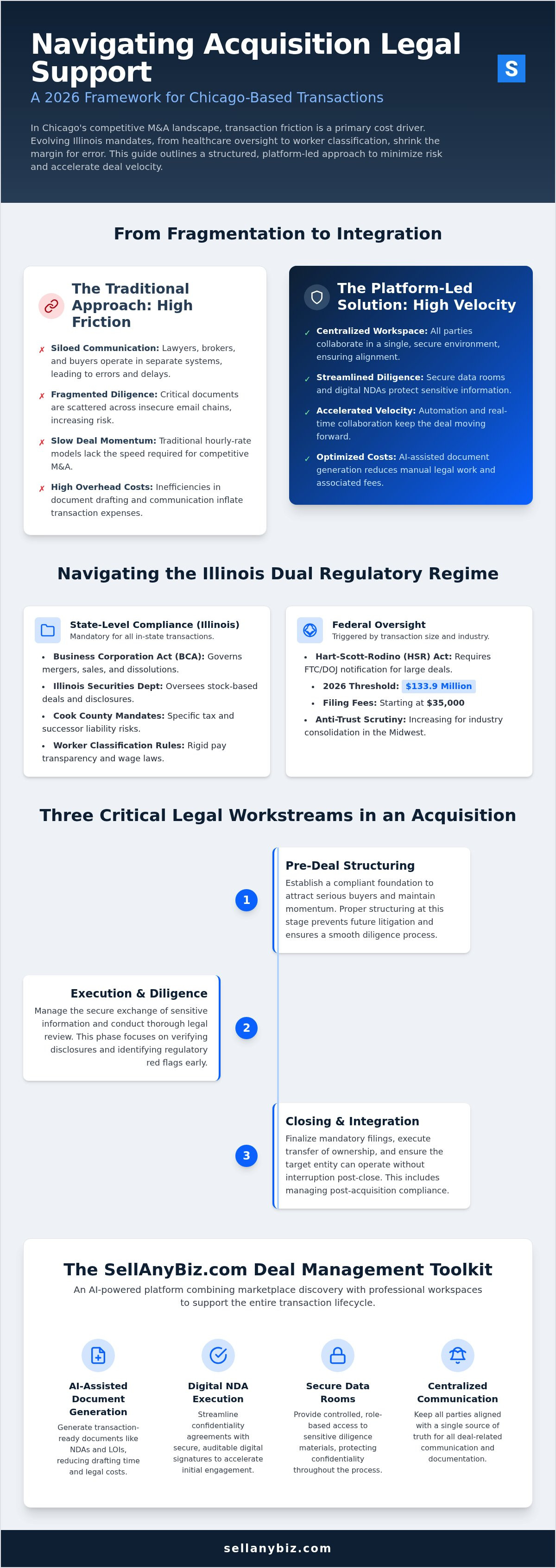
Chicago deals don't exist in a vacuum. They sit at the intersection of local mandates and federal oversight. This dual regulatory regime requires specific acquisition legal support Chicago to avoid costly delays. At the state level, the Illinois Securities Department oversees stock-based transactions. Parties must adhere to the Illinois statute on corporate mergers, which outlines the procedural requirements for combining entities. Simultaneously, larger mid-market deals often trigger federal review. For 2026, the Hart-Scott-Rodino (HSR) Act size-of-transaction threshold is $133.9 million. Crossing this line requires formal notification to the FTC and DOJ. Filing fees for these transactions start at $35,000.
Maintaining a confidential business sale process is critical during these early stages. Premature disclosure can complicate regulatory filings and damage employee morale. SellAnyBiz.com manages this risk through secure transaction workspaces. These environments ensure that sensitive data remains protected until the appropriate regulatory milestones are met.
State vs. Federal Compliance Requirements
Illinois employment laws are notably rigid compared to neighboring states. In 2026, expanded pay transparency and worker classification rules impact how buyers evaluate target payrolls. Post-acquisition integration must account for these Illinois-specific wage requirements to avoid successor liability. On the federal side, anti-trust scrutiny is increasing for industry consolidation within the Midwest. SellAnyBiz.com AI Smart Search helps buyers identify compliant targets by surfacing entities that fit specific regional and regulatory filters. This allows for a more focused discovery of Chicago business opportunities without over-extending into high-risk regulatory zones.
Regulatory Filings and the Illinois Commerce Commission
Regulated sectors like transport, energy, and healthcare face additional hurdles. Illinois House Bill 5000, effective January 1, 2027, already influences 2026 deal-making by requiring pre-closing notices for healthcare acquisitions involving private equity. The Illinois Commerce Commission (ICC) also requires specific approvals for utility or infrastructure transfers. Approval timelines in 2026 typically range from 60 to 120 days. Securing acquisition legal support Chicago specifically for these regulated filings is non-negotiable for infrastructure deals. Using secure data rooms to organize regulatory documentation ensures that state reviewers receive complete, structured filings. This preparation prevents the "request for information" loops that often derail closing dates.
Core Legal Workstreams for Chicago Business Acquisitions
Legal support for a Chicago transaction follows a rigid, three-phase lifecycle. It moves from initial intent to the final transfer of title. Effective acquisition legal support Chicago ensures these phases don't stagnate or overlap. Each stage requires specific documentation and verification to protect the capital at risk.
Phase 1 focuses on the Letter of Intent (LOI). This document defines the price, deal structure, and exclusivity period. It's the foundation of the transaction. Phase 2 is the execution phase, dominated by due diligence. This is where the buyer validates financial, legal, and operational hygiene. Phase 3 concludes with the definitive agreement. Finalizing the Asset Purchase Agreement (APA) or Stock Purchase Agreement (SPA) marks the transition of control. Accuracy in these final drafts prevents post-closing disputes.
Due Diligence: The Illinois Checklist
Verifying corporate standing is the first step in any Chicago deal. You must check the Illinois Secretary of State records to confirm the target is authorized to conduct business. The Illinois Business Corporation Act provides the statutory framework for these requirements. Next, review all UCC-1 filings. These reveal existing liens on Chicago-based equipment or inventory. Finally, audit local employment contracts. Illinois has specific standards for non-compete enforceability. In 2026, these rules are more restrictive than in previous years. Missteps here lead to immediate litigation risks.
Stock Deals vs. Asset Deals in Chicago
Asset deals are frequent in the Chicago metropolitan area. They allow buyers to select specific assets while leaving behind unwanted liabilities. This structure often results in a favorable "step-up" in tax basis. Stock deals are different. The buyer acquires the entire entity, including all historical tax and legal liabilities. Illinois law treats these transfers with distinct scrutiny, particularly regarding successor liability.
Structuring these complex deal terms requires precision. You can use the SellAnyBiz.com AI Builder for initial drafts of these agreements. This tool generates structured templates that align with current M&A standards. It allows you to move from intent to a professional draft in minutes. This platform-led approach ensures your acquisition legal support Chicago is both efficient and grounded in deal-room reality. It bridges the gap between fragmented communication and a closed deal.
Traditional Legal Counsel vs. Platform-Led Support
Traditional acquisition legal support Chicago often relies on inefficient document silos. Hourly billing models prioritize billable increments over transaction speed. Email-based exchange creates versioning risks and fragmented due diligence. These legacy methods struggle to keep pace with 2026 deal velocity. They often lead to "deal fatigue" before the first draft of an APA is even reviewed. The friction inherent in fragmented communication is a primary cause of deal failure in the mid-market.
Platform-led support offers a rational alternative. It integrates flat-fee advisory options through partner networks with structured deal rooms. AI-assisted drafting handles high-volume, low-complexity documents. This allows human experts to focus on high-stakes negotiation and risk mitigation. The SellAnyBiz.com Broker and M&A Advisor Workspace bridges this gap. It provides the infrastructure for a connected deal lifecycle. Transaction participants move from intent to closing within a single, secure environment.
Why Platform Integration Accelerates Closing
Centralized deal management eliminates administrative back-and-forth. All participants have real-time visibility into document status. Buyers and sellers track progress without waiting for weekly status calls. This transparency reduces total legal spend. By providing "clean" transaction materials to attorneys, you minimize the time they spend on basic data entry. They receive structured data, not messy folders. This shift allows for faster execution and lower overhead. It ensures that every stakeholder is working from the most recent version of the truth.
The Hybrid Approach: AI + Expert Human Judgment
AI handles the initial friction of a deal. It generates digital NDAs and teasers instantly. This speed is critical for maintaining buyer interest in a competitive market. However, complex negotiation still requires expert judgment. SellAnyBiz.com connects Chicago buyers with vetted legal partners who understand the local landscape. You can maintain a 2026 seller’s checklist directly within the platform. This ensures no regulatory or operational steps are missed during the closing sprint. The combination of algorithmic speed and human expertise creates a superior closing environment.
To start your search for vetted opportunities, you can browse current Chicago business listings.
Executing Your Chicago Deal with SellAnyBiz.com
SellAnyBiz.com provides the institutional infrastructure required for sophisticated mid-market deals. It's an AI-powered business-transaction platform built to eliminate the friction of fragmented communication. For buyers and advisors seeking acquisition legal support Chicago, the platform serves as the central deal room. It ensures that every legal workstream is visible, tracked, and secure. It replaces the traditional, siloed approach with a connected ecosystem.
Executing a Chicago deal involves a methodical progression through the platform's core tools:
- Step 1: Mandate Registration. Define your acquisition intent and surface vetted Chicago listings that match your strategic profile.
- Step 2: Document Generation. Use the SellAnyBiz.com AI Builder to produce initial NDAs and LOIs. These templates are designed for professional M&A standards.
- Step 3: Data Room Launch. Open a secure data room. This centralizes the due diligence process and provides a clear audit trail for legal reviewers.
- Step 4: Counsel Integration. Invite your legal team into the Workspace. They can review documents and manage task lists in real time without email silos.
Leveraging AI for Transaction Readiness
Preparation is the key to deal velocity. Buyers can justify offer prices by generating professional Business Valuation Reports directly through the platform. This data-driven approach builds credibility with sellers and their advisors. Natural-language search tools allow you to filter for Illinois-specific business opportunities with precision. You can also automate the outreach process to Chicago business owners. This ensures a consistent deal flow without the overhead of manual prospecting. Every step is designed to make the buyer "deal-ready" before formal negotiations begin.
Managing the Closing Process
The final sprint to closing requires disciplined project management. The SellAnyBiz.com Engagement CRM tracks every deal stage and individual task. It provides a high-level overview of the transaction's health. For capital requirements, the platform provides introductions to escrow services and acquisition funding solutions through verified partners. This connected ecosystem supports the entire transaction lifecycle. It moves the deal from initial engagement through due diligence to a successful completion. Structured deal management tools ensure that the transfer of ownership is compliant, documented, and secure.
Securing Your Transaction Infrastructure
Successful acquisitions in Chicago now depend on the integration of local legal expertise and modern transaction technology. Navigating the 2026 landscape, with its specific Illinois Securities Department mandates and shifting HSR thresholds, requires a structured approach. Fragmented communication and document silos are no longer viable in a high-velocity market. These inefficiencies lead to deal fatigue and increased risk. To explore how strategic advisory can further strengthen your acquisition path, you can discover PP-X and their approach to business growth.
By centralizing your deal flow within a secure, AI-powered ecosystem, you ensure that every legal workstream is both compliant and efficient. You move from initial discovery to closing with the assurance that your documentation meets the highest professional standards. Securing the right acquisition legal support Chicago is about more than just hiring counsel. It's about building a foundation for deal readiness and long-term security—a concept that extends to technical infrastructure for sectors like hospitality, where TableCompass.ai ensures POS systems and delivery platforms remain integrated post-close. You can leverage AI-powered deal management tools, secure data rooms for Illinois due diligence, and access a vetted pool of high-intent acquisition targets today.
Browse Vetted Chicago Business Listings on SellAnyBiz.com.
Your path to a successful mid-market closing starts with the right platform; to ensure your team is ready to scale revenue immediately after the acquisition, check out Just Go Sell for expert sales training. We look forward to seeing your next deal move forward with precision.
Frequently Asked Questions
What are the specific legal requirements for buying a business in Chicago?
Buying a Chicago business requires compliance with the Illinois Business Corporation Act. You must verify corporate standing with the Secretary of State and manage the transfer of City of Chicago business licenses. If the deal involves stock, the Illinois Securities Department provides oversight. Large transactions may also trigger federal Hart-Scott-Rodino filings. Every step requires precise documentation to ensure the legal title transfers without existing municipal liabilities.
How does Illinois law differ from other states regarding business acquisitions?
Illinois law features unique protections regarding worker classification and pay transparency that impact post-acquisition integration. Successor liability standards in Cook County are also distinct, often holding buyers responsible for certain seller obligations. Unlike some states with more flexible non-compete rules, Illinois has tightened enforceability standards as of 2026. These local nuances make specialized acquisition legal support Chicago essential for identifying risks that don't exist in other jurisdictions.
Do I need a local Chicago attorney for a small business purchase?
Local expertise is critical even for small transactions due to Chicago's complex municipal code. City-specific zoning, health permits, and liquor licenses don't follow a standard state template. A local attorney understands the specific requirements of the City of Chicago Department of Business Affairs and Consumer Protection. They ensure that your new entity is authorized to operate immediately after closing without facing unexpected fines or operational shutdowns.
What is the typical cost of legal support for an M&A deal in Illinois?
Costs vary based on deal size and the chosen fee structure. Many Illinois firms are shifting toward alternative fee arrangements or value-based pricing rather than traditional hourly billing. Complex deals requiring Hart-Scott-Rodino filings or Illinois Commerce Commission approval involve higher administrative and filing fees. While we don't provide specific pricing for legal services, the complexity of the regulatory environment typically dictates the total investment in professional counsel.
How can SellAnyBiz.com help reduce my legal fees during an acquisition?
SellAnyBiz.com reduces legal overhead by automating the administrative phase of the transaction. You can use the AI Builder to generate initial NDAs and LOIs, which reduces the time attorneys spend on basic drafting. The platform's centralized Workspace and secure data rooms keep documents organized and accessible. This transparency allows your legal team to focus on high-value negotiation rather than searching for fragmented files or managing email-based version control.
What should I check during legal due diligence for a Chicago company?
Your due diligence should prioritize UCC-1 lien searches and a thorough audit of Illinois-specific employment contracts. Verify the target's standing with the Illinois Secretary of State and check for any outstanding Cook County tax liabilities. In 2026, it's vital to review compliance with expanded pay transparency and worker classification rules. These areas represent the highest risk for successor liability and post-closing litigation in the Chicago market.
How long does the legal closing process take for a mid-market Chicago deal?
A typical mid-market transaction in Chicago takes between 60 and 120 days to reach a legal close. This timeline accounts for the execution of the LOI, the due diligence period, and the finalization of the purchase agreement. If the transaction requires regulatory approval from the Illinois Commerce Commission or federal agencies, the timeline can extend. Using structured deal management tools helps maintain momentum and prevents administrative delays from stalling your closing.
Disclaimer
Disclaimer: SellAnyBiz provides general business marketplace, brokerage and transaction-support information. Services may be subject to regional legal and regulatory requirements. Please review our Disclaimer & Compliance Notice for full details.